
Easiest Homemade Almond Milk Recipe
This post may contain affiliate links from which I will earn a commission. Learn more in our disclosure.
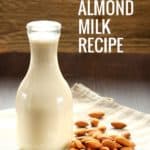
This Homemade Almond Milk Recipe is going to rock your world, because it's literally the easiest recipe out there. No fuss and no mess, just easy almond milk. You'll see what I mean!

Making processed food substitutes can help you save a ton of money on your whole foods budget. And it doesn't have to take a bunch of time either.
I'm all about easy.
I make my own Homemade Chocolate Chips, Cream of Rice Cereal, Pumpkin Spice Creamer, and Homemade Ketchup.
All of those taste great, and are very simple to make.
But today I'm sharing with you the Easiest Almond Milk Recipe Ever. Seriously.
Enter your email and I'll send it straight to your inbox. Plus, you'll get healthy living updates too.
Why Is Almond Milk Popular?
- Dairy allergies are on the increase.
- Lactose intolerance is on the increase.
- People living a vegan lifestyle want alternatives to dairy for cooking, baking and drinking.
Why Make Your Own Homemade Almond Milk?
- The obvious – save money.
- Save time and money by not running out the store because you've run out of milk (or a dairy-free alternative). (See the price of gas going up – oh, my heart be still. Every trip you can save is money in the bank!)
- Life a more sustainable lifestyle – less packaging and less waste. Even if they ever figure out a way to recycle those aseptic cartons, you can bet that it will be a super labor intensive.
Ever since my oldest was diagnosed with a life-threatening allergy to dairy (at 3 months of age), I've had to find ways to make allergy-free substitutes for drinking and for baking. But this method makes it super easy.
To be fair, this method won't match the super-creamy store-bought, aseptic packed almond milk you are used to. But it gets the job done lickety split. And it's pretty good.
Just yesterday both of my sons asked for some. They said it's not quite as good as my Homemade Coconut Milk, but good nonetheless.
How Much Can You Save?
Just so you can feel super good about yourself and your new frugal tip to help with your budget, here are the real numbers: Of course, this all depends upon where you buy it and your cost for almonds.
Almond Milk bought in bulk, buying 4 32 oz containers at Amazon, costs $2.43 for 4 cups.
Homemade Almond Milk (using a price of $4 per pound for almonds) costs $1.27 for 4 cups (plus your water cost, of course.) Savings: 48% That's not as amazing of a savings amount compared to my Homemade Coconut Milk, or Homemade Rice Milk, but saving almost 50% is nothing to sneeze at.
So there you have it – motivated to save time and money (and be environmentally conscious at the same time)? I hope so!
How to Store
Store this homemade almond milk in the fridge. It should keep for up to 3 or 4 days.
You could alternatively freeze it in cubes to use in your beverages or for making frozen treats in a high speed blender.
What to Do With Leftover Pulp
If you do choose to strain your almond milk, why waste all of that solid almond pulp goodess?
Good thing is, you don't have to!
You can dehydrate it in a dehydrator or an oven on low. Then pulse in food processor (or blender) to make into a finer powder.
The resulting almond meal can be tossed on cereals, put in smoothies or shakes, or used in most any recipe that calls for almond flour.
Recipes for Leftover Almond Pulp Turned to Almond Meal
Here are some great recipes to use your leftover pulp/meal in.
- Edible Cookie Dough – called “dangerously addictive” by a taste tester
- Healthy Green Bean Casserole – so much better than typical recipes
- Sugar-free Twix Bars – your childhood favorite made healthier
- Grain-free Meatballs – no bread or breadcrumbs needed!
- Eggnog Cookies – so tasty, they're absolutely not just for the Holidays
Recipe Notes
1. Appearance: This recipe uses whole almonds. If you want your almond milk to be more uniform in appearance, you can use blanched almonds. Otherwise, you will have specks of the almond skins in the resulting milk.
2. Stir and Serve: If you don't strain the milk (the way I typically don't), you can either stir the solids into the mix as you wish or use the solids for another purpose.
3. Soak First: Some people make almond milk from soaked almonds, but I don't do that. I know it might sound counter-intuitive to dry the almonds before making milk, but I soak and dry a lot of nuts at a time. Then I store them and keep them on hand for snacking, making almond butter, or making this almond milk, or almond meal…you get the picture. This way I always have soaked nuts at the ready for making milk instead of having to time my soaking and milk making together.
4. If you are doing a food plan like Trim Healthy Mama, a more acceptable proportion is 1/2 cup almonds per 4 cups of water. You can thicken the resultant milk with glucomannan if desired. This recipe is an “S” for THM.
5. Notes on Stevia / other sweeteners. Stevia is very very sweet. You can read here for more information on how to use it. You can omit the sweetener or use another one as desired.
6. Other Milks: You can use this method for making other nut-based milk as well – I personally haven't made these (mainly since my son is allergic to all nuts except almond and macadamia – and those macadamias are super pricey!) but you could definitely try:
- walnut milk
- pecan milk
- hazelnut milk
- cashew milk
7. Sweetener Options: You can substitute any other healthy sweetener for stevia. If using stevia, see How to Use Stevia.
8. Flavoring Options: For flavorings, chocolate or carob, as well as cinnamon, are great options, but the sky's the limit!
More “Quick and Easy” Pantry Staples
If you like saving money and easy recipes, you will love these other options.
- Powdered Sugar – works with any type of sweetener
- Powdered Egg Replacer – works in almost any recipe
- Homemade Vegetable Broth – doubles as an amazing all-purpose seasoning
- Homemade Coconut Butter – great for so many recipes and saves tons of money

Easiest Homemade Almond Milk Recipe
Ingredients
Instructions
- Place all ingredients in a blender.
- Blend 'til smooth. In my Vitamix, I blend for approximately 2-3 minutes. This machine it totally worth it!
- Strain milk through a or , if desired.
- Pour and enjoy.
Notes
- Appearance: This recipe uses whole almonds. If you want your almond milk to be more uniform in appearance, you can use blanched almonds. Otherwise, you will have specks of the almond skins in the resulting milk.
- Stir and Serve: If you don't strain the milk (the way I typically don't), you can either stir the solids into the mix as you wish or use the solids for another purpose.
- Soak First: Some people make almond milk from soaked almonds, but I don't do that. I know it might sound counter-intuitive to dry the almonds before making milk, but I soak and dry a lot of nuts at a time. Then I store them and keep them on hand for snacking, making almond butter, or making this almond milk, or almond meal…you get the picture. This way I always have soaked nuts at the ready for making milk instead of having to time my soaking and milk making together.
- If you are doing a food plan like Trim Healthy Mama, a more acceptable proportion is 1/2 cup almonds per 4 cups of water. You can thicken the resultant milk with glucomannan if desired. This recipe is an “S” for THM.
- Sweeteners. Stevia is very very sweet but you can omit the sweetener or use another one as desired.
- Other Milks: You can use this method for making walnut, pecan, hazelnut, or cashew milk.
- Sweetener Options: You can substitute any other healthy sweetener for stevia. If using stevia, see How to Use Stevia.
- Flavoring Options: For flavorings, chocolate or carob, as well as cinnamon, are great options, but the sky's the limit!
- To Strain or Not to Strain: I typically don't bother and just deal with the milk not being perfect. But it is a lot smoother that way so do whatever you like!
Nutrition
Nutritional information is provided as a courtesy and is merely an approximation. Optional ingredients are not included and when there is an alternative, the primary ingredient is typically used. We cannot guarantee the accuracy of the nutritional information given for any recipe on this site. Erythritol carbs are not included in carb counts since they have been shown not to impact blood sugar. Net carbs are the total carbs minus fiber.
What's your favorite way to use almond milk?
I make almond milk using almond flour. I put 44g in a quart mason jar, add 1/2tsp of Himalayan salt, then fill almost to the top with very hot water. I shake it vigorously, then put in the fridge for at least a day.
I then pour it into a nut milk bag, drop it until a 6L pot on medium-low heat, and then add water to the 2l mark.
The hot water seems to bring about a solvent action.
Finally, I add .75-1.5 tsp (depending on application) of (I have always used NOW Foods) stevia powder, and 80g of Sparrow Cocoa.
I stir it with a whisk until the cocoa has been fully assimilated, then I pour it into a 1/2 gallon jar.
I combine it 50/50 (always by weight) with brewed coffee. I drink at least 500ml of this every day. When cold, I just drink it. When making it hot, I add another 1/8 tsp of stevia powder, and after hearing, 2 TBS (which works out to 19-20g) of plain Collagen (gelatin) powder, and stir until it’s fully dissolved. It’s rich, very tasty, and of course, very good for you. ✌️
Hi Dennis – interesting – what do you do with it in the pot? Are you saying that you do or don’t squeeze it?
Do you have any recipes for the almond meal you are left with if you strain it?
Hi there. Just to clarify, what’s left after making the milk and straining is almond pulp. You basically will have to dehydrate the pulp and then process it to make it more fine but then you have basically a course almond flour that you can use in loads of recipes. I will be updating this post with more photos etcetera about that. But in the meantime, I put a list of some recipes on the blog that it should work in – go check them out :). I think the cookie recipe is my favorite.