
How to Make Vanilla Powder (Vanilla Bean Powder Recipe)
This post may contain affiliate links from which I will earn a commission. Learn more in our disclosure.
Learn how to make vanilla powder at home using real vanilla beans. This easy vanilla powder recipe takes just minutes and makes a perfect substitute for vanilla extract in baking and beverages.
What’s really great about it and what sets it apart from vanilla extract is that vanilla powder can be made super fast whether you need it at the last minute for a recipe or a homemade gift.

For many people, holidays include lots of baking. And baking includes lots of vanilla.
While vanilla extract is what most people use for baking, it does take awhile to make.
With this super simple vanilla powder, you can have a vanilla extract substitute ready in a few minutes. No fillers or funky ingredients: just exotic, rich vanilla.
If you like, you can add it to your sweetener of choice to make vanilla sugar. Some people refer to vanilla sugar as vanilla powder, but they really are two different things.
What Is Vanilla Powder?
Vanilla powder is simply dried vanilla beans that are ground into a powder. It’s different from vanilla extract, which is the result of steeping vanilla beans in alcohol for months. It’s also different from vanilla sugar, which is vanilla powder blended into sugar.
How to Make Vanilla Powder (Step-by-Step)
- Cut into pieces for easier grinding.
- Dry vanilla beans (if soft). Air dry or use an oven/dehydrator to fully dry them.
- Grind in coffee grinder/spice grinder until fine.
- Store in airtight jar away from heat and light.
How to Dry Vanilla Beans
Most vanilla beans need to be dried before grinding into powder. If your beans are soft and flexible, dry them at 170°F for 60–90 minutes, or until they are completely dry and brittle.
You can also use a dehydrator on a low setting until the beans snap easily instead of bending.
How and When to Substitute Vanilla Powder for Extract
Here’s how to use vanilla powder instead of vanilla extract in recipes.
- 1 tsp extract = ¼–½ tsp powder
Vanilla powder is the better choice when you’re trying to:
- avoid adding liquid to a recipe (for example for chocolate or meringues)
- prevent vanilla flavor evaporating during high heat cooking or baking due to its alcohol content (in fact once you try using vanilla powder in all your baking, you might never go back to extract)
- add visible vanilla specks to a dish. Think about how vanilla ice cream looks so much better with those little vanilla bits.
- add intense flavor. Vanilla powder provides a more concentrated substitute for vanilla extract.
Vanilla Powder vs Vanilla Extract vs Vanilla Sugar (What’s the Difference?)
Here’s a quick comparison to help you understand the differences between vanilla powder, extract, and vanilla sugar:
| Type | What It Is | Best Uses | Notes |
|---|---|---|---|
| Vanilla Powder | Ground dried vanilla beans | Baking, dry mixes, drinks | No alcohol, concentrated flavor |
| Vanilla Extract | Vanilla beans soaked in alcohol | Most baking recipes | Adds liquid; most common form |
| Vanilla Sugar | Sugar infused with vanilla | Topping, sweetening | Contains sugar (not low-carb) unless using a low-carb sweetener |
Vanilla powder is especially useful when you want strong vanilla flavor without adding liquid, while vanilla extract is more versatile for traditional baking. Vanilla sugar is best for sweetening and flavoring and can even work for low-carb recipes if you swap out the sweetener for a low-carb option.
How to Use Homemade Vanilla Powder
And you can use this vanilla powder to so many things, including recipes that don’t actually call for it. Some great recipes that are basically just calling for some vanilla powder are Low-carb Almond Crescents, Coffee Substitute, Vegan Eggnog, or Adaptogenic Hot Chocolate. This Caffeine-Free Chai Latte already has vanilla powder listed as one of the ingredients.
Vanilla powder is just perfect for holiday baking. Simply use 1/4-1/2 teaspoon vanilla powder for each teaspoon of vanilla extract in any recipe.
And of course, you can always taste test your recipe to see if you have enough vanilla and add more of the vanilla powder if you like.
How to Make Toasted Vanilla Powder
If you roast the vanilla beans longer at a higher temperature, you’ll end up with Toasted Vanilla Powder. Some love the intensity of the flavor of toasted vanilla, while others really dislike it.
If you haven’t had toasted vanilla powder before, I recommed trying it with one or two beans only to make sure you like it before making a larger batch.

How to Store
You can store this homemade vanilla powder in either glass or plastic, but I use glass as much as possible.
In some countries, spices are sold in paper envelopes, so you could do that as well, but that’s not advisable for humid environments.
You could also make a small paper funnel to put the powder in small glass bottles such as cleaned essential oil bottles.
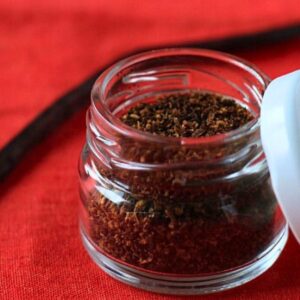
Vanilla Powder Recipe (How to Make Vanilla Bean Powder)
Ingredients
- whole vanilla beans (Grade B recommended; most beans are soft and pliable when purchased) Make sure they are still pliable and moist.
Instructions
- Slice the vanilla beans lengthwise while they are still soft and pliable. This helps them dry more evenly and grind more easily.
- Place the sliced beans on a cookie sheet and dry at 170°F for about 90 minutes, or until fully dry and brittle.
- Place the dried beans into a spice/coffee grinder or blender.
- Process the beans to make a fine powder.
- Store in an airtight container away from heat and light.
Quick Drying/Toasting Method
- For a faster method, dry the vanilla beans at 350°F for 3–8 minutes instead of the lower-temperature method above. However, roast/dry the vanilla beans at 350°F for 3-8 minutes. Pay close attention to them to prevent burning. At the 3 minute mark, the beans will likely be ready to use. Roasting them longer will result in toasted vanilla powder.
Notes
- Quick cooking method notes: The 90-minute method takes longer, but the higher temperature makes it more likely that the vanilla beans will burn, and the high heat could alter the flavor of the beans.
- To substitute for vanilla extract: Use ¼–½ teaspoon vanilla powder for every 1 teaspoon vanilla extract.
- If your vanilla beans are already very dry and brittle, you can skip slicing and simply break them into smaller pieces before grinding.
- Pure vanilla powder should contain only ground vanilla beans, with no added sugar, starch, or fillers.
Nutritional information is provided as a courtesy and is an estimate only. It may vary depending on ingredient brands, substitutions, and preparation methods. Optional ingredients are not included. Net carbs are typically calculated by subtracting fiber and sugar alcohols (such as erythritol) from total carbohydrates. This information should not be relied upon for medical or nutritional purposes.
I hope this gives you inspiration for a way to easy have homemade vanilla in your home, or for a simple homemade gift to bless others with.
Let me know how you like this vanilla powder after you make it!
Photo Credits: Naomi Huzovicova
What is the name of that fancy font you use (see ‘Vanilla powder’)?
Hi there – I think it’s Sacramento.
Can these be dehydrated rather than roasted?
I think so.
What if you are actually allergic to vanilla?
Oh my. I guess go w/ other flavorings or artificial if you must have it. Orange, chocolate, or almond perhaps?
I love making vanilla extract. I was wondering if I could use the leftover vanilla beans (that have been seeping for quiet some time) for this recipe. Might be more like a vanilla paste though right?
I think you’d be fine – the toasting should dry them out I would think.
Wow, a great tip! I hadn’t ever thought of using vanilla beans this way. I have made my own extract with vodka or rum, but I’ll have to give this a try!
Thanks Virginia! I love it too!
I am very excited about this. I have made my own vanilla for many years. Since I have moved, the past two years have made getting organic vodka (I do not want anything made from GMO’s.) nearly impossible. This will work just wonderful. I can not wait to do this. THANK YOU!!
Oh I hadn’t even thought about the need to get organic vodka. I am going to have to ask my friends about that. I have made some with glycerine from non GMO sources. Hmmmm…You are welcome!
I’m excited to try this recipe. I don’t tolerate alcohol well in any form so this looks doable for me.
I’m afraid this might be a silly question, but I am unsure about whether you put the whole vanilla pods in the blender after roasting, or if you scrape the seeds out and blend them??
Thanks so much.
The whole bean, no scraping or fiddling around required. Glad you found an alternative!
This is great to have in the recipe collection. I wanted to make the liquid version but never get round to it – it is hard to find vanilla beans here in Trinidad and Tobago and when you do find some it is very expensive. I am going to try and source some and do this lovely recipe. Thank you and Naomi for sharing.
You’re welcome! I can’t wait to make it myself!
You’re welcome! Never get around to it – that’s me!
I am sooo excited you posted this today. I ordered 20 vanilla beans today, so I could soak them in vodka to make my own extract. BUT, I would prefer to make this and not use the alcohol. What is the shelf life of the powder? I didn’t know if I should do up all the beans or if I should store some. I never bought vanilla beans before.
That’s great! I’ll have Naomi drop by to answer :). I did hear that you can cut the beans in half and store them in glycerine to keep them longer.
What great timing! I wouldn’t do all the beans at once. Grinding up the bean will expose it to air, which in turn will lessen the vanilla-ness over time. Every spice is much stronger freshly ground than packaged ground. If it’s in an airtight container, I would keep it for 3-6 months. It won’t go bad, just loose flavour. And make sure the rest of the beans are kept airtight, otherwise they will dry out. Good luck!