
How to Soak Nuts and Seeds (Step-by-Step Guide)
This post may contain affiliate links from which I will earn a commission. Learn more in our disclosure.

Wondering how to soak nuts and seeds properly and why you might want to do it? This post shares the simple steps to a traditional way to improve digestibility and address phytic acid in nuts and seeds. Here’s exactly how to do it, a soaking time chart, and an explanation of the benefits.
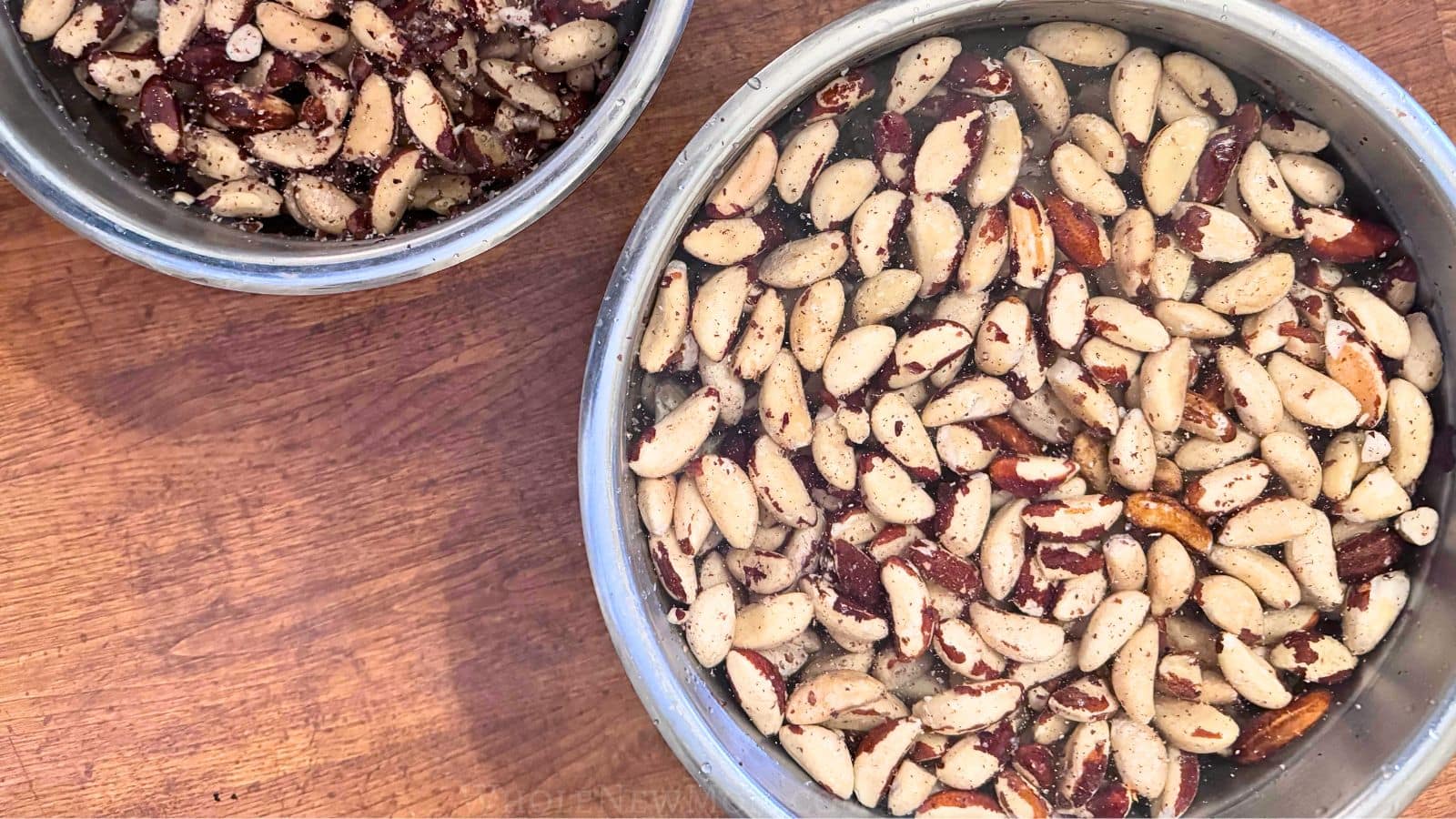
I’ve been soaking nuts and seeds for years since I learned about the likely benefits. During that time, I’ve heard that it might not be as beneficial as I originally thought, but the soaked nuts are lighter and crispier, the touch of salt is just perfect, and they taste fantastic.
So the truth is, regardless of the benefits, I’ll keep soaking our nuts and seeds no matter what.
Do You Need to Soak Nuts?
Good question and the short answer is: not always—but it can help in some situations.
Soaking nuts is often recommended to reduce compounds like phytic acid and make them easier to digest. However, there’s more research on the benefits of soaking grains and beans than on soaking nuts, and not everyone notices a difference.
Here’s a simple way to think about it:
- You might benefit from soaking nuts if:
- nuts feel hard to digest
- you eat them frequently or in large amounts
- you’re following a traditional foods or gut-healing approach
- You might not need to soak nuts if:
- you tolerate them well
- you eat them occasionally
- you prefer the convenience of using them as-is
In other words, soaking nuts isn’t essential—but it can improve texture and digestibility for some people. And it definitely improves taste.
If you do want to soak nuts and seeds, it’s super easy to do so. Here’s how.
How to Soak Nuts and Seeds (Quick Method)
Here’s all you need to do to soak your nuts and seeds.
- Put nuts or seeds in bowl
- Cover with water (filtered preferred)
- Add salt (optional. Salt enhances the soaking procedure and gives your nuts great flavor.)
- Soak
- Drain
- Dehydrate
Soaking Times for Nuts and Seeds
Use this quick chart to find the right soaking time for various nuts and seeds.
| Nut / Seed | Soaking Time | Notes |
|---|---|---|
| Almonds | 8–12 hours | One of the longest soaking times |
| Walnuts | 4–8 hours | Softer, don’t over-soak |
| Pecans | 6–8 hours | High fat, moderate soak |
| Hazelnuts | 8–12 hours | Longer soak improves texture |
| Brazil nuts | 4–6 hours | Shorter soak works well |
| Macadamia nuts | 2–4 hours | Very soft, don’t over-soak |
| Cashews | 2–4 hours | Can get slimy if over-soaked |
| Pumpkin seeds | 6–8 hours | Common for soaking |
| Sunflower seeds | 4–6 hours | Shorter soak is enough |
| Sesame seeds | 4–6 hours | Small, soak less time |
Soaking times aren’t exact—different sources recommend slightly different ranges. In practice, anything within these time frames works well.
Note that chia and flax seeds should not be soaked this way. Instead they are used as egg substitutes and are mixed with water right before using. Flax seeds are usually ground before mixing to make flax eggs while chia seeds can be used as chia eggs either whole or ground.
Special Notes About Cashews
Cashews are a bit different from other nuts. In their raw state, they contain naturally occurring undesirable compounds in the shell that are removed during processing, which is why cashews are typically sold pre-treated.
Because of this, they’re already ready to eat as-is and don’t behave the same way when soaking.
When soaked:
- they soften very quickly
- they can become slimy if soaked too long
- they don’t dry into a very “crispy” texture
- If you choose to soak cashews, keep the soaking time short—about 2–4 hours is usually enough.
Why You Should be Soaking Nuts and Seeds
- It helps with digestibility
- It’s easier and takes less time than you think
- They just plain taste better this way!
Nuts and seeds are a wonderful addition to your diet. However, they can also be a bit rough on your stomach. That’s because they contain phytic acid and enzyme inhibitors that may make them harder to digest for some people.
For some people, soaking nuts can make them easier to digest and improve texture. While it’s not essential for everyone, it’s a simple step that many find helpful.
When seeds and nuts are planted in the ground, the warmth and moisture in the soil around them break down their skins so that they can germinate and grow into plants. Likewise, soaking nuts and seeds breaks down the encasing of these great sources of energy and make the nutrients more available.
Most of the time spent soaking and dehydrating is hands-off time. You just put the seeds or nuts in a bowl, transfer them to the dehydrator (or oven), and then take them out when dry.
What About the Soaking Water?
After soaking, the water may look cloudy. That’s normal—it can contain small amounts of natural compounds from the nuts along with fine particles from processing.
Some people prefer to rinse nuts after soaking to remove this residue. Others skip this step, especially if they are drying the nuts afterward.
In my experience, both approaches work. I usually skip rinsing for simplicity and flavor.
How to Dry Soaked Nuts
After soaking, drying the nuts is what gives them that crisp texture and helps them store well.
Spread the soaked nuts in a single layer on dehydrator trays or baking sheets. If you’re drying seeds, they can be piled a bit more since they dry faster than larger nuts.
Dry at a low temperature until completely crisp. In a dehydrator, this is typically around 115–125°F. Drying time varies depending on the type of nut, but most take anywhere from 12–24 hours (sometimes longer).
You can also use an oven set to its lowest temperature. Just keep in mind that ovens tend to run hotter and may not dry as evenly.
So while you don’t need a dehydrator to dry soaked nuts, it’s a much easier way to do it than using an oven. In my post about the benefits of dehydrating I share a lot of tips including how to choose a dehydrator that meets your needs.
Notes and Tips
- Temperature control is one way in which the dehydrator is a much better option than the oven. Typically the lowest temperature for an oven is high enough to destroy the enzymes in the nuts/seeds, therefore diminishing their healthful qualities. However, if you’re not ready to invest in a dehydrator, using your oven is a great starting point.
- Dehydrator Temperature. There is debate about what temperature to dehydrate at to preserve the enzymes in your food. For now, I am comfortable with 125. I am not an ardent raw foodist, and after researching this I found that the temperature of the food in most dehydrators is significantly below the temperature of the air around it. Thus, if the setting of the dehydrator is 125, your food temperature is almost certainly in the raw food range which is 115 or below.
Roasting Nuts and Phytic Acid
Roasted nuts are popular because they taste great—but roasting and soaking are not the same thing.
Roasting may reduce some compounds like phytic acid and can make nuts easier to digest. However, it’s unclear how much of a difference it really makes, and results vary depending on temperature and cooking time.
In contrast, soaking is designed specifically to help break down enzyme inhibitors and support digestibility before drying.
Another thing to consider is how store-bought nuts are processed. Many “roasted” nuts are actually cooked in oils, which may not be ideal depending on the type of oil used (most often they are cooked in seed oils).
If you enjoy roasted nuts, a better option is to roast them yourself at a lower temperature. This gives you more control over both the ingredients and the process. Nuts can be more prone to going rancid when roasted at higher temperatures (source). Also, roasting almonds at a higher temperature causes almonds to form a significant amount of cancer-causing acrylamide (source).
Should You Soak Nuts Before Roasting?
If you plan to roast nuts, you may wonder if soaking them first is worth the extra step.
There isn’t strong evidence comparing soaking vs. roasting directly. However, soaking and drying nuts first is a simple way to support digestion—and it gives you flexibility.
You can:
- eat them as “crispy nuts” after drying
- or roast them afterward for additional flavor
In my experience, soaking first and then roasting gives the best balance of texture and digestibility.
How to Use Soaked & Dried Nuts aka “Crispy Nuts”
- Eat them plain
- Make Homemade Nut or Seed Butter
- Make Nut or Seed Milk – Here’s the Easiest Almond Milk Ever
- Make a healthy trail mix.
- Yummy Chocolate / Carob Nuts.
I’m sure you’ll agree that your nuts and seeds are much tastier and lighter than before. You will never go back again.
This simple method works for most nuts and seeds. See the soaking chart above for specific timing.
How to Soak Nuts and Seeds (aka – How to Make Crispy Nuts)
Ingredients
- 4 cups nuts or seeds
- water
- 2 teaspoons salt
Instructions
- Add nuts or seeds to a bowl. Use about 4 cups, or whatever amount fits your dehydrator.
- Cover completely with filtered water.
- Add salt.Use about 2 teaspoons salt per 4 cups of nuts or seeds.
- Soak for 7–12 hours (overnight works well).
- Drain (and rinse if desired).
- Spread in a single layer on dehydrator trays or baking sheets (nuts should be in a single layer, whereas seeds can be piled slightly).
- Dry at low temperature: Dehydrator: ~125°F Oven: lowest setting
- Dry until completely crisp. Cool and store for later use.
Notes
- Salt Amount: Some sources recommend different salt amounts for different nuts/seeds. I just keep it simple and use the same for all of them.
- Cashews: Soak only 2–4 hours—they soften quickly and can become slimy.
- Seeds dry faster: Pumpkin, sunflower, and sesame seeds may be slightly piled on dehydrator trays whereas nuts should be dried in a single layer.
- Drying tip: Nuts should be fully dry and crisp before storing to prevent spoilage.
Nutrition
Nutritional information is provided as a courtesy and is an estimate only. It may vary depending on ingredient brands, substitutions, and preparation methods. Optional ingredients are not included. Net carbs are typically calculated by subtracting fiber and sugar alcohols (such as erythritol) from total carbohydrates. This information should not be relied upon for medical or nutritional purposes.
More Food Preparation Posts
Like this post? Here are some more you’ll likely enjoy:
I’d love to hear how the soaking and drying works for you!
oh! And one more thing – after soaking & dehydrating – do they need to be refrigerated? Or is just in the cupboard/pantry good enough?
I follow my nut and seed storage post :).
One quick question…for the soaking process you said you use 2 tsp. of salt for 4 cups or nuts – just to clarify – is that 2 tsps for the ENTIRE batch of four cups of nuts? Or is it 2 tsp for each (1) cup of nuts? Thanks!!
2 tsp for each batch of 4 cups. I dehydrate about 35 cups at a time so I use about 18 tsp salt each time :).
Hi, I bought a big bag of raw pine nuts the other day and brought them home. I put them on a cookie sheet and popped them in the oven for ten minutes (375), stirring them a couple of times. Well, they smelled really strong, like the pitch from a pine tree. I had never noticed that before. I ignored that and ate bunches of them.
I really got an upset stomach! I treated myself with acidophulous supplements all day and I was better the next day. I’ll never do that again. And now I learned….it’s just as you said, there is too much oil in the raw nuts. Thank you for this informative article.
Hi Fran. The issue is the phytates and enzyme inhibitors – not the oils. But I am sure pine nuts would do better this way as well. Take care!
I have a dehydrator that I bought over 20 years ago. It has a wood frame and about 9 or 10 trays in it, that are wood frame with teflon coated webbing type stuff and a removable teflon flex screen to put on top. It has worked for dehydrating meat to make jerky and I have even done fruit leather in it? How do you know what temp? I usually leave my jerky meat in overnight and it is done in the am. It is a just plug in and leave it with no adjustments
I typically dehydrate around 125. The temp of the food is lower than the temp of the dehydrator. From the reading I’ve done that keeps the nuts “raw” w/ enzymes intact. But I might move that temp down a bit.
I looked up the keyboard degree symbol for you. It’s ALT + 0176 °
Have to say I love the Just Almonds source you researched for us! I really had not thought about soaking and THEN dehydrating and then storing for later use….not sure why… as I own an Excalibur! (but have not had a single moment to break it out and use yet).
This gives me my first great idea and I will definitely begin soaking and dehydrating my raw seeds. Any sources for chemical free raw walnut seeds? or do you just do those from your local co-op? thanks
I just buy organic seeds since I get them in bulk and they’re not that much more money. I haven’t heard about any issues like the engine fuel stuff :).
I just saw this post over on FB. 🙂 I have a “dumb” question…what kind of nuts do you get? Are they raw? Thanks,
Not dumb at all….I buy everything raw. The roasted ones have dead enzymes. The almonds you can’t really get raw easily. Did you see my post on Engine Fuel on Almonds??
yes, I did see that one and thanks!!! 🙂 I am trying to change my way of eating and need all the help i can get, lolol. I know that nuts are really good for you too. 🙂 Thank you!
Hi there! Love your site. Wondering.. about how long does it take to dry a pan of walnuts in the oven after soaking them, and the same question for in the sun?
I think it depends on a number of factors – the size of the nuts, oven temp and the amount of sun. Sorry that I can’t be too specific about that.
A couple of questions in follow-up. Why do you add salt to the soaking water? Do you rinse the nuts before dehydrating them? If I plan to use the nuts to make raw crackers, is it necessary to dehydrate them first or can I simply grind up the soaked nuts? Thanks for your help.
According to Nourishing Traditions, “salt in soaking water activates enzymes that neutralize enzyme inhibitors.” It also makes them taste great :-)!
This whole soaking and dehydrating is very new to me, but I am interested as my digestion is sad due to the poisoning. We are vegan and eat whole foods and only organic. I am also looking at your excaliber dehydrators. Would welcome any information and usage. How long does it take to dehydrate nuts? What is the electrical cost? I am desperate to feel better and I am always looking to improve cooking/preparation for my husband’s MS. Thanks for any help you could give me! 🙂 Cheeryshirley
H Shirley! The time to dehydrate nuts and seeds depends on the size and temperature. Pumpkin and sunflower seeds take a very short time and walnuts are next. The more “solid” nuts like hazelnuts and almonds and macadamias take a longer time. I have a post on the cost (it’s a bit out of date, but very interesting) that you can read. Which Costs more – Dehydrating, Canning or Freezing?