
Homemade Saline Nasal Spray for Amazing Sinus Relief
This post may contain affiliate links from which I will earn a commission. Learn more in our disclosure.
Struggling with sinus issues? This Homemade Saline Nasal Spray is just what you need. Neti Pots and Saline Nasal Sprays are a great way to treat them, but buying those pre-made salt packets will break the bank.
Here's how to feel better fast and save money while you're doing it. Plus I've added in a recipe for a Homemade Xylitol Nasal Spray too–similar to Xlear.
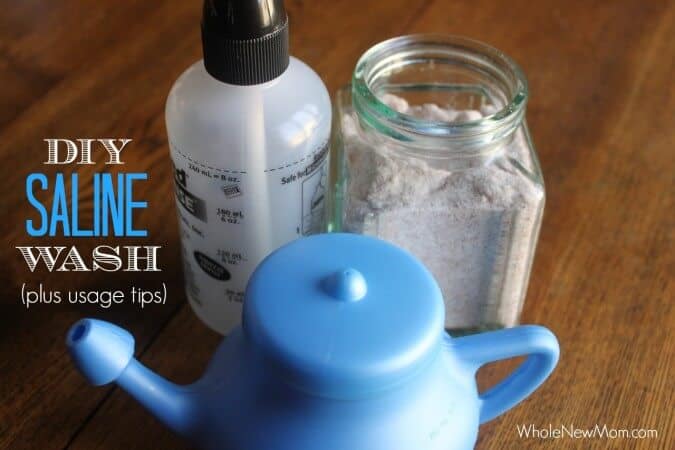
Sinus issues are the worst.
I have somewhat narrow sinus passages, so whenever I get any kind of sickness that involved my nose, I get plugged up badly.
Now, you can use nose sprays for things like that, but they often can create a rebound issue where you get MORE plugged up after stopping.
No thanks!
Many years ago, I heard about using saline for sinus relief.
I'm sure most of you have seen or heard of net-pots, saline nose sprays, or those spray bottles that spray saline wash into your nostrils.
In my opinion, homemade saline solution in a nasal spray bottle is a lifesaver. Really.
Today I'm going to show you how you can easily make these sprays yourself to save a ton of money and hopefully stay well.
Why I Started Using Saline
When I was younger, I saw saline spray bottles in the store. My grandmother recommended that I try Ocean® Brand, which she said helped her immensely.
I personally never saw benefits from that kind of thing after trying it once or twice, but that all changed years later.
I was working at a small insurance agency. My boss was from Russia and we at times enjoyed talking about health issues.
At one point, I got quite sick with a cold, and my nose, in typical fashion, got very stuffed up (I have very narrow nasal passages, so I get pretty miserable pretty quickly from colds and such).
Anyhow, one day at work we started talking about sinus issues and my boss bought up saline washes. I told him that they never worked for me, and he proceeded to tell me how they used to do it in Russia.
This is what they would do.
“Russian” Basic DIY Saline Method
- put some warm water in your hand
- dump some salt in the water
- breathe the mixture in
- inhale further ensuring that the saline mixture goes back to fill the sinus cavities
- hold the saline for about 10 seconds
- blow the saline out
I was intrigued and tried it.
And it worked amazingly well, though the salt stung pretty bad sometimes.
Anyhow, I figured if I could apply that technique to a saline bottle, then I would have something very helpful, and more user-friendly than a hand full of saltwater!
So —
I went to the store, bought a starter kit for a saline wash, and was on my way.
And I have to say, this has made my narrow-sinus issues at least a little more bearable.
Anyway, as the years went on, I started using different forms of saline washes and found that they work great!
Why Make Your Own
One of the things that bug me is that when you go into your local drug, grocery, or health food store, and buy a neti-pot or saline spray wash, they give you little packets of pre-made saline mix to get you started.
However, then you feel the need to come back and buy more of their little packets.
Well, if you've looked at those packets, really the only thing that is in them is….
—salt and maybe baking soda.
Pretty simple, eh?
So I decided to figure out how much of each I needed to use in order to avoid the highway robbery of buying those little packets (not to mention all the extra garbage they generate. Sigh.)
The benefits of all of this?
1. Save a TON of money.
2. Reduce waste from those little packets of saline mix.
3. Control how much of everything you add easily.
Important Notes
Water: Use only purified water (see How to Make Your Tap Water Safe). Here is really icky documentation of folks who got brain-eating amoebas from using tap water. Yuck!
Salt: Use only pure salt like sea salt or my favorite, Real Salt. Table salt has lots of other things like anti-caking agents, silicon dioxide and even sugar sometimes. I don't want those in my nose, thank you.
Bottle Type: I like this brand, but I think they are all good. Personally, I don't think that the net-pots work as well since the spraying action seems to get the saline rinse in my sinuses better than the force of gravity.
Not for Daily Use: Some advise against continual use of saline washes. I found this article to be quite interesting. Do keep in mind that it might not be a good idea to use this on a daily basis.
Water Temperature: I prefer my water a little warmer than just lukewarm as it seems to help the salt dissolve better, but please take care to not overheat the water.
More Benefits: added sinus-cleansing action, after putting the saline solution into your nose, inhale a bit and hold some of it in your nose for about 10 seconds, and then blow out. I found this technique on my saline bottle's insert and it supposedly helps the saline solution get into all the nasal cavities.
If you find yourself in a real pinch and don't have a saline rinse container, you can mix this up in your hand the “Russian” way. Just make sure your hand is really clean.
Bonus Tip
In addition to the above “added sinus-cleaning action”, one of the best methods for getting this to address your whole sinus area is to use the wash and then tilt your head back over the edge of your bed. The saline mix will go all the way back into your sinuses. Hold it there for 2 minutes, and then blow out.
I've used this method with amazing success for stubborn sinus issues.
When to Use
- When you have a cold
- To clean out sinuses to support your body so are less likely to have a cold take root
- As a natural allergy help
- To moisten sinus passages in dry weather
Why Is Baking Soda Added to Saline?
Good question. There are two reasons for this.
Baking soda helps to open the sinus passages. Studies have shown that this mixture of concentrated saltwater and baking soda (bicarbonate) helps the nose work better and moves mucus out of the nose faster than saline solutions alone.
Also, baking soda acts as butter in the saline solution, so that it is less irritating.
Storage
You can store this mixture for up to 3 days, but not for longer.
Though salt is a natural preservative, water naturally grows bacteria easily. There are store-bought saline sprays that can be stored longer but they are made from sterile solutions and I believe that they are in airtight containers so that's a different situation.

Optional Additions
At one point I had a very stubborn sinus issue. I thought it was allergies, but it turned out to be a doozy of a sinus infection.
Since I was pretty desperate, I added a bunch of different things to my saline bottle to aid in my healing. Here are the possible additives for the nasal rinse that I read about and tried (I tried all except the honey).
– Apple Cider Vinegar: (just a drop or two. Don't make the mistake I did by adding about 1 tablespoon. Ouch!)
– Colloidal Silver: (I only used about one drop.)
– Grapefruit seed extract (GSE): This is supposed to be a great anti-viral agent. Just add one drop if you try this since it's really really strong!
– Xylitol – Some say it aids in making the solution non-stinging. It is also supposed to be helpful against bacteria and viruses. In fact, there are Xylitol Nose Sprays on the market now. (Source)
– Manuka Honey: I didn't try this but I have read that it is a natural way to kill germs, etc.
More DIY Wellness Supports
If you like this formula for a saline wash, you'll love these DIY products too!
– DIY Decongestant (like Vicks Vapo-Rub) – skip the toxins and save money with this simple formula
– Herbal Steam – a total game-changer for respiratory issues and it's great for your skin and hair too.
– DIY Thieves Oil – so much cheaper and it works great.

Ingredients
Homemade Saline Nasal Spray
- 1 cup (8 ounce) water
- 1 teaspoon natural salt (you can add more for more "punch" but it does sting. I use Real Salt)
- 1/8 teaspoon (pinch) baking soda
Homemade Xylitol Nasal Spray Version
- 1 cup water
- 1/4 teaspoon salt
- 1/2 teaspoon xylitol
- 1/8-1/4 teaspoon baking soda
- 1 drop grapefruit seed extract optional
Instructions
- Warm the water to a temperature that is as warm as you can tolerate (of course, this is a subjective term. The water should not be so hot as to damage your nasal passages. See notes below.)
- Add salt and baking soda to your saline container (neti-pot or saline spray bottle).
- Add water and mix / shake to combine.
- Follow directions for using your saline wash container.
- Make sure to rinse out your container after use and leave it open to air dry.
How about you? Have you used saline sprays before?
Sorry for the double post, I wanting to add something about baking soda. It’s a preservative/PH buffering agent. I literally just made some Hydromorphone [Dilaudid] nasal spray and added 3 pinches of sea salt, 3 pinches of baking soda to adjust the PH with distilled water. You have to filter the binders from the tablets for better absorption. It’s very easy to do with some research. I’m not going into detail as I’m not a Dr. just lots of trial and error, haha. I hope this post helps anyone with pain issues that needs this class of meds. Kava kava and turmeric are great for pain also far as natural goes! Sorry for my rant, thanks.
Hi there…are you saying that you used the kava and turmeric in your spray? I’m confused. Thanks.
Hi, I used manuka honey for a nasty H pylori infection I had in my stomach. It’s good stuff, and tastes amazing! Only downside is it’s pretty pricey [around $30 The BEST nnatural antibiotic is MASTIC GUM500mg twice daily, preferrably from Chios island [Greece]. I’m Greek too btw and I SWEAR by those 2! Take care, love your site. Peace
Would Himalayan salt work?
Yes, you can use that.
Hi,
maybe it’s not a great idea to put iron oxide, cadmium or algae into your nose:
https://science.howstuffworks.com/innovation/edible-innovations/salt2.htm
Eating that is also not the best (my opinion).
Thanks for the article.
Hi there. Sorry for the late response to your comment. Actually I have no problem with some algaes and I actually love spirulina (you can see more in this post): https://wholenewmom.com/natural-allergy-remedies/
Iron oxide–looks to me from other sites that it’s naturally occurring. I don’t have a problem necessarily with that. In fact many are deficient in iron. As for cadmium, I think you read that wrong b/c I don’t see that in the article. Thanks for reading!
Thank you, I don’t want to buy the saline solution in the stores, cause I don’t know what is really in them. I like to make natural homemade thing.
Thanks for this. I came here looking for how much salt to add. I use 1 tsp sea salt in 4 oz water for a sinus flush and get no burn. Maybe regular table salt burns more.
I “winged” it after forgetting my doctor’s directions… 1 tsp sea salt in half cup water – doesn’t burn. I use an ear syringe, lie on bed with head hanging over with nasal openings straight up (holding a few paper towels) and fill sinuses with about 25 ml – some drains down throat. Hold it in for a minute or two, then hold paper towels over nose and get up, go to sink and let it drain. After a few minutes, I nose and can hear it in my ears, which I don’t think happened when I did this years ago. I modified the saline mix with 10 drops of 2% iodine tincture in 4 oz solution (not decolorized or the kind with ammonia or acetone in it), AND because of long term problems with mould, I let four 500,000 units of nystatin (topical antifungal) dissolve in solution. Got to stir/swirl it around just before pulling it into syringe. Now I don’t need the Dristan stuff and when I eat normal amounts of sugar or cut grass my sinuses don’t swell up (they did a bit yesterday after 12 pancakes/syrup, large orange juice, and a piece cake, but okay now). Makes it so I have more energy too. Had forgetten about this flush out method – MUCH better than the nasal spray. I also put some of this in an old nasal spray bottle. Rinsing sinuses twice a week does fine – maybe spray a couple times a day.
What brand of iodine tincture and nystatin topical because I don’t want to get the wrong kind.
Nystatin is already a brand name.
would it still work if your blow your nose immediately after using the saline, or does that defeat the purpose.
I hold it in for 10 seconds to aid in cleaning my sinuses but any application should have some beneficial aspect. However I can’t make medical claims.
All good info. Thanks….Just a tip .any benefit from .silver is negated when it is added to a salt solution. I read it in a couple of places.. I use the silver in a nasal spray separate from my homemade saline now.
Also it seems that 1 tsp salt may be excessive according to all the other recipes I have seen..maybe it works better though…but I’m afraid it may burn more
Interesting. Thanks. I have never found my silver to be very helpful. Probably I need a different brand. Yes, it’s strong. It’s up to you how strong you want it.
My sinuses don’t burn with 1 tsp sea salt in 4 ounces water but that might change if my sinuses get better (maybe gunk/scar tissue shielding mucus membrane). In the past, I felt a burn (probably 1 tsp / 8 oz water), but was using table salt.
Buffer the salt with baking soda, that way there is no burn. Some people get no burn with straight salt, some do.
Another really great and informative post.
I just recently began using a neti pot regularly this past winter after I kept battling colds (which I eventually found out were from chronic mold exposure.). The neti pot has been a blessing. I look forward to making your recipe. Thank you.
I wanted to ask you if you’ve ever made your own essential oil infusted neti salt? We recently purchased some pre-made by a company called Baraka. They have great products, but I’ve been wondering if I can make my own infused neti salt to save money in the long run, as well as making different blends.
All the best.
I have never done that! How interesting. I guess it’s just salt and EOs? Only for use in the neti pot?
Thanx, great!
But what is the effect of adding baking soda? May I add a little menthol to the mix?
It makes the solution more tolerable. I would be very careful about adding anything so please study the effects of putting that in your nose and be very very cautious. You can talk about it w/ your physician as well.
The baking soda acts as a ph buffer, so the salt won’t burn, or not as much, anyway.