
How to De-Gas Beans. What Works and What Doesn’t
This post may contain affiliate links from which I will earn a commission. Learn more in our disclosure.


Do you love beans, but they don’t—er—love you? Beans are delicious, nutritious, and cheap, which makes them great for so many reasons. However, they cause gas (aka flatulence or tooting), which is isn’t so great.
Thankfully, I’ve learned how de-gas beans easily to improve your digestion and your relationships! I’ve tried a bunch of methods and I know what works–and what doesn’t.

You know how it goes: beans beans the musical fruit. Well, there’s nothing magical about stinking up a room. But what is magical is that once you learn how to degas beans, the stinky music actually stops.
When I say that I know how to de-gas means, I mean it.
We used to be vegan and ate a lot of beans. We aren’t vegan now, but we cook a HUGE pot beans in our large pressure cooker several times a week.
Benefits of Beans
Just in case you wondered why adding more beans to your diet is a good thing to consider, here are some great reasons.
Nutrition powerhouses
Beans are very high in fiber, protein and complex carbohydrates.
Cheap, cheap cheap
Even the price of heirloom organic beans pales in comparison to that of meat. Now, I am not saying that you shouldn’t eat meat, but beans sure can help you stretch your food budget.
And who doesn’t need a bit of stretch these days?
Long shelf life
In these days of concern about inflationary food prices with folks storing up food for leaner days ahead, beans are a logical choice. They may take longer to cook as they age, but they do not spoil.
Why Do Beans Cause Gas?
There are two reasons why beans cause flatulence (otherwise affectionately known as gas). We actually called this “poohstinkies” in my family, but that’s beside the point.
Fiber
Beans are high in dietary fiber, which is mostly soluble fiber. Soluble means it dissolves in water. The fiber absorbs water in your digestive tract to form a thick substance.
Fiber is known for its health benefits, but if you increase your fiber intake too quickly, you can end up with (you guessed it)–intestinal gas and bloating.
When dietary fiber makes it to the colon, it’s fermented by beneficial bacteria there and gas is produced.
Raffinose Oligosaccharides
Beans also contain oligosaccharides, specifically the raffinose family. They are sugars that are also found in cruciferous vegetables like cabbage, broccoli, and Brussels sprouts. Alpha-galactosidase is an enzyme that digests these sugars, but since it’s not that prevalent in the human digestive tract, you get gas when you eat them.
For the same reason, if any food ends up in the large intestine without being digested, it can cause gas as well.
The enzyme is derived from the fungus Aspergillus niger and is sold as Beano as well as under other names.
If you don’t want to spend a huge amount on Beano, you definitely need these de-gassing tips.
Side note, there’s an article online stating that we get gas from eating beans because we don’t have an enzyme that the beans contain. That makes no sense at all. We don’t have much of an enzyme to digest what beans have in them.
Does Baking Soda Degas Beans?
Well, yes, but there can be a big problem with this method.
There are some who claim that baking soda doesn’t work and that it only changes the pH of the cooking water. Others say that changing the pH of the water reduces the amount of raffinose in the beans.
In my experience, it’s true that a little baking soda works to degas beans. However (and this is a BIG however), you will end up with VERY mushy beans.
I mean seriously mushy especially if you cook them in a pressure cooker. Sometimes mushy beans are great (for refried beans, this bean dip, or this savory hummus,) but not so great for chili or bean salad.
How Much Baking Soda Do You Need to Degas Beans?
If you’d like to try the baking soda method, you can. As mentioned, if you’re cooking your beans in a pressure cooker or Instant Pot, just be prepared for some mushiness.
Simply add 1/4 teaspoon baking soda to the cooking water for every pound of dried beans and cook as usual.

How to De-gas Your Beans
Here are my very well tested tips for perfectly de-gassed and non-mushy beans. It’s actually a full court press against bean gas. You can do any of these and it will help, but doing all of them is pretty much guaranteed to give you gas-free beans.
These are the basics. Make sure to read the recipe card below for more details.
soak, drain, and rinse beans
add de-gassing herbs, spices, or other de-gassing aids
pressure cook the beans

Spices That De-Gas Beans
There are a number of spices that work to de-gas beans. Here are some that work the best. We used to use ajwain and epazote all the time, but more recently have used ginger and fennel. They all work great.
- ajwain
- epazote
- ginger
- cumin
- fennel
- asafoetida
- kombu (This isn’t a spice, but it can work well too. You’ll want to put about a 2 inch piece of dried kombu seaweed in the pot with the beans. It’s more costly than other options, however.)
Now, here are some more detailed instructions about how to get the toot factor out of your beans.
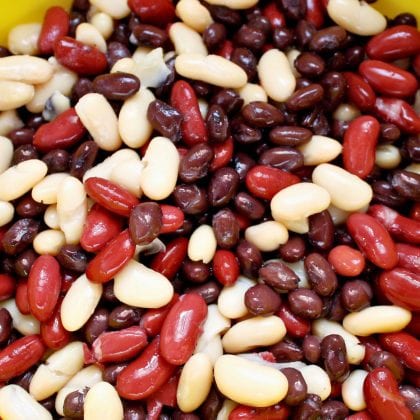
Instructions
- Soak beans or for at least 8 hours. Cover the beans in filtered water with at least enough water so you can touch the beans with your middle finger's tip and have the water cover your second knuckle. If you're planning to have beans for dinner, you can always start soaking them in the morning when you wake up and then cook them starting 8 hours later.
- Alternatively, speed soak in a pressure cooker. You can soak beans in only 2 minutes in one of these amazing kitchen tools. Just cover the beans with filtered water (as instructed above) and cook on high for 2 minutes.
- Drain and rinse the beans
- Bring beans to a boil, then skim off the scum/foam that builds up on top.
- Add a total of 1 heaping teaspoon total (for every 3 cups of beans) of one or more of the following to the beans ajwain or epazote gingercuminfennelasafoetida (an Indian spice that is a good substitute for onion or garlic).For ajwain, use 1/2 teaspoon for every 2 cups of cooked beans (or 2/3 cup dried)For epazote, use 1 tablespoon for every 1 cup dried beans.
Notes
Nutritional information is provided as a courtesy and is an estimate only. It may vary depending on ingredient brands, substitutions, and preparation methods. Optional ingredients are not included. Net carbs are typically calculated by subtracting fiber and sugar alcohols (such as erythritol) from total carbohydrates. This information should not be relied upon for medical or nutritional purposes.
Can You De-gas Canned Beans?
To reduce the effects of gassy components from canned beans, rinse the beans twice before using them in a recipe. It’s not as effective as de-gassing dried beans, but it canhelp.
Bean Recipes
Here are some of our favorite bean recipes (surely there will be more in the future!)
- Pizza Hummus
- Fast and Yummy Bean Dip
- Buckwheat Lentil Crackers
- Lentil Recipes – from Breakfast to Dessert
- Indian Lentils
More Digestion-Boosting Tips
I’ve mentioned a few of these already, but these are some other topics regarding digestion that might be of interest.
Beans are good for you, good for your budget, and good for your family (and friends) if you de-gas them. Get it? If you eat a lot of beans, by using these tipcs, hopefully you can keep all of your friends and not get disowned.
Do Beans Give You Gas?
Got another de-Gassing tip to share?
Thanks for sharing with
Simply Delish.
Hope to see you again next weekend.
Thank you for sharing this post with the Hearth and Soul Blog Hop. There are some great tips here!
These are great tips–thank you for submitting them to Wellness Weekends! This past year, I’ve developed a true love affair with beans. I liked them before, but now–love. 🙂
Thanks for sharing this great information.
Soak them overnight covered by about 2 in. of water & add a Tbsp. or two of vinegar. It does seem to lessen the cooking time.
It’s a good idea also to soak ALL dried beans/peas – even lentils, split peas, etc. – b/c they contain “anti-nutrients” as well… Anti-nutrients (i.e. phytates, trypsin-inhibiters, lectins, etc.) prevent the body from absorbing important nutrients, such as minerals, etc.
How long do you soak them for — and does it change the cooking time? I assume so. Could you share more details please? Thanks!
Great post! As a vegetarian I love finding high protein foods.
Hi Adrienne,
I am trying this with my very next pot of beans and if it works for my Honey Bunny, you need to sell stock in this recipe, I sure hope it works for him. Thank you so much for sharing with Full Plate Thursday and hope to see you again real soon!
Miz Helen
Hi Helen!
I so hope it works! Let me know, OK? If digestion is an issue with all foods, I have some other ideas as well.
Do you know how I could put it on the market? I used to work on the stock options floor in Philadelphia and taught options valuation in Chicago. Funny, eh :-)?
Hi 🙂 I followed your link here from ‘This Chick cooks’.
I haven’t used dry beans in y-e-a-r-s. However, I have found that you can de-gas processed beans by adding a SMALL amount of ground ginger to them before cooking or baking. Not enough ginger to be able to taste it, mind you. I added a half teaspoon to 2 institutional cans of ‘baked beans’. And it worked ;-p
That makes sense since ginger is supposed to be good for digestion. I took ginger tea when experiencing morning sickness and my friend ate ginger – whatever when she had the same issues. Thanks!
Great advice! I rarely cook dry beans (other than lentils) because I work outside the home so it’s hard to find time. With canned beans, rinsing is really important to prevent gas. It also lowers the sodium as the “goo” around canned beans usually is very salty.
My favorite bean recipe is Honey Baked Lentils: Mix it up in minutes from cheap, shelf-stable ingredients, and then it bakes unattended while you do something else! Delicious, too!