
Egg Replacer Powder (Compare to Ener-G®)
This post may contain affiliate links from which I will earn a commission. Learn more in our disclosure.


If you've got an allergy to eggs, baking can be tough. Thankfully, there are options out there to make your egg-free baking life simpler, like this egg replacer powder. It's a homemade version of one of the best egg replacers that I have ever used.

I love making homemade versions of pricey store-bought items, like homemade coconut butter, homemade coconut milk, or homemade almond butter.
Well, imagine my glee when I figured out how to replace the expensive powdered egg substitute that we'd been buying for years.
This egg replacer recipe is for everyone – whether you, or someone you know, has a food allergy, or if you have ever run out of eggs while in the middle of a recipe.
Of courses, if you run out of eggs in the middle of a recipe you can run to the store, but having an egg substitute on hand is a much more frugal way to go.
The Making of this Egg Substitute
Ever since my son was diagnosed with a life-threatening food allergy to egg whites (and other foods) at the age of 5 months, baking and cooking have become a bit of a challenge.
At first, it felt completely daunting to me.
How on earth was I supposed to bake without eggs?
Well, the truth is, his (and my) other later dietary changes have proven to be even more challenging (going gluten-free and even sugar-free) than the “egg issue”. And on top of that, his autism (Asperger's Syndrome) diagnosis was an even harder issue to navigate than the food allergies ever were.
However, adopting an individual's or family's diet to meet special needs is still a very real challenge. So real that it causes a great deal of stress on whoever is responsible for taking care of the meals.
This is actually one of the main reasons that I started this blog –to make food preparation easier and more wholesome for those dealing with special dietary needs. Because I know how hard it is to deal with all of this and I need easy solutions wherever I can find them.
You too, huh? If I can get it done quicker, healthier, and cheaper, then I am all over it.
And I really enjoy helping others meet this challenge as well.

Finding a good substitute for eggs in baking and cooking can be a bit of a chore, but there are a number of options. One of my long-time favorites was Ener-G's Egg Replacer.
It's a powdered egg substitute that can be used in quite a few dishes that call for eggs, egg whites, or egg yolks.
I bought this product for years, but typical of my “Can I do this myself” mentality, one day I set out to see if I could make this powdered egg replacer myself. The main reason I wanted to do it was to save money, but the other is that there is one ingredient in their product that wasn't entirely desirable so I wanted an alternative.
Well, it worked.
I found a recipe for powdered egg replacer on the internet, made some changes, and now I have a quick, easy, cheaper and additive-free way to replace eggs in loads of recipes including cookies, cakes, cupcakes (like these Gluten-Free Chocolate Cupcakes) and more.
The inspiration for this recipe was a blog called Celineyum, which unfortunately is no longer online.

Other Egg Substitutes
There are other egg substitutes that can work as well, but it all depends on what the eggs' purpose is in the recipe.
This powdered egg replacer works as a binder and as a leavening agent so it works quite well in almost all baking recipes.
Other options are:
- bananas
- flax eggs
- chia eggs
- gelatin eggs
- yogurt
- tofu
- cornstarch (please use non GMO, organic like this brand)
- pureed fruits
- buttermilk
- applesauce
- vinegar and baking powder
- pumpkin
and more!
Addressing Carbohydrate Concerns
The only issue with this powdered egg replacer is that it is high in carbs. Typically, this kind of starch is considered to be pretty unhealthy, but there is some interesting information that has come out to possibly counter this thinking.
You can use all or mostly all arrowroot instead of the other starches, as it is thought to have helpful nutritional qualities, but there is more information coming out about other starches like tapioca and potato starch in the resistant starch realm.
From what I'm reading, you should try to purchase raw starches if this is a consideration for you.
So as long as you aren't on a low carb diet, though this seems at first glance that this is an egg replacer that is devoid of nutrition, that might not entirely be the case.
Starches vs Flours
It's very important to get the correct ingredients for this recipe. Which leads to the questions, “Is tapioca starch the same as tapioca flour” and “Is potato starch the same as potato flour?”
The answers to these questions is confusing but here they are. Tapioca starch is the same as tapioca flour, however potato starch is not the same as potato flour.
Potato flour is the whole potato dried up and ground. Potato starch is just the starch portion.
Tapioca flour/starch is the ground up root of the cassava (yuca/manioc) plant. It's the same thing that makes up tapioca pearls.
How to Use
- To substitute for 1 egg, use one rounded 1/2 tablespoon egg replacer powder and 2 tablespoons (1/8 cup) water (filtered water preferred). If your recipe calls for egg whites beaten stiff, beat the egg replacer powder with water until somewhat stiff (this won't work for heavily egg-white-based dishes like meringues, however. Believe me, I learned this the hard way when I tried making a meringue with this. Hint: It didn't turn out at all like a meringue :-).)
- For recipes calling for egg yolks, use 1 rounded 1/2 tablespoons egg replacer powder with 1 tablespoon water.
- To substitute for 1 egg white, use 1/2 tablespoons egg replacer powder and 2 tablespoons water.
Note: I often use a rounded half tablespoon when baking, but use whatever amount you'd like.
Recipe Notes and Substitutions
- Time Saving Tip: Rinsing the spoon off after using this replacer gets tedious really fast. I leave a ½ tablespoon spoon in my container at all times. See my post on Saving Time with Measuring Tools.
- Tip Card: I recommend putting a little card with the measuring instructions on the outside of your Powdered Egg Replacer container so that it will always be handy when you need it!
- Act Fast: You should always get whatever you are making into the oven or onto the stove as soon as possible after mixing in the egg replacer. It tends to lose its effectiveness the longer you wait (due to the leavening agents in it).
- Tapioca Alternatives: You can substitute cornstarch or arrowroot for the tapioca starch with I think minimal difference. You could also sub out the potato starch, but it is a bit “heftier” than the other starches so I would use it if you can. You could also possibly use white flour for either, but then your egg replacer will not be gluten-free.
- Typically it's recommended to blend the water and egg substitute powder together prior to adding to a recipe, but I have done it both ways and had it work out.
- For a homemade baking powder option, see Aluminum & Corn-Free Baking Powder.
Special Diet Notes
- whole30 – this recipe is whole30 compliant if you use my homemade baking powder
- paleo & AIP – Although some say that potatoes are paleo, you can use arrowroot or additional tapioca for the potato starch for AIP or paleo. Just note that the recipe might not work quite as well.

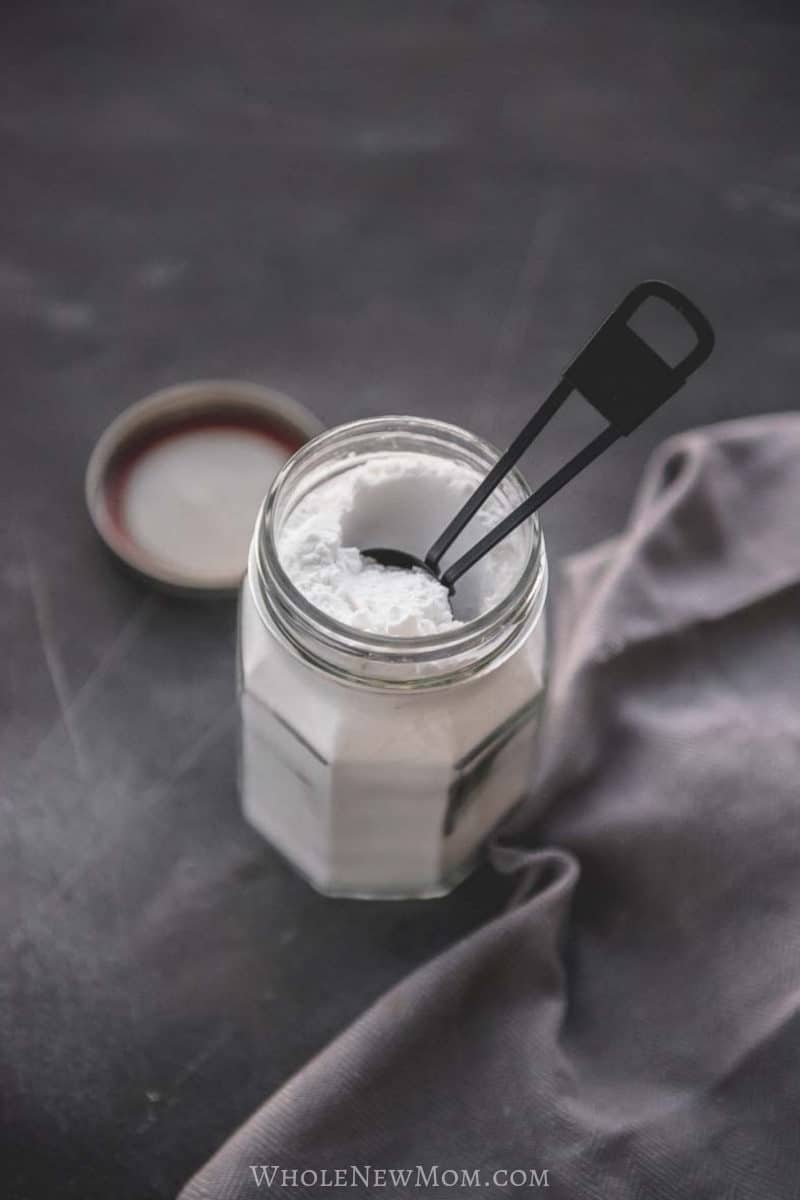
Egg Replacer Powder (Compare to Ener-G®)
Ingredients
- 2 1/2 cups potato starch
- 1 1/2 cups tapioca starch (see other starch options above in Recipe Notes section)
- 2/3 cup baking powder (see Homemade Baking Powder)
- 1/3 cup baking soda
Instructions
- Place all ingredients in a bowl.
- Combine well.
- Store in an airtight container.
- For 1 egg, use one rounded 1/2 tablespoon egg replacer powder and 2 tablespoons water.For 1 egg yolk, use 1 rounded 1/2 tablespoon egg replacer powder with 1 tablespoon water.For 1 egg white, use 1/2 tablespoons egg replacer powder and 2 tablespoons water. See Recipe Notes for more usage information.
Notes
-
- The full batch of this recipe makes about 5 cups of mix, enough to replace about 160 eggs.
-
To substitute for 1 egg, use 1/2 tablespoon egg replacer powder and 2 tablespoons (1/8 cup) water.
If your recipe calls for egg whites beaten stiff, beat the egg replacer powder with water until somewhat stiff (this won't work for heavily egg-white-based dishes like meringues, however. Believe me, I learned this the hard way when I tried making a meringue with this powder. Hint: It didn't turn out at all like a meringue. - To substitute for 1 egg yolk, use 1/2 tablespoon egg replacer powder with 1 tablespoon water.
- To substitute for 1 egg white, use 1/2 tablespoon egg replacer powder and 2 tablespoons water.
- Time Saving Tip: Rinsing the spoon off after using this replacer gets tedious really fast. I leave a ½ tablespoon spoon in my container at all times. See my post on Saving Time with Measuring Tools.
-
- Card Tip: I recommend putting a little card with the measuring instructions on the outside of your Powdered Egg Replacer container so that it will always be handy when you need it.
-
- Act Fast: You should always get whatever you are making into the oven or onto the stove as soon as possible after mixing in the egg replacer. It tends to lose its effectiveness the longer you wait (due to the leavening agents in it).
-
- Tapioca Alternatives: You can substitute cornstarch or arrowroot for the tapioca starch with I think minimal difference. You could also sub out the potato starch, but it is a bit “heftier” than the other starches so I would use it if you can. You could also possibly use white flour for either, but then your egg replacer will not be gluten free.
-
- Typically it's recommended to blend the water and egg substitute powder together prior to adding to a recipe, but I have done it both ways and it's worked for me.
- whole30 – this recipe is whole30 compliant if you use this homemade baking powder.
- paleo & AIP – Although some say that potatoes are paleo, you can use arrowroot or additional tapioca for the potato starch for AIP or paleo. Just note that the recipe might not work quite as well.
- 1 1/4 cups potato starch
- 3/4 cup tapioca starch
- 1/3 cup baking powder
- 2 tablespoons + 2 teaspoons baking soda
Nutrition
Nutritional information is provided as a courtesy and is an estimate only. It may vary depending on ingredient brands, substitutions, and preparation methods. Optional ingredients are not included. Net carbs are typically calculated by subtracting fiber and sugar alcohols (such as erythritol) from total carbohydrates. This information should not be relied upon for medical or nutritional purposes.
Looking for other handy dandy allergy-friendly kitchen subs? How about these:
- Homemade Coconut Milk
- Easiest Almond Milk Ever
- Powdered Sugar Substitute
- Homemade Rice Milk
- Easy Chocolate Chips (dairy free with sugar-free option)
- Homemade Vegetable Broth
I'd love to hear how this works for you!
Thank you so very much for this! It will help out very much. My youngest son was just a couple of weeks ago diagnosed with allergy to egg white, wheat and cow’s milk(milk which I knew about since he was a baby) it was a huge blow to me being low on finances right now and had no clue what to do! But I know I will find so much support now. Thank you!
Oh my. That is hard. You can do it — my son is allergic to egg white, dairy, peanuts, almost all nuts, and sesame. And he’s off gluten and we avoid sugar as much as possible. More recipes coming! If there’s something you really need, let me know.
To use this in a recioe, do we mix the powdered egg replacer with the water and then use that mixture, or do you just add the replacer and water separately? Or does it matter? Thanks!
You are supposed to mix with water first but often I don’t do that :).
Hi! My daughter is allergic to potato (besides egg and a myriad other things- however corn/cornstarch is fine). If I were to sub the potato starch, what starch do you think would be best to use instead? Thank you!
I would do the arrowroot. Or cornstarch, but I think arrowroot is a healthier choice. So hard w/ all the allergies!!
Thank you.
I am wondering about the second ingredient (tapioca STARCH). When I click on your link, it takes me to Amazon to Tapioca FLOUR. Which one is to be used? Are these the same?
They are the same. 🙂
Thank you! Just ordered the products! 🙂
🙂 Hope you enjoy it!
Awesome! I was only looking for an egg replacer for vegan fries eggs, and now I think I will use to ALL!
Yea!!!
I don’t get it. Eggs have protein in them. Tapioca and potato starch have ZERO and are very carby subs. no bueno
Hi there. It is a way to make recipes turn out for those who can’t have eggs. My son is deathly allergic so this is one of the options that works for him, but we typically use flax, chia, or gelatin these days b/c of the concerns you mentioned. Also, I am thinking about another option for this. Thanks.
Maybe this helps: a really good egg replacer (works for meringues as well) is aquafaba (liquid from chickpea cans) – you can google more on the subject or just follow Vegan meringues- Hits and misses on Facebook (works great in GF pancakes or crepes too).
I have heard of that. Tried it once and it wasn’t that great – hope to try again!
I scrolled through comments, but did not see this: what modifications–if any–do I need to make if I am using the egg replacer with a boxed cake mix. I made a white cake last month, but it seemed a little to fluffy and not dense enough. thanks.
From what I have read you don’t need modifications. Sorry :).
Thanks for this egg replacer recipe! I’m making a dry cake mix for some friends and was wondering if I could just add the appropriate amount of egg replacer directly into the dry mix (with the flour and baking soda, salt, etc.) and just add the water to the rest of the liquid and then make the batter. Or, do I have to mix the water with egg replacer first and then add that water/egg replacer mixture to the batter because that’s a crucial step to help the batter rise? Thank you for the help!
Yes, I think you could do that. It’s best to mix the water w/ the egg replacer when making the recipe, but it’s not for sure necessary.
I’m on the hunt for a successful egg substitute in gluten-free breads I’m trying to make. My 2 year old granddaughter has just been diagnosed with multiple food allergies, with eggs being the number one offender. Wheat is another top one, too. I’ve made three loaves now, using “chia seed eggs”, and I think it’s the reason every one of those gooey things ended up in the trash. I see that you advise baking quickly after mixing, so I’m wondering if you’ve had any luck in breads that need rising time. Thanks for your help!
Hmmmmm…good question. I haven’t tried that but I never used eggs in bread that I made. Would this recipe work for you? https://www.forkandbeans.com/2014/01/01/gluten-free-vegan-bread/