
Easy Homemade Sauerkraut
This post may contain affiliate links from which I will earn a commission. Learn more in our disclosure.

Fermented foods are one of the best ways to get powerful probiotics into your diet, and this Easy Homemade Sauerkraut Recipe is likely the most frugal and the simplest way to do it.
Follow the easy step-by-step instructions below and get on the way to improving your gut and overall health today!

Sometimes there are things that I want to do, that I know are good for me, and yet it can seem like such an overwhelming step to actually do it.
I wanted to make sourdough for years, and it was only when I was walked step by step (online) through it that I was able to actually do it, and it was easier than I thought.
Lactofermenting vegetables are like that. If you haven't done it, it can seem overwhelming. But it's really so very simple.
Concerns People Have About Fermenting Vegetables
There are a lot of questions surrounding fermenting vegetables like
- Is it safe to ferment your own vegetables and other foods at home?
- How do you know if the ferment has gone bad?
- What should it look like when it's fermenting and when it's done?
- What should it smell like?
- What should good sauerkraut taste like?
- What ingredients, containers, and recipe should you use?
It's hard to get started making fermented foods when you have all of these unknowns, so I'll do my best to address them here so you can get on your way to confident fermenting.
The History of Sauerkraut
Cabbage has been fermented into sauerkraut for at least 2,000 years, and the concept was brought over to Europe from China. Both the Tatar and Roman soldiers considered it valuable enough bring it when traveling (maybe it was part of their secret?).
Sailors also took it with them to prevent scurvy, which is a lack of vitamin C.

And, crazy enough, fermenting the cabbage actually increases the amount of vitamin C and K.
Yes, the same amount of sauerkraut contains more vitamin C and K than the cabbage that is was made from.
Sauerkraut is also full of probiotics; bacteria that are vital to health. These beneficial bacteria heal and strengthen the health of the gut, which in turn impacts everything from immunity to food allergies to skin health and mental health.
There are too many benefits of probiotics to list here, but I've written A Scientific Look at the Benefits of Probiotics, which is full of references to a slew of studies.
Basically, probiotics are absolutely necessary for good health, and fermented foods are the cheapest and freshest way to consume them.
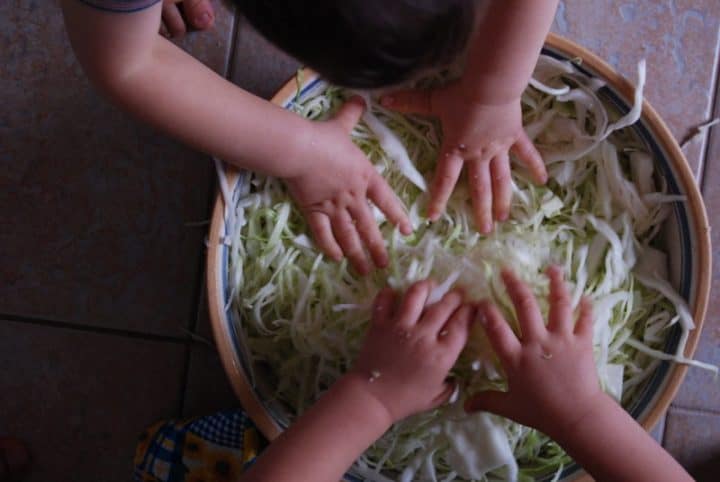
I call this recipe lazy sauerkraut because I let the cabbage sit with salt a while before massaging it and the salt brings out the water on its own.
All you need is cabbage and salt —other spices and vegetables are optional.
What You Need to Make This Easy Sauerkraut
Here's a short list of what you'll need to make this super simple recipe. There are more details in the next section.
Knife, Mandoline Slicer, or Food Processor with Slicing Attachment
Salt
Cabbage
Large Bowl or Sauerkraut Crock and/or Large Jar
Fermentation Weights (optional but very helpful)
Bay Leaves (optional)
Caraway Seeds (optional)
Aerobic vs Anaerobic Fermentation
There are several schools of thought about fermenting.
Some say that easy aerobic fermentation is fine, which is the technique used in this post. Others say that anaerobic fermentation is the only way to go.
The method used in this post is basically super easy wild fermentation.
If you would prefer to go the anaerobic way, this fermentation kit is a great option. Here is another great fermenting kit as well.
Homemade Sauerkraut FAQs
What Type of Salt Should You Use for Making Sauerkraut?
For salt, make sure there are no anti-caking additives or iodine added. This means that your regular table salt is not the best. Unrefined sea salt is the best, but there are other (cheaper) salts available. I personally use a coarse sea salt from an Asian food store.
Do You Need to Use Weights for Making Sauerkraut?
It's very important to make sure all vegetable matter is under liquid, or it will mold.
It is useful to have a fermentation weight to ensure the cabbage stays down.
You can lay a cabbage leaf over top and weigh it down with a small jar filled with water, a clean rock, or purchase pottery weights which are basically disks with a hole.
Do You Need Special Containers to Make Sauerkraut?
There is some debate over whether ferments should be in special airlock jars. My own opinion is that if you are just starting out, do not let that be a deterrent to beginning to ferment vegetables; the benefits of fermented veggies far outweigh the harm of delaying making them, or not getting around to it at all.
Start out with mason jars, and as you delve into the world of fermenting you can do more research to decide if you want to get special jars or not.
How Do You Know If Your Sauerkraut Is Bad?
Basically if your sauerkraut doesn't taste or look like raw sauerkraut, it's likely gone bad. I've had it happen myself and it's just icky.
- Smell: The kraut will have an off-smelling, yeasty, or moldy smell to it.
- Color: If the sauerkraut is a lighter color or different than what you usually see.
- Texture: Kraut should be crisp and not mushy.
- Mold: If there's mold growing that's a clear indication that the kraut is bad.
- Flavor: If you taste your kraut and it just tastes bad (and you normally like kraut), then it's spoiled.
- Cloudy: If the liquid that the kraut is in is cloudy, then it's spoiled.
How Long Does Homemade Sauerkraut Last?
Once cabbage has been fermented, the combination of salinity, acidity, and preserving bacteria prevent spoilage. It can keep almost indefinitely, although cooler temperatures are better.
After the initial stage, warm temperatures cause the cabbage to become soft and more sour.
Is It Safe to Ferment Foods at Home?
Generally fermenting foods at home is safe as long as you follow solid directions.
One thing to consider is that if you do wild fermentation you wouldn't want to do this in a house with a known mold problem. If you're concerned about that, you might want to consider anaerobic fermentation.
How Do You Know When Your Sauerkraut Is Done?
The kraut is done when it's softer and a lighter color that's also kind of translucent (clear), basically like cooked vegetables.
Other Fermented Food Options
If you're looking for more super easy ways to ferment vegetables, a delicious one is cauliflower, one of our favourites. Just break up florets, pour over salt water, and wait. Another super simple one is fermented red onions, which can be done just with onions and salt.
I don't like raw onions, but I'm continually impressed with fermented ones. They are so versatile, and I can throw them in a salad, spread, or sandwich to add a dash of probiotic goodness. Mixed with other foods, you can't taste any sourness. In fact, the onions turn almost sweet.
Fermented fruit recipes like spiced apple chutney are also great. I've eaten a whole quart on my own at one sitting. In the name of health, of course.
Kimchi, originally from Korea, is another great ferment of napa cabbage. White kimchi is a version that doesn't have any hot pepper in it, and I can barely keep up with our family's consumption.
Another great fermented food that many are making these days is apple cider vinegar.
Special Diet Notes
THM: This is a fuel pull for those on the Trim Healthy Mama plan.
Keto / Low Carb: Homemade Sauerkraut is naturally low-carb and works for the keto diet as well.
Some Great Fermentation Tools
A Great Book for Making and Using Fermented Foods
Want to learn to make even more fermented foods? This book by my friend, Hayley Ryczek, is a great resource. Not only does it help you make ferments, but it shows you how to use them while retaining their benefits.

Fermentation Kit
You can get everything you need in one place with this handy dandy fermentation kit.
Where to Buy Raw Sauerkraut
There are a few good brands on the market but the most important thing to know is that sauerkraut in the can doesn't have probiotic benefits. Instead, shop the refrigerator section of the grocery store.
Bubbies is one good brand. Adrienne's family buys Wild Brine at Costco.
Easy Homemade Sauerkraut
Equipment
- Mandoline Slicer
- Sauerkraut Crock (optional)
Ingredients
- cabbage
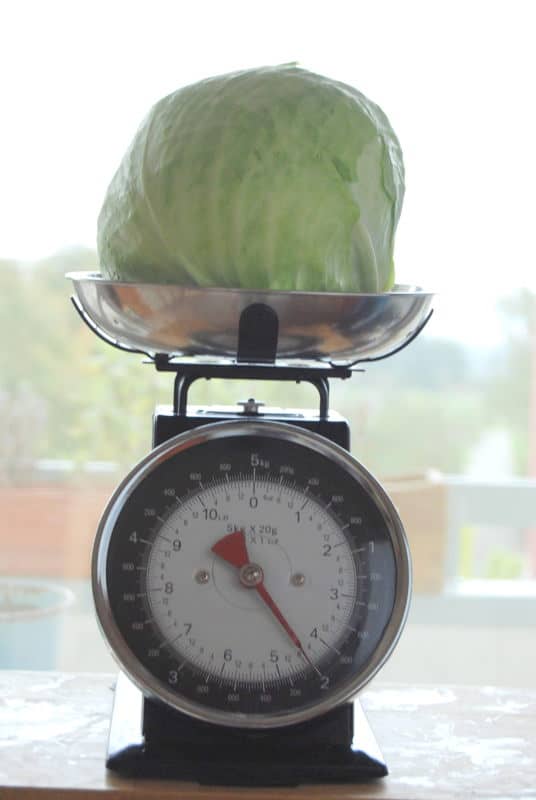
- salt 20 grams for every kilogram of cabbage / 9 grams (about 1/3 ounce / {2 teaspoon}) for every pound.
- bay leaves (optional)
- caraway seeds (optional)
Instructions
- Slice cabbage thinly. This can be done with a knife, a mandolin slicer, or the slicing attachment on a food processor.
- Add salt and mix.
- Toss cabbage and salt with your hands so it is well distributed. Let rest about one hour.
- Knead / massage the cabbage with your hands to encourage more juice to come out.
- Add optional bay leaves (about 1 per lb) and/or caraway seeds (about 1 teaspoon per pound).
- Pack tightly into a jar. I usually grab a handful, drop it into the jar, and then use my fist to push it down well. You can also use a pounder, or something like a thick stick.
- Once all the cabbage is in, make sure there is enough liquid (from kneading) to cover the cabbage by about an inch. Weigh the cabbage down, as discussed above.
- Put a lid on the jar. Be aware that you will need to occasionally let the C02 out that will accumulate.
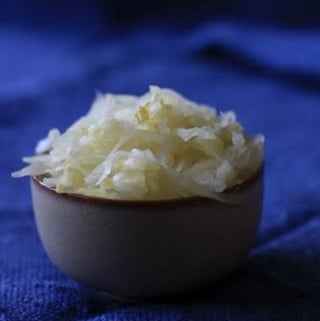
- Set it out of direct sunlight and let sit for at least 4-6 weeks. 4 weeks is the minimum required for the full cycle of probiotics to develop. Exact fermenting times will depend on ambient temperature and your tastes. The sauerkraut pictured has sat for a month, and it could use a little more time.
- Put in the fridge to slow fermentation. Enjoy probiotic goodness!
Nutritional information is provided as a courtesy and is an estimate only. It may vary depending on ingredient brands, substitutions, and preparation methods. Optional ingredients are not included. Net carbs are typically calculated by subtracting fiber and sugar alcohols (such as erythritol) from total carbohydrates. This information should not be relied upon for medical or nutritional purposes.
Have you ever made sauerkraut or other ferments?
Please share any tips for fermenting in the comment section below.

Naomi is originally from Canada but is now a wife and mom in Slovakia. She tries to live each day as a follower of Christ in the chaos of caring for children. Using real food and creating an environmentally friendly surrounding for her family is a priority. She dreams of a little farm while living in an apartment, enjoys handmade creations, and still doesn’t like brussels sprouts. Naomi shares her food creations and photos of Slovakia at Almost Bananas. She looks forward to connecting with you on Pinterest, and Facebook.
When kneading it to get the liquid out, to put into the jar, how long should this step take before placing it in the jar? Also is it the same for the onions?
Thank you
Janet
Hi there. I am sorry but I am not sure how long – it depends how hard you push to get the amount that you want. I’m not sure about onions as they would have less water in them. I suspect fermenting different veggies are very different.
I let mine set out on my kitchen counter during fermentation. It is out of direct sun. It does fine! Just finished a large gallon jar of kraut I made last year so just got another one done today!
I m shock when you says it takes months….mine take 4 days to be done…Hot and humid climate tho.
Cheers
You can indeed eat sauerkraut after just a few days fermentation, but it will only have developed the first round of bacteria that creates the characteristic acidity. Studies have measured populations of different strains of bacteria over time in fermenting sauerkraut, and they typically rise and fall over 3-4 weeks. What makes this particularly interesting is that histamine drops in the third week; something that some people are quite sensitive to and try to avoid. So it’s not as simple as you might think, and there may be good reasons to exercise patience and go with a long ferment although I find it difficult to keep mold out for a month. Sorry, no citations on the science, some ag-university study somewhere.
Great article and recipe. When you say set it out of direct sunlight, is this for the entire weeks? Weather here is crazy, it’s winter yet it’s been in the 70’s and 80’s and now it’s going down above freezing 40’s but this weekend the 70-80’s is coming back. Every week it’s different, so am wondering how the temperatures will affect it if in fact I have to place it outside.
Thank you in advance!!
I think that would be for the whole week. Do you have a place in your house that is not in direct sunlight?
Another great way of doing it is to ferment whole heads of cabbage. That way you can wedge the cabbages against each other in a large food grade plastic bucket (got it in a restaurant suppy store), add salt, pour water over it and voila! about a month after you have pickled cabbage. No floaters, no muss or fuss. Just chop as finely as you like, or wrap some meat/rice combo in whole leaves and make sarma. Pickling juice is great hangover cure as well 😉
Interesting! Do you just put them in whole or cut into quarters so they fit better?
Hi I haven’t tried this yet but I have a question. I can’t use salt but I just started using the substitute salt called Nu salt which has nothing in it but potassium and taste just like salt could you please tell me if I can use this to make my sauerkraut thank you your new subscriber Vicki
Hi Vicki and thanks for subscribing! You do not need salt to ferment but you will want flavor. So I think your method will work! Please do let me know!
If I don’t use salt what will suppress the growth of unwanted bacteria? Will the potassium ions in Nu salt do the same thing as the sodium and chlorine ions in noniodized salt?
I have no idea. What is Nu salt?
I just looked up it and I don’t see any information about that. Maybe contact the manufacturer.
Is it ok if you don’t slice the cabbage real thin? And, are we adding water to the jar when first starting out?
You can slice it how you’d like but it’s easier to fit more in the container and you want it be uniform so it all ferments at the same pace.
I made the saurkraut for the first time, my liquid bubbled out and I have know more liquid in the jar, is it OK to eat? I’m done fermenting.
I’m sorry but I don’t know. I will see if the author can chime in – thanks!
Hi Mari,
Whatever is exposed to air will either mold or go yeasty. There are a few things you can do. You can pour in 2% salt water (or a little less salt, as there is already salt in the sauerkraut) until the sauerkraut is under water. You could also transfer the sauerkraut into bags and suck the air out with a straw. Divide it into smaller bags that you would use one up in a few days – the sauerkraut that is in closed airless bags will stay good in the fridge and what is opened will last a couple days.
Do you know what type of bacteria is formed from fermented vegetables? Because I saw that probiotic tablets have various strains in them and there are other factors that help particular problems.
Yes, not all probiotics act the same, each type carries out a particular function that can help a particular problem.
Exactly which probiotics are present in sauerkraut depends partly on when you eat it and how it was made, but there are about 15 different types of bacteria that have been identified – and some that still have not been identified and there are different strains of many of those types.. The most numerous of these is L. plantarum, which will be the most numerous on any vegetable ferment.
This article might be helpful: https://www.ncbi.nlm.nih.gov/pmc/articles/PMC2168044/
I love sour kraut definitely gonna make this
How many tsp. or tbsp. are 20g of salt?
Thank you for sharing your recipe!
One tsp is roughly 5 grams.
Conversions are available using Google.
Hi its my first time making it , Have a question My jar is bigger than the amount of cabbage . The liquid covers the veggie by an inch ,. is it ok to have little empty space in the jar .Thanks
A little bit of head room is good, half a jar empty is too much.. If it’s something like two inches empty above the brine you should be fine.