
Stevia: What it Is and How to Use It
This post may contain affiliate links from which I will earn a commission. Learn more in our disclosure.
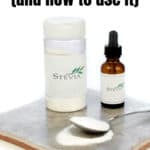
Have you heard about stevia but you aren't really sure what it is or how to use it? If so, you've come to the right place.
My family and I have been using stevia for years, before it was even a thing. Let me introduce to you to what is seriously our favorite sweetener and why it will likely become yours as well.

Stevia is quite the “sweetener in the news” these days.
It used to be something most people hadn't heard about, but now it's basically in everything: in bottled drinks, in the sweetener section of your grocery store, in treats, and more.
Since I get a lot of questions about stevia, I'm sharing some facts about stevia, what kinds of stevia there are, and how to use it as well.
What is Stevia?
Stevia rebaudiana is a plant in the stevia group of plants that grows wild in Paraguay and Brazil. The glucosides in the leaves are the extremely sweet part of the plant.
Stevia is super sweet (the leaves are about 10-15 times as sweet as sugar while the extract is about 300 times as sweet as sugar)
Stevia has no calories,
Stevia doesn't feed candida.
Stevia has a glycemic index of zero (meaning it doesn't affect blood sugar levels), making it a sweetener of choice for those who suffer from candida, or who have sugar metabolism issues, like diabetes.
There are some who are wondering, “is stevia safe?” I have done quite a bit of research into this and I feel very comfortable using it. You can read the post linked to in the previous sentence to find out how I reached that conclusion.
Different Forms of Stevia
Before we get into the different kinds of stevia, I think what is most important to point out is that the answer to the question, “What is stevia?” is that it is a plant that is made into a variety of different sweetening forms. Here they are:
Stevia Plant
The stevia leaves can be dried, crushed, and used as a sweetener. They are sweeter than sugar, but the “licorice-y” aftertaste is stronger than that of the pure white powder extract. You can also buy stevia in this powdered form.
I have never used this form. I hope to grow stevia myself soon and get more experience with this and also make stevia extract with it!
Green Stevia Drops
There used to be a liquid form of whole leaf stevia, but it's been discontinued. Approximately 1 Tablespoon of this was equal to 1 cup of sugar. It had a stronger aftertaste than the refined powder with a more “licorice-y” taste.
I'm guessing that it wasn't that popular, so not holding my breath that it will come back on the market.
Stevia Blends

These typically come in convenient packets that make it easy to take with you and add to your favorite beverages while on the run. They also come in baking blends so you can easily use them 1:1 for baking.
I never buy these, for several reasons.
- Most of them have fillers that are not what I want in my body (natural flavors, etc.).
- They are expensive compared to using pure extract powder. I'm
cheap-er-frugal. I would rather carry around my little container of stevia extract powder in my purse with a little stainless steel scoop and use that. See below for scoop info. - The packets are just more garbage to add to landfills. As much as we can, we try to be a “no throw away” family. If everyone does their part we can clean up this world little by little.
Liquid Stevia Drops
This liquid stevia is a great choice for liquid stevia since it's a large bottle at a great price with great flavor
They have a lot of other flavors too. Those are more expensive but super yummy. There's Chai Spice, French Vanilla, and more!
If you are trying to get your family off of soft drinks, these drops are a great thing to bring into your household. You could buy sparkling water and add these to it. And if you're advanced in your fermentation skills, you could add these to your “fizzed” water kefirs or kombuchas.

This recipe for Homemade Liquid Stevia Drops is a super frugal way to make your own stevia drops for use in recipes, beverages, or hot cereals.
Pure Stevia Extract Powder
This is the form of stevia that I most often use.
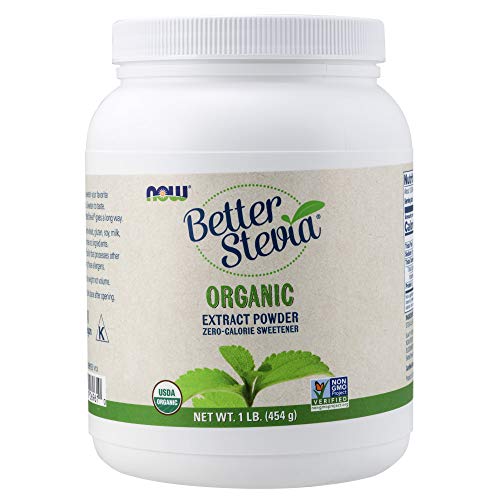
It is a super sweet powdery substance that comes in containers from 1 oz up to 1 lb. I currently buy the 1 lb size to save money (I buy almost everything in bulk). Stevia's shelf-life is long and that container lasts us about 1 year or more. And we use stevia a lot.
How to Use Stevia
Now that we've answered the question, “What is stevia,” let's move on to how to use this amazing sweetener.
There are tons of recipes using stevia on the internet (and on my blog.)
You can use stevia to sweeten drinks (like my Sugar-Free Lemonade), or my Rich and Nutritious Coffee Substitute.
Or, you can mix some into warm cereals, or put on top of cold cereals. One of our favorite warm cereals is this Cream of Brown Rice.
Baking with stevia is a little tricky. Here are some tips that I think will help.
Use With Other Sweeteners
I find that it's better to use a mixture of alternative sweeteners to get a smoother “more like sugar” taste. Plus, stevia on its own has no bulking agents so you will have to add something to your recipe to get it to work something like the original if you are only using stevia.
What I typically do is cut the sweetener in a recipe in half and use one half of a no glycemic index, candida-diet-friendly sweetener (like xylitol in my case. You of course, can use a sweetener that is appropriate for your health needs) and then use stevia powdered extract for the other half. See the next section for measuring stevia.
How to Measure Stevia
Since the stevia extract powder is about 300 times as sweet as sugar, a little goes a long way. That's why a 1 lb container lasts a long time.
But it can be pretty tricky measuring something so strong.
When I first started using stevia, I was working on a candida protocol via Whole Approach. The ladies there were all talking about a “scoop” of stevia.
I soon found out when I bought my first container of stevia extract that it came with a teeny plastic scoop in the container (it was kind of hidden in the white powder) and it served its purpose well for a long time. However, it eventually broke and I found that not all stevia extracts come with such a scoop. I ended up finding the same scoops at soap making companies, but they broke quickly so I wanted to find a better alternative.
These mini stainless measuring scoops fit the bill perfectly. I only needed one of the scoops, but they are pretty reasonable so I was willing to buy the set.
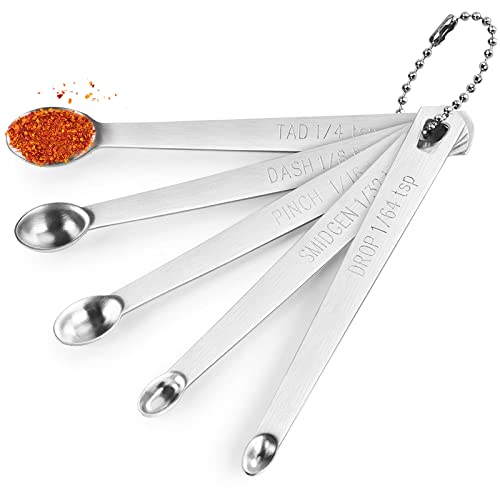
The 2nd smallest scoop is 1/32 of a teaspoon (the standard “stevia scoop” size) and it fits nicely in my small stevia container.
I purchased one of the smaller stevia containers (about a 3 oz size) and then refill it with stevia from the 1 pound size. Alternatively, you can of course find some other small container to hold your stevia. This is the first brand of stevia I bought and it happened to be the right size for everyday use. (If you choose to buy it, I hope the container is still the same size as it was years ago:).)
How to Use Stevia in Recipes
Since stevia is so sweet and concentrated, using it in recipes can be a little tricky.
1 scoop of stevia extract (1/32 teaspoon) = 2 tablespoon sugar
Typically you can assume that 1 scoop of stevia equals 2 tablespoons of sugar.
But that will depend on the type of stevia you use. I have found that the strengths really vary from brand to brand.
Same goes for the liquid drops. I've found it hard to find a “one size fits all” chart to depend on so I recommend you use stevia “to taste” in your recipes and then keep track of what you like.
NOTE: If you're using powdered green stevia, substitute 1 T ground green stevia for every 1 cup sugar.
I hope that helped you to answer the question “what is stevia” as well as to learn how to use stevia, and that this made it easier for you to use it for your family should you need and/or choose to do so.
If you have other questions about stevia,
Nothing will ever be better than the good ole’ sugar that comes from sugar cane…
You can’t get anymore natural than that. Sugar replacement is a scam, and scams are created to help people get rich, and not necessarily, to help the consumer at all. This is my opinion…
Hi Eric,
Thanks for commenting. I am sorry, however — I disagree. First of all, sugar has been highly processed. Secondly, it has a horrible effect on blood sugar. Third, there are many concerns arising about sugar’s link to cancer. Fourth, it is totally empty calories. I know people who are killing cancer by going low carb. If you have evidence about stevia being a scam, please share, but it has been used in Japan for years, and I am very very pleased with how it has helped my family’s health. Thank you.
Your empty words are not evidence for anything… making it, merely your opinion. Also, everything is processed in one way or another before it reaches the store, and stevia is highly processed. There are lots of blogs and/or on-line articles that show that sugar isn’t so bad for you… as long as you don’t over-do it… and that is true with just about anything you eat. Just GOOGLE “sugar isn’t so bad” (without the quotation marks) and read till your heart’s content, or in your case… till you feel like puking. NOW… GOOGLE “stevia is bad”, and read the articles that show that stevia isn’t that good for you. In fact, one site (empoweredsustenance.com/is-stevia-bad-for-you) has an article that says, the cons outweigh the pros when it comes to stevia, and so the person (I believe, Lauren is the person’s name) quit using it. The article also gives its sources and references. It’s still my opinion, but the only people that are really getting any benefit from stevia are the companies that produce it and those people that have stock in it when it’s selling well, because I don’t see any worthy benefit of stevia over sugar. Someone can say,”Stevia is the best thing for you when done right”… and someone else can say the say thing about sugar. It’s ALL opinion.
Just recently, I drank a pineapple soda with high fructose corn syrup in it, and a different pineapple soda with real sugar in it instead of high fructose corn syrup, and to my surprise, the pineapple soda with the real sugar in it was by far the best tasting pineapple soda I’ve ever had… but then again, that is my opinion.
Hi Eric. Which of my words do you think are “empty” and I will address them. One quick search about sugar and diabetes or sugar and cancer and you will have a ton of evidence despite the sugar lobby.
If you prefer not to have stevia that is processed then buy the green kind, or grow your own. As I said, I buy stevia extract that is only extracted with water.
I have a whole article on stevia safety and it is heavily research based. It also addresses some of Lauren’s claims. I like Lauren and she is a talented blogger, but I think some of her points in her post are not well made. https://wholenewmom.com/health-concerns/is-stevia-safe-is-stevia-bad-for-you-stevia-infertility/
I spent hours and hours on that.
What do you think about Lauren’s claim that we should avoid stevia b/c it is often mixed with undesirable things? Do you avoid meat b/c sometimes it is made into hot dogs or has MSG added to it in some applications?
On another note, I am sure your pineapple soda tasted great, but I would prefer it to be with stevia to avoid the potential move towards diabetes or metabolic syndrome.
Again, if you want to make claims, please do. You are saying that Lauren has sources and references, but then you say it is all opinion. My article on stevia safety is not all opinion by any means. Let me know what you think.
Your “liquid form of stevia” link is broken. Just thought you might want to know. It says, “Not found, error 404.”
Thank you! Fixed!
How do I open my stevia drops bottle ? Do I cut or pierce the rubber top ? There are no instructions !!
There should be a plastic strip around the base of the dropper top. It comes off like another other and then you just unscrew.
Thanks
Do you know what the self life is of the stevia drops once they are opened. I have a bottle and just wondering if it would still be good.
It seems to depend on the manufacturer. Some say to refrigerate and others don’t.
Thanks for sharing! I’m curious to try some of my food pure essential oils as a flavoring to the powder blend. Unfortunately, the Sweet Leaf brand uses “natural Flavoring” in all of their varieties. I do my best to avoid such fillers as well.
You are so welcome. I do think that their “natural flavors are all clean. I should call them again. Have you contacted them?
For those of us who accidentally bought licorice-y stevia, can’t bear to throw it away, and don’t enjoy licorice-y flavours in our non-licorice-type sweetened foods, what vegan recipes/foods would you suggest making to use it up? I’m trying in particular to find baked goods recipes that can mask or work with the licorice flavour.
Greatly looking forward to finishing these up so I can try out NuNatural’s reportedly better product!
Many thanks.
Hi there. I would try this post to see if it helps: https://wholenewmom.com/health-concerns/how-to-like-stevia/
So 1 scoop in your recipes equals 1/32 teaspoon? Love your site…Just started Paleo recently and many of my searches lead me to your site…Thanks for your hard work. sharing and instructions! I keep thinking I like the way this whole new Mom thinks!
Yes, that’s right. Thanks for the encouragement! Here you go: https://wholenewmom.com/kitchen-tips/stevia-what-it-is-and-how-to-use-it/
My question is will non-alcoholic liquid stevia extract blend with coconut oil? I just made my first attempt at making coconut oil chocolate with the powdered stevia extract (just to be clear, the kind that looks just like regular white sugar) and learned the hard way that it does not dissolve in oil! I was so bummed it didn’t work! All the stevia sank to the bottom of the bowl that I melted all the ingredients into, it didn’t matter how much I stirred. But now I’m concerned that non-alcoholic liquid stevia extract won’t blend with the oil because it’s water-based (right?) and water and oil don’t mix. Please help! I’ve gotta have my chocolate if I’m going to stay sugar free!
I am wondering why the powdered stevia didn’t blend in. I have seen several other recipes using either just the powdered or the powdered w/ the liquid. Could that be it? Maybe you need to be blending it w/ the cocoa / carob at the same time? Here’s my recipe: https://wholenewmom.com/whole-new-budget/homemade-chocolate-chips-carob-chips-recipe-revised/
I use a combination of SweetLeaf and saccharin for my baking. We love it. Unfortunately my new cookbook is all honey and I am allergic. Any advice on how to translate honey into a sugar based equivalent? I am quite used to translating sugar into my preferred sweetener blend.
This post should help: https://wholenewmom.com/whole-new-budget/baking-with-honey-sugar-for-baking/ :).
What is the measuring size of a ‘scoop’? 1/8 tsp? 1/4 tsp? I have a recipe that calls for Stevia but when putting in to analyze it the only measurements for Stevia are in scoops.
Hi there. I thought I had that explained but typically it’s 1/32 tsp. However, different stevias are stronger or weaker (most are weaker) so you may need to adjust. Thanks!