
How to Soak Grains (and Does It Really Work?)
This post may contain affiliate links from which I will earn a commission. Learn more in our disclosure.

Soaking grains is a traditional food preparation method that many people use to improve digestion and reduce compounds like phytates. Here’s how to soak grains, why some people do it, and how to adapt your grain recipes to incorporate soaking into them.
After I'd been trying to eat healthier and had switched from processed foods to a whole grain and more overall whole foods lifestyle, I heard about the importance of soaking grains. I was actually grinding my own grain, and thought I was doing a lot of things, right, but this was a new healthy living topic to investigate.
It turns out that soaking grains is just one of many ways people try to make grains easier to digest and more nourishing.
But does soaking grains really make a difference? And if so, how much?
How to Soak Grains (Quick Method)
To soak grains, combine whole, rolled, or ground grains with warm water and a small amount of an acidic ingredient like lemon juice or vinegar. Let sit at room temperature for 12–24 hours before cooking or baking.
- 1 cup grains
- enough water to cover
- 1 tbsp acid per cup liquid
- soak 12–24 hrs
Why Soak Grains Is Recommended
When you think about it, grains are seeds. You plant them in the ground and they sprout into plants. Other types of seeds that we eat are seeds, nuts, and grains.
All of these have protective coatings that need to be removed for the seeds to germinate. Of course we remove the shells of the nuts and seeds before eating them, but there are naturally occurring compounds in the bran that can make whole grains harder for some people to digest.
In my post about how to soak nuts and seeds I addressed that food group, and in how to de-gas beans, I talked about making beans more digestible. Well, now it's time to work on the grains.
Soaking grains neutralizes enzyme inhibitors in the bran to make grains easier to digest (source). So much easier, in fact, that some people find they don't have a problem (or as much of a problem) with gluten-containing foods when they soak their gluten-containing grains first.
In our experience, soaked grain recipes tend to have a lighter texture and feel gentler on digestion, which makes soaking worthwhile for us.
Is Soaking Grains Necessary?
There’s actually quite a bit of debate about how important soaking grains really is.
Some people believe soaking is an essential traditional preparation method that can improve digestion and help make minerals more available. Others point out that many people eating a balanced diet likely get enough minerals overall, especially if grains are only a small part of their diet.
Personally, I think soaking grains can be a helpful practice—especially for people who eat a lot of grains or who notice digestive issues with them—but I also don’t think it’s something to become stressed or obsessive about.
Like many traditional food practices, it’s probably best viewed as one helpful tool rather than an all-or-nothing rule.
Soaking grains may be more helpful if you:
- eat a diet high in grains and legumes
- follow a vegetarian or vegan diet
- notice digestive discomfort with grains
It may matter less if you:
- eat a varied diet with mineral-rich foods
- consume animal proteins regularly
- don’t notice digestive issues with grains
Some Grains Need More Than Just Soaking
Soaking grains using the above method works fine for grains that are high in phytase (buckwheat, wheat, or rye), but for grains that are low in phytase (oats, rice, millet, corn, etc.) you need to add a high-phytase grain to the low-phytase grain in order to have the soaking be beneficial (source).
It appears that substituting approximately 10% of the low-phytase grain / flour with a high-phytase grain source is sufficient (source). For example, if you are making a cake that calls for 3 cups of flour, then you would remove approximately 1/3 of a cup of the flour and replace it with wheat or rye, or you can use buckwheat as an option if you are gluten-free.
Oats and Phytates
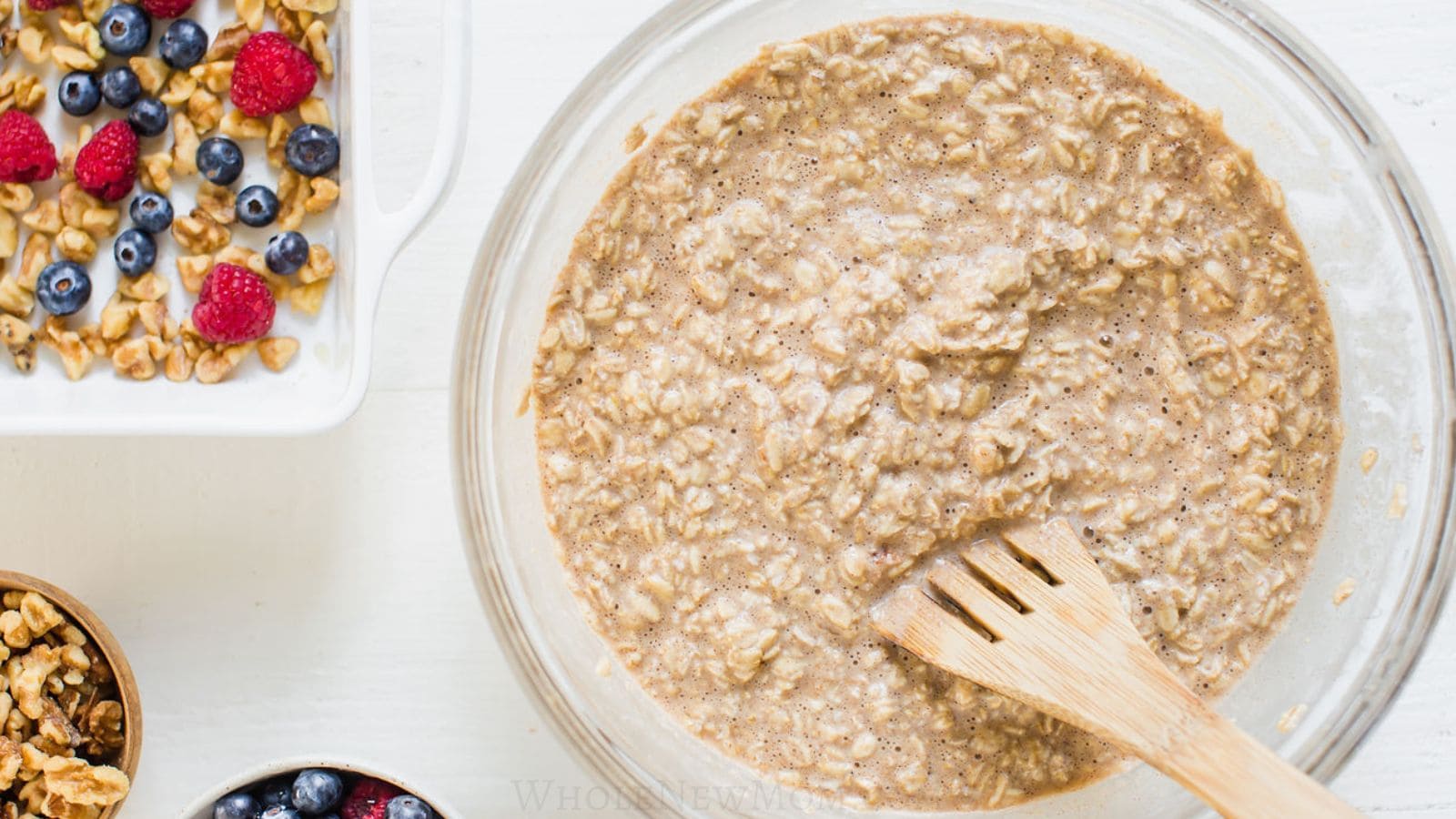
One other thing to note is that oats are particularly high in phytates so soaking oats is something that I definitely recommend (source). This recipe for Baked Oatmeal is a great one with the soaking built right in to the recipe.
Soaking Grains Time Chart
Here's information about the time needed, plus extra tips for soaking some common grains.
| Grain | Soak Time | Acid Needed? | Notes |
|---|---|---|---|
| Oats | 12–24 hrs | Recommended | Add high-phytase grain |
| Brown rice | 12–24 hrs | Recommended | Warm soak helpful |
| Wheat | 12–24 hrs | Optional | Naturally higher phytase |
| Millet | 10–12 hrs | Recommended | Low phytase |
| Quinoa | 4–8 hrs | Optional | Rinse well |
Best Acidic Mediums for Soaking Grains
Here are some options for acids to add to your grains.
- lemon juice
- apple cider vinegar
- whey
- yogurt
- kefir
Some people prefer fermented acidic mediums like kefir, yogurt, kombucha, or sourdough starter because they contain active cultures that may help support fermentation during soaking. Some prefer to use whey, kombucha or water kefir to cut down on the sour taste. I like using lemon juice or apple cider vinegar because they’re simple and easy to keep on hand.
How to Adapt Your Favorite Recipes With Soaking
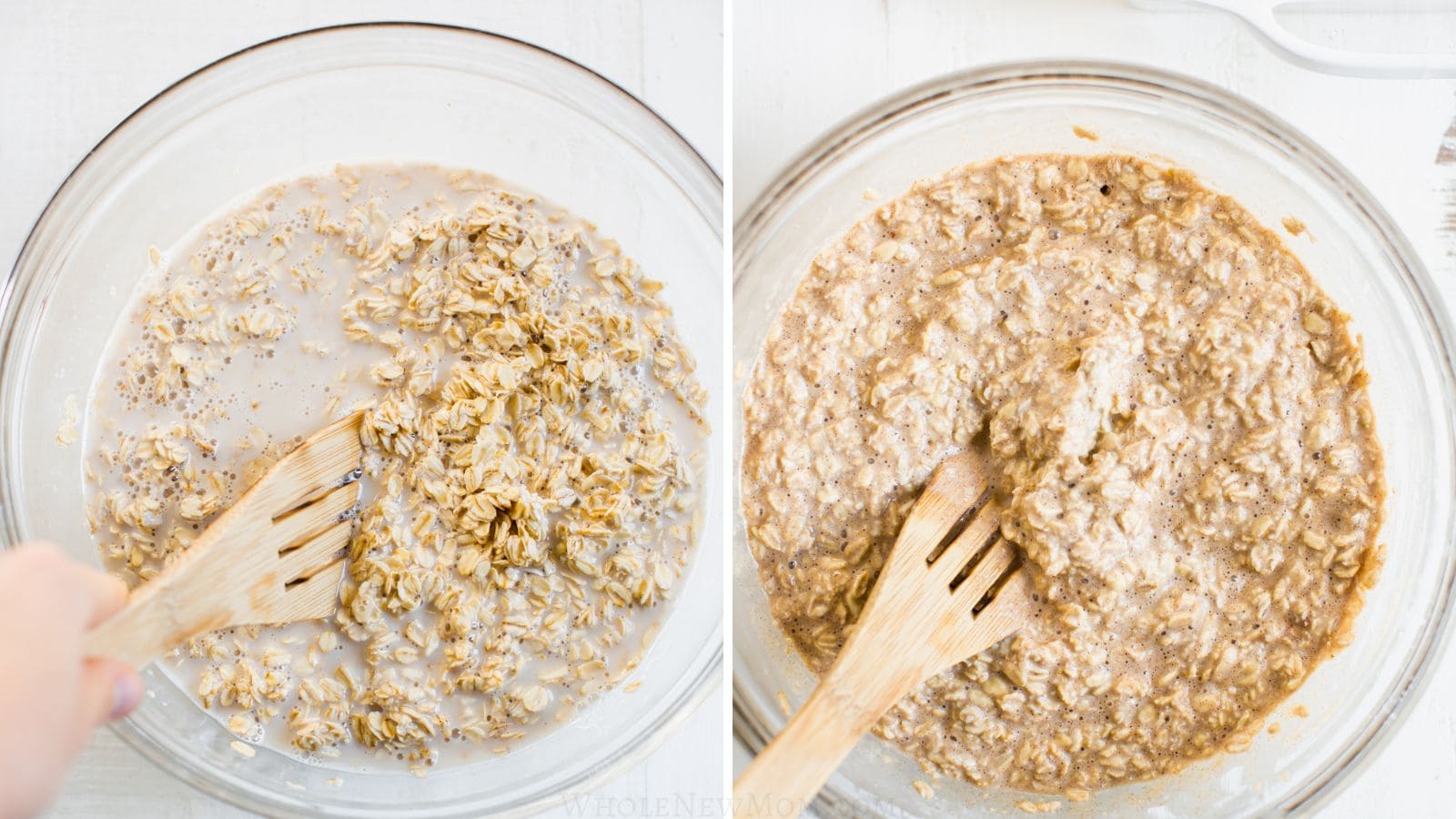
- Combine grains (either whole or in cut, flaked, or flour form) with liquids, sweeteners and fats.
- Replace 1 tablespoon of your liquid with an acidic medium (vinegar, lemon juice, or whey). If the liquid is already acidic or cultured, then you can simply skip this step.
- Allow your mixture to sit at room temperature for at least 12 and for up to 24 hours. When I'm in a rush, I soak for 7 hours and call it good enough.
- Add the remaining ingredients for your recipe and proceed as close as possible to the original instructions.
With some recipes that have a more stiff dough (like pie crust, bars, or these delicious whole grain doughnuts), the dough will definitely be hard to mix at this point.
However, if you're willing to put in a little elbow grease and make sure that all of the ingredients get mixed in well, you can use this soaking technique for any grain-based recipe to make the food more digestible.
How To Soak Grains
Ingredients
- grain of choice
- water
- acidic medium of choice 1 tablespoon per 1 cup grain (such as Kombucha, raw apple cider vinegar, lemon juice, buttermilk, kefir, whey, yogurt, etc.)
- traditional fat 1/2 tablespoon per 1 cup grain (such as grass-fed butter, olive oil, coconut oil, etc.)
- salt
Instructions
- Combine grains, water, and acid in pot or bowl the day before you need to cook them. If making a baked good, you can add the sweetener and fat as well.
- Cover the pot or bowl and let sit out on counter for at least 7 to 8 hours, up to 24 hours.
- Proceed with your recipe as written.
Final Thoughts on Soaking Grains
Soaking grains is one of many traditional food preparation methods that people use to improve digestibility and reduce compounds like phytates. While there’s debate about how necessary soaking really is, many people—including me—find that soaked grains have a lighter texture and are easier on digestion.
Fortunately, soaking grains is simple to do and easy to experiment with. Whether you soak occasionally or make it a regular part of your routine, it can be a helpful tool for preparing grain-based foods.
How about you?
Did you know about why you should soak grains or do you already do it?
You read so well! Makes me a lot more comfortable with my scarce efforts to feed myself and aging mom a safe, healthy dinner. Thank you and please keep at it. Rob Capitano
Hello, Be careful about your wording and punctuation: “For example, if you are making a cake that calls for 3 cups of flour, then you would remove approximately 1/3 of a cup of the flour and replace it with wheat, rye, or buckwheat if you are gluten-free.” A gluten-free novice might interpret all 3 of the alternatives – wheat, rye, or buckwheat – as options available to them.
Yes, you are correct! Thanks for catching that. It’s fixed now! I am working really hard to update so many posts. So little time! Thanks again!
Adrienne, is this possibly the source you were referring to, re: “substituting approximately 10% of the low-phytase grain / flour with a high-phytase” ? (If not *the source, you may still find it valid. They seem to agree with your supposition and make reference to research.
(Link deleted by Whole New Mom due to it not working anymore)
Be well!!
Hello there! Yes, I believe that is the same information but from another source. The author of that blog is an online friend of mine–she’s a great gal. Thanks for reading!
This is a very good article you have written on soaking grains, nuts, seeds, etc. I have issues with vinegar. I was told by an herbalist at the local health foods store that I am not allergic to the yeast in the vinegar it is the way they commercially produce the yeast that is ,an issue for me. I become still all over. To add egg and leave it out on the counter over night concerns me. I will of course research this. In the end one will cook it and I am sure that is helpful.
Thank you! Many soak with milk in there but some choose not to do so. You can add the eggs after soaking.
Thank you so much for all you do. Yes, I have read about soaking grains so I was only doing rice & quinoa, then I found out other countries, the sub-continent, has always known to do this.
Red lentils do not need soaking but all other larger lentils should be soaked. Another website soaks her flour but I really did not understand. Now I totally get it, thanks to you.
Also I rinse the starch out of my diced red potatoes, and other things I soak. Why? I am diabetic and cannot have starch. In India & Pakistan, they use starch from rice to iron their clothes. Can you imagine? No one needs extra starch.
I love using a “sprout jar” to do my soaking now after seeing that someone did this. I had a new, unused jar with the green top, now it gets used almost everyday. Thanks again, take care…
So great! I just read that cooking pasta and then cooling it and reheating it reduces the carb count by possibly 50%! Is that what you do with your potatoes? We are watching starches as well. Are you using the sprout jar for nuts? Grains?
You mention using 10% high-phytase grain when soaking low-phytase grains such as Oats. May I ask if wheat bran is one i could use for this, as i have a bag lying around already?
I would think so since, from what I have read, it has a lot of phytase in it.
Not sure I understand the process of soaking that you describe above. Are you saying that you can soak flour? Would love to see a video if you ever get the time. This is my first visit to your site. I think it’s great and has lots of value for your readers. It’s the latest addition to my bookmarks bar. Thanks.
Yes, you can soak the flour in liquid. A video will probably be awhile in coming but hope that helps. Thanks so much for the kind words!
Hello, I loved reading all these comments because this has been my lifelong quest as well. I’m a health sciences major as well as a GAPS practitioner and herbologist (aka natural research scientist). I think I can fill in a few of the missing details about how phytic acid interacts with bionutrients and natural yeasts. First of all, it’s vitally important to establish that lactobacilli exist EVERYWHERE and are ever so vital for our very existence! They originate from the soil but spill over and thrive on and in every substance and surface on our planet. There are millions of different species and our bodies ideally utilize about a thousand of them at any given time. (That’s a very utopic and general statement!) Realistically, our bodies in this area of the world nurture enterotypes (foundational bacterial ecosystems that make up our intestinal flora) to about 300-500 different species which is very low. All of this is a fancy way of saying that these microorganisms are essentially the enzymes that digest the food we choose to eat; if we can nurture a greater variety of these microorganisms in our systems, we can digest a greater variety of foods.
I culture a lot of the food I eat for this very purpose and my kitchen resembles a cozy science lab at any given time. It is safe to leave things open and most bacterial cultures need the variety of lactobacilli introduced from its surrounding environment to thrive, but if there are fruit flies or other pests present (parasites that would use the microorganisms to reproduce for their own benefit), you will want to preserve the culture for yourself and I like to use a lot of coffee filters or tightly woven cheese clothes secured with rubber bands to do that. I like the idea of using a larger bowl of water to keep out creeping organisms!
Do not be fooled, when you add liquids to your dry ingredients, you’re not just soaking them, these mixtures are very much alive and although you can’t see it with the naked eye, chemical reactions are taking place, communities of bacteria (enzymes) are growing exponentially, and your grains are predigesting right under your nose. It’s very probable that your body doesn’t support the necessary enzymes to completely digest the wonderful array of nutrients housed inside the grains you’re about to partake of and introducing an opportunity to culture the bacteria from your natural environment is the most effective way, in fact the only way I’m aware of, to begin the digestive process and trigger the necessary chemical reactions to ensure the presence of any missing enzymes that your enterotype may not have established.
I also want to add here that aerobic reactions are quite possible (mold from air particles) if your soaking/culturing mixture is left out for a considerable amount of time. Mold that grows because of exposure to the air is not harmful and can simply be plucked off and discarded. The truly dangerous organisms reproduce anaerobically alongside the ultimately beneficial organisms, but please understand that it is their nature to react and combat with each other; because of the sheer numbers of good bacteria vs bad, the good will always prevail, so if you are concerned about the possibility that your soak/culture is contaminated with adverse organisms, all you need do is wait a while and allow for the good bacteria to overpower the bad (or start again and be careful not to introduce contaminants).
As for the phytic acid, it is a molecule that acts as a storage place for phosphorus and inositol, both nutrients that are beneficial for our bodies. Phosphorus is responsible for knitting our bones together and it stimulates and conditions the brain for clearer thinking. Inositol removes excess fats from the blood and helps the production of lecithin, assisting the heart by reducing blood cholesterol levels. It also stimulates digestion and normal growth and survival of cells in bone marrow and eye membranes, and promotes hair growth. The only way to gain access to these essential benefits is to digest them. There is a specific bacteria (enzyme) called phytase that is responsible for breaking down the phytic acid molecules we consume. Without it, the phytic acid molecule acts as a foreign substance and triggers an immune or inflammatory response if there becomes a significant amount built up in your body. The phytase enzyme will unlock the phosphorus and inositol from the phytic acid molecule that our bodies need, and you guessed it, we can culture this enzyme from the bacteria in our environment just by adding water and letting nature take its course. This is why it’s so significant to soak your grains (or culture your milk or ferment your vegetables or brew your tea or create a sourdough starter), it all comes down to nurturing and activating the lactobacillus that would normally remain somewhat inert in our environment otherwise.
There really is a lot more detail to this explanation that affects many more strains and organs and systems that I couldn’t possibly expound on in this post, but I love to engage in those topics so feel free to PM me if you’d like to chat some more!
Thanks for commenting. I can’t attest to the validity of what you wrote, or the safety, but it seems to me that not always will the “good bacteria….overpower the bad” as there are sometimes problematic cultures introduced that are sometimes not visible. Thanks again.
awesome input!!!! ?
THANK YOU for your detailed and thoughtful response! I am a botanist, by degree, and enjoyed getting to read your educated perspective on this subject. It was very informative and very helpful. I also believe what you’re saying 100%! We have been trained to think contrary to what you’re saying so it’s a hard sell. Just wanted to take a moment to properly thank you for taking the time to educate people about which you’re passionate and knowledgeable!
Hi, I was very impressed with your take on how we manage to digest our food and the importance of preperation. I ferment vegetables for the consumption of the beneficial bacteria after suffering a candida overgrowth. I would appreciate reading more of what you have to say if you are willing to contact me
Wow, that is one very detailed reply. Very interesting. Thank you.
Thanks. This is a very good post. Just one question.
When you soak the grain overnight, what you do with the remaining water in which they are soaked? Do you throw it? Will throwing the water not loose some nutritional values of the grain?
When you soak, you soak using the liquid in the recipe so there isn’t any left over. If you soak a different grain, I guess you could have some left over (if you use too much). I have no idea about some of the nutritional value being lost. I would guess it could happen. Good question:)!
I too love to soak & dehydrate my grains. I found it easier to soak my grains for 8 hours, rinse them, & then dehydrate for 8 hours, similar to your method to soak & dehydrate nuts & seeds. Then I can mill my grains & use them just like I did before S & D them. I soak in a gallon jar & after drying, return them to the jar. Then I know they are ready to go & I always have a batch ‘in the bank’ so to speak. I do this w/ my bread grains ( Prairie Gold wheat, spelt & Kamut), & my all purpose grains ( spelt, brown rice & barley) For a complete explanation, I have an instructional video series on my website. Thanks for listening. Hope I haven’t used up too much space.
Really appreciate your articles & recipes. I have used several in my classes, always pointing folks to your column.
Very interesting. Thanks for sharing. I wonder if that works as well but the literature on soaking grains is very mixed. Some grains will need grains w/ phytase though which would complicate matters. Thanks again.
Margaret, I’d be interested to know more about your website. I’m curious about soaking flours and its effectiveness. Thanks
Hi Char – not sure if she will respond, but what are you wanting to know? There is mixed information on its effectiveness. But sprouting does appear to reduce carb load.
Thanks again, Adrienne! I had never heard of soaking flours before and since I’m not able to find all of my flours already sprouted I was intrigued by the idea of being able to sprout them. Mostly to reduce anti-nutrients, but to aid digestibility too. Reducing carb load would be of interest to me too. I’ve never heard of that either. How much does it reduce the carb load, how does it do it, and does it work on all nut/seed flours.
Apparently it does work on all flours but nuts and seeds are already low in carbs so this would pertain to the grain flours. It works for reheating cold pastas and things like that as well, apparently it’s about cooking and cooling and the food becomes resistant to the enzymes in the gut that digest the food. I should write a post about this. 🙂