
Homemade Natural Blue Food Coloring
This post may contain affiliate links from which I will earn a commission. Learn more in our disclosure.

Today I am sharing something that I never thought I would make: a Homemade Natural Blue Food Coloring Recipe.
Natural blue food coloring is one of the hardest colors to make naturally—but there are a few options that actually work and one of them costs very little to make.

Most of the time I try to keep things simple in the kitchen since my life is really busy, but sometimes I like to have a little extra fun with food to make our whole food/allergy-friendly kitchen more interesting, especially true when our kids were little.
But artificial food coloring is just a no go for me.
There are a few ways to make natural blue food coloring. Some work better than others depending on what you need it for.
- Red cabbage – the best DIY method (explained below)
- Blue spirulina – the most vibrant blue, great for frosting and smoothies
- Butterfly pea flower – a bright blue that changes color depending on acidity
Below, I’ll show you how to make blue food coloring at home using red cabbage, plus tips for getting the best color.
Why I Made This Blue Food Coloring
Our boys skated in a local charity hockey league and for their season finale, the team members were going to receive a cupcake decorated with frosting to match their uniforms.
It would have been simple if they’d been on a green, red, or yellow team, but blue?!
I had a good Carob Muffin recipe that I could use for healthy cupcakes and then the green source from these Mint Fat Bombs would work, and turmeric is great for yellow and beets work for pink. But blue?
I initially told my boys not to get their hopes up, but I was so happy when I found a healthy solution to make their day more festive!
Reasons to Avoid Artificial Food Colors
We all know that those artificial food colors are not healthy. I mean, who thinks that eating something fake is good for you?
Here are some things to consider. Artificial food colorings:
- are suspected of having links to behavioral and health problems.
- can have aluminum in them. When you see, “FD & C Yellow Aluminum Lake” on an ingredient label, you can know that you will be eating aluminum. There is discussion about this form not being as toxic as other forms, but I would prefer to take no chances here.
- can contain barium or zirconium.
How to Use This Natural Blue Color
You could use this natural blue food coloring for any of the following:
- dying frosting (like this sugar-free buttercream frosting) of course
- dying Easter eggs
- paper mache projects
- crafts
- fun creative food ideas (blue mashed potatoes, anyone?)

How to Make Natural Blue Food Coloring (Red Cabbage Method)
Here are the basic instructions with some process images. For the complete information, scroll to the printable recipe card.
- Boil cabbage
- Reserve water
- Add baking soda to the water
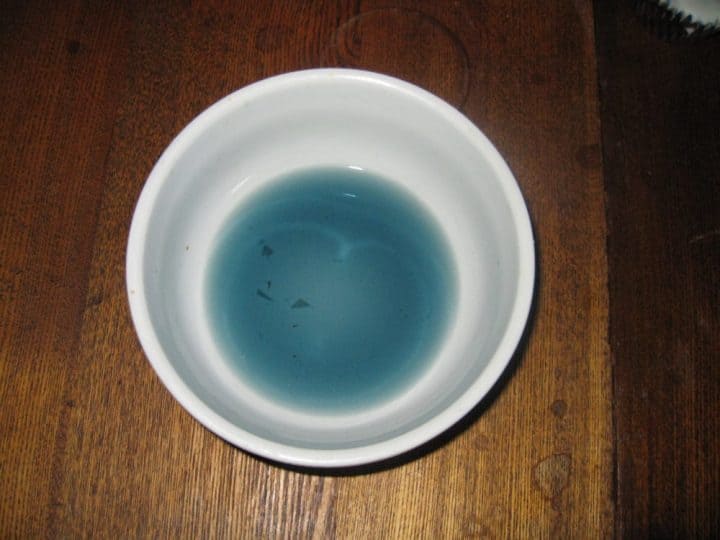
Photo 1: Reserved cabbage water.

Photo 2: The final result: homemade natural blue food coloring.
Money Saving Tip: Use filtered water for cooking the cabbage and then, though it is pretty well boiled, you can still eat the leftover veggies for dinner. Try topping them with Moroccan Vinaigrette and Chaat Masala.
Recipe Notes
- Natural food coloring is prone to fading quickly. If your color isn’t that deep to begin with, you won’t have much margin for fading.
- Don’t try to make this blue too dark by adding a bunch of baking soda to the water if you’re using it for food, or you’ll end up with baking soda-flavored food.
- The color in the cabbage juice itself is not particularly sensitive to temperature, but the mixture of the baking soda with the juice is. So you will want to add the color after the food item has cooled, or else only add it to food items that will not be heated.
- If you’re making frosting, note that this method creates a softer, more muted blue—blue spirulina typically will create a brighter result.
When Natural Blue Food Coloring Won’t Work Well
Natural blue food coloring is very sensitive to pH:
- Acidic ingredients in your recipe (like lemon juice or yogurt) will turn it purple
- Using too much baking soda can push it toward green
- Heat can dull the color
For best results, add the coloring after cooking and use it in neutral or slightly alkaline foods.
Homemade Natural Blue Food Coloring
Ingredients
- Half-head red cabbage (yes, I said “red cabbage!”)
- Water
- Baking Soda
Instructions
- Wash the cabbage and cut out the stem.
- Chop into small pieces.
- Place cabbage pieces in a pot and add water until the cabbage is covered.
- Simmer for 10 minutes and then drain.
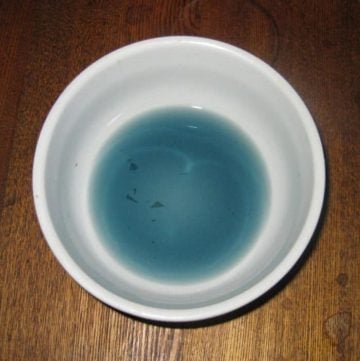
- The resulting liquid will be purplish (see photo #1 above).
- Gradually add baking soda, ½ teaspoon at a time, until you get a nice blue hue (see photo #2, above). Be careful, because the baking soda will add flavor to the coloring. If you are using the color for something you will be eating then you need to be especially careful how much you add. Since it is the alkaline quality of the baking soda that causes the red cabbage juice to turn blue, you can also add spinach juice, green tea, or another alkaline ingredient.
Notes
- The color in the cabbage juice itself is not particularly sensitive to temperature, but the mixture of the baking soda with the juice is. So you will want to add the color after the food item has cooled, or else only add it to food items that will not be heated.
- Natural food coloring is prone to fading quickly. And the if your color isn’t that deep to begin with, you won’t have much margin for fading.
- Don’t try to make this blue too dark by adding a bunch of baking soda to the water if you’re using it for food, or you’ll end up with baking soda-flavored foo
Nutritional information is provided as a courtesy and is an estimate only. It may vary depending on ingredient brands, substitutions, and preparation methods. Optional ingredients are not included. Net carbs are typically calculated by subtracting fiber and sugar alcohols (such as erythritol) from total carbohydrates. This information should not be relied upon for medical or nutritional purposes.
Don’t Feel Like DIYing?
If you’d rather not have to make your own natural blue food coloring or would like an option that will work for an acidic recipe, here is a link to a set of good natural food coloring including blue.
What will YOU use this Natural Blue Food Coloring for?
You can also get blue coloring from the water you soak dried black beans in, AND it can be used to dye fabric.
Very interesting – thanks!
We dyed our eggs and the colors are amazing. Beet kvass made purple, red cabbage made blue, turmeric made yellow, yellow onions made orange. Blueberries made a a dark navy and red onion a rust.
I’m confused about how you add that much water to your frosting without making it runny. Do you boil it down more after the cabbage simmers to concentrate it before the alkaline trick? I really want to do this, but I can’t help feeling like I’m not understanding something. Pardon my tired mama brain. 🙂 Love your site!
Also, can you store this or will it fade even if the dye hasn’t been added to a food yet?
I just added a small amount of the colored water. I think boiling it down is a great idea. I don’t know if you can store it, but I would think so since the frosting didn’t change color :).
Wow that dyed blue effect sure looks so amazing! I really would want to take it to the next level quite as you did. Keep them coming and more power!
can this be used to dte frabic
I would think so but I am not sure.
Hi…Can I use this technique to dye noodle? my younger sister has always wanted me to make blue noodle for her. Thanks 🙂
I would think so – hope it works out!
Hi Adrienne, No offense taken. I was actually hoping I didn’t sound like I was criticizing what YOU choose to eat ! Everyone seems to have a different idea about what’s healthy and what’s not. I’ve met people who swear that you should not eat soy, not eat gluten, not eat meat, not eat dairy, etc. and they all say “our body isn’t meant to handle that.” Here, we don’t eliminate any one food, but we do try to eliminate chemicals or things that wouldn’t have been found in our grandmother’s kitchen, (within reason, I mean grandma didn’t have agave). I don’t worry much about what other people eat or don’t eat, and I just judge what we’re going to eat as I along and do the best I can. I used to obsess about it a lot more, but it’s SO much work to avoid chemicals today totally, and I read an article about the stress being as bad for you as the actual chemicals. I still try to avoid them, but I’m a lot less uptight about it… I really like this site and when I have more time, I can’t wait to check out a lot of the recipes you posted! Kelly
Hi Kelly. I just wanted to make sure I wasn’t offending you. No worries. I just read Mercola’s article and it seemed like he was choosing to focus on erythritol but was stating the sugar alcohols as a group aren’t sugar or alcohol. He just was focusing on the Vitamin Water.
And the stress is awful. I’ve been particularly stressed this past week and it is not good. Thanks for the reminder!!!
https://articles.mercola.com/sites/articles/archive/2009/05/26/what-is-erythritol-doing-in-vitamin-water.aspx
I added the part about Olestra, because that also passes right through you and can cause stomachaches and diarrhea….
I actually don’t see the logic in his arguments, but I don’t mean to criticize you. This is the kind of dialogue I want to have on my site….I don’t see Mercola selling something in this article, but in my understanding, all sugar alcohols are the same in a lot of ways and I don’t see the differentiation in his article. From what I have read and from personal experience, things like maltitol and sorbitol are much more difficult on the digestive system. But xylitol and erythritol are much easier. I think that Olestra is an entirely different thing. That being said, these should be used in moderation. I have heard if you start slow w/ xylitol and add it little by little you can tolerate it better. I hope that helps. Let me know if you read it differently.
Well, I don’t like the fact that it can have a laxative effect and Dr. Mercola, on his website, says it’s because while it’s called a sugar alcohol, it’s not either, and that it passes through your body like olestra. He doesn’t recommend it. I prefer things that you can find in your grandmother’s kitchen. I’m still trying with the blue icing…we’ll see how it turns out. I’ll let you know. Kelly
I’d be happy to read what he says. I personally find more digestive upset w/ xylitol I think…..what do you mean “it’s not either”. Not a sugar alcohol and what is the other thing it is not?” I guess you need to make the best decision you can regarding sweeteners. Personally I can’t use sugar and I think w/ all the diabetes going around and what I’ve learned from different practitioners, sugar intake is one of the biggest problems. So I’m opting for things that don’t affect blood glucose levels, or feed candida.
But I’d be interested in seeing what you are referring to.
Yes, I was thinking the coconut oil is liquid, because right now, here anyway, mine is. I’ll see if my health food store has some affordable cocoa butter or palm shortening. I just called about the Xylitol, though, and they said it’s not organic, and since it’s made from corn cobs, it’s probably GM. I’ll have to check into it. Freaking out over this icing! I need it for Monday, and if I had nothing else to do, that would be plenty of time. Thanks Adrienne. If you or anyone else has any other tips that might be helpful, I’d appreciate it! Kelly
Can you get erythritol? That’s not a GMO problem.