
Homemade Saline Nasal Spray for Amazing Sinus Relief
This post may contain affiliate links from which I will earn a commission. Learn more in our disclosure.
Struggling with sinus issues? This Homemade Saline Nasal Spray is just what you need. Neti Pots and Saline Nasal Sprays are a great way to treat them, but buying those pre-made salt packets will break the bank.
Here's how to feel better fast and save money while you're doing it. Plus I've added in a recipe for a Homemade Xylitol Nasal Spray too–similar to Xlear.
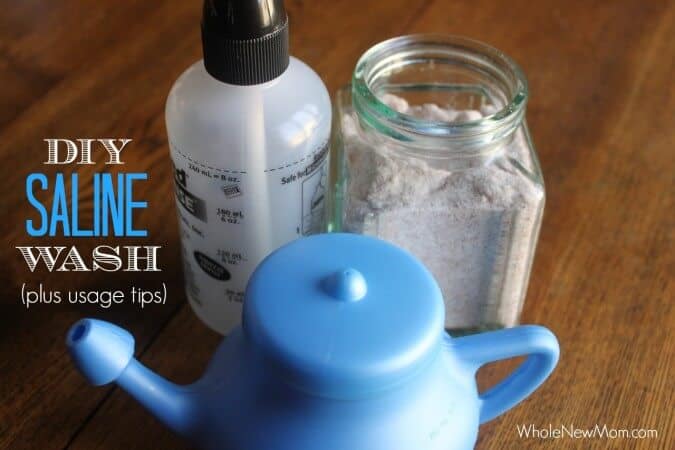
Sinus issues are the worst.
I have somewhat narrow sinus passages, so whenever I get any kind of sickness that involved my nose, I get plugged up badly.
Now, you can use nose sprays for things like that, but they often can create a rebound issue where you get MORE plugged up after stopping.
No thanks!
Many years ago, I heard about using saline for sinus relief.
I'm sure most of you have seen or heard of net-pots, saline nose sprays, or those spray bottles that spray saline wash into your nostrils.
In my opinion, homemade saline solution in a nasal spray bottle is a lifesaver. Really.
Today I'm going to show you how you can easily make these sprays yourself to save a ton of money and hopefully stay well.
Why I Started Using Saline
When I was younger, I saw saline spray bottles in the store. My grandmother recommended that I try Ocean® Brand, which she said helped her immensely.
I personally never saw benefits from that kind of thing after trying it once or twice, but that all changed years later.
I was working at a small insurance agency. My boss was from Russia and we at times enjoyed talking about health issues.
At one point, I got quite sick with a cold, and my nose, in typical fashion, got very stuffed up (I have very narrow nasal passages, so I get pretty miserable pretty quickly from colds and such).
Anyhow, one day at work we started talking about sinus issues and my boss bought up saline washes. I told him that they never worked for me, and he proceeded to tell me how they used to do it in Russia.
This is what they would do.
“Russian” Basic DIY Saline Method
- put some warm water in your hand
- dump some salt in the water
- breathe the mixture in
- inhale further ensuring that the saline mixture goes back to fill the sinus cavities
- hold the saline for about 10 seconds
- blow the saline out
I was intrigued and tried it.
And it worked amazingly well, though the salt stung pretty bad sometimes.
Anyhow, I figured if I could apply that technique to a saline bottle, then I would have something very helpful, and more user-friendly than a hand full of saltwater!
So —
I went to the store, bought a starter kit for a saline wash, and was on my way.
And I have to say, this has made my narrow-sinus issues at least a little more bearable.
Anyway, as the years went on, I started using different forms of saline washes and found that they work great!
Why Make Your Own
One of the things that bug me is that when you go into your local drug, grocery, or health food store, and buy a neti-pot or saline spray wash, they give you little packets of pre-made saline mix to get you started.
However, then you feel the need to come back and buy more of their little packets.
Well, if you've looked at those packets, really the only thing that is in them is….
—salt and maybe baking soda.
Pretty simple, eh?
So I decided to figure out how much of each I needed to use in order to avoid the highway robbery of buying those little packets (not to mention all the extra garbage they generate. Sigh.)
The benefits of all of this?
1. Save a TON of money.
2. Reduce waste from those little packets of saline mix.
3. Control how much of everything you add easily.
Important Notes
Water: Use only purified water (see How to Make Your Tap Water Safe). Here is really icky documentation of folks who got brain-eating amoebas from using tap water. Yuck!
Salt: Use only pure salt like sea salt or my favorite, Real Salt. Table salt has lots of other things like anti-caking agents, silicon dioxide and even sugar sometimes. I don't want those in my nose, thank you.
Bottle Type: I like this brand, but I think they are all good. Personally, I don't think that the net-pots work as well since the spraying action seems to get the saline rinse in my sinuses better than the force of gravity.
Not for Daily Use: Some advise against continual use of saline washes. I found this article to be quite interesting. Do keep in mind that it might not be a good idea to use this on a daily basis.
Water Temperature: I prefer my water a little warmer than just lukewarm as it seems to help the salt dissolve better, but please take care to not overheat the water.
More Benefits: added sinus-cleansing action, after putting the saline solution into your nose, inhale a bit and hold some of it in your nose for about 10 seconds, and then blow out. I found this technique on my saline bottle's insert and it supposedly helps the saline solution get into all the nasal cavities.
If you find yourself in a real pinch and don't have a saline rinse container, you can mix this up in your hand the “Russian” way. Just make sure your hand is really clean.
Bonus Tip
In addition to the above “added sinus-cleaning action”, one of the best methods for getting this to address your whole sinus area is to use the wash and then tilt your head back over the edge of your bed. The saline mix will go all the way back into your sinuses. Hold it there for 2 minutes, and then blow out.
I've used this method with amazing success for stubborn sinus issues.
When to Use
- When you have a cold
- To clean out sinuses to support your body so are less likely to have a cold take root
- As a natural allergy help
- To moisten sinus passages in dry weather
Why Is Baking Soda Added to Saline?
Good question. There are two reasons for this.
Baking soda helps to open the sinus passages. Studies have shown that this mixture of concentrated saltwater and baking soda (bicarbonate) helps the nose work better and moves mucus out of the nose faster than saline solutions alone.
Also, baking soda acts as butter in the saline solution, so that it is less irritating.
Storage
You can store this mixture for up to 3 days, but not for longer.
Though salt is a natural preservative, water naturally grows bacteria easily. There are store-bought saline sprays that can be stored longer but they are made from sterile solutions and I believe that they are in airtight containers so that's a different situation.

Optional Additions
At one point I had a very stubborn sinus issue. I thought it was allergies, but it turned out to be a doozy of a sinus infection.
Since I was pretty desperate, I added a bunch of different things to my saline bottle to aid in my healing. Here are the possible additives for the nasal rinse that I read about and tried (I tried all except the honey).
– Apple Cider Vinegar: (just a drop or two. Don't make the mistake I did by adding about 1 tablespoon. Ouch!)
– Colloidal Silver: (I only used about one drop.)
– Grapefruit seed extract (GSE): This is supposed to be a great anti-viral agent. Just add one drop if you try this since it's really really strong!
– Xylitol – Some say it aids in making the solution non-stinging. It is also supposed to be helpful against bacteria and viruses. In fact, there are Xylitol Nose Sprays on the market now. (Source)
– Manuka Honey: I didn't try this but I have read that it is a natural way to kill germs, etc.
More DIY Wellness Supports
If you like this formula for a saline wash, you'll love these DIY products too!
– DIY Decongestant (like Vicks Vapo-Rub) – skip the toxins and save money with this simple formula
– Herbal Steam – a total game-changer for respiratory issues and it's great for your skin and hair too.
– DIY Thieves Oil – so much cheaper and it works great.

Ingredients
Homemade Saline Nasal Spray
- 1 cup (8 ounce) water
- 1 teaspoon natural salt (you can add more for more "punch" but it does sting. I use Real Salt)
- 1/8 teaspoon (pinch) baking soda
Homemade Xylitol Nasal Spray Version
- 1 cup water
- 1/4 teaspoon salt
- 1/2 teaspoon xylitol
- 1/8-1/4 teaspoon baking soda
- 1 drop grapefruit seed extract optional
Instructions
- Warm the water to a temperature that is as warm as you can tolerate (of course, this is a subjective term. The water should not be so hot as to damage your nasal passages. See notes below.)
- Add salt and baking soda to your saline container (neti-pot or saline spray bottle).
- Add water and mix / shake to combine.
- Follow directions for using your saline wash container.
- Make sure to rinse out your container after use and leave it open to air dry.
How about you? Have you used saline sprays before?
So wish I had read the entire post before making some and using it on myself and son. I used hot tap water and now I’m freaking out about the brain eating amoeba. I can’t even bring myself to watch the documentary. Boiling water now to make a new batch.
Blech. I know. No amoebas for me either.
Wonderful article. I had just been using tap water, but will now use boiled since I read about the ameobas (spelling?). I use 1/2 tsp sea salt & pinch of baking soda 🙂
Thank you so much!
I discovered sinus rinsing about the time when I was dealing with off and on sinusitis. After sitting up all night not being able to sleep from intense pain, I discovered posts about cayenne pepper on EarthClinic. Desperate, I used a pinch of cayenne in with my rinse…gotta admit for a minute the pain was actually worse but within MINUTES the sinusitis pain subsided and I was able to sleep.
Normal rinsing really helps during allergy season but if feel sinuses might be getting bad I use the tiniest pinch of cayenne in with rinse and have not had sinusitis in two years.
Great tip – thanks!!!
Thanks so much for this! I did personally find the full teaspoon a bit intense for my sinuses, so I may go for the half next time, but this was super helpful since paying $20 for saline refills just isn’t going to cut it for me anymore. Cheers!!
Feels great to save in such a simple way, doesn’t it? :).
The first time I did this I was very skeptical about it working, but I was also desperate. Since I didn’t think it would work I wanted to go cheap. I went to the drug store and bought one of those baby medicine droppers, the bigger kind and mixed up my own solution with sea salt and water. It worked so well it turned me into a believer. Now I do not do this all the time, call me crazy but shooting salted water into my sinus passages is just not something I look forward to doing, but when I need it I know what to do. So my cost in this “neti pot” this is $1.99, because I already had the sea salt in my kitchen.
Great to hear it!
Thank you so much for this very useful info. My daughter suffered through a terrible cold and 2 rounds of antibiotics and still had awful sticky green goop coming out of her nose, until someone told be to try a saline spray. Her infection cleared in less than 3 days! I was amazed. I just had one question. Once you make the solution, how long does it keep?
Thanks again. Hope you’re feeling better.
I use it immediately. If you need less, just make less. I am. I am really curious about what happened to me but I am suspicious about heavy metals and their possible implication in all of this. Thanks!
hello! adrienne – next time you get sick get your hands on some monolaurin. or better yet, get it before so you can nip it in the bud when you feel like you are coming down with something. it’s an extract of the lauric acid component in coconut oil. it penetrates the lipid coating of bacteria and viruses and croaks them dead. google it; you’ll find good stuff.
my husband and i tsp of salt? that sounds like a LOT. there’s not nearly that much in each packet. ??? sometimes my husband will use two packets (maybe 1/4 tsp total between the two) and that’s almost too much for him. i cannot imagine using a whole teaspoon…. hth! anja
Thanks – I’ll check it out. I don’t know abt the salt – I’ve used even more than that and it really helps get the ick out :).
just for haha’s, i measured the packet this morning. between the salt and baking soda, it’s 1/4 tsp total. since it’s something my husband does every day, maybe it’s best to leave it at 1/4 tsp unless he has an issue?
i did read the article you linked re: perhaps not doing it every day due to increased incidence of sinus infections. that has not been the case here. my husband used to get 2 to 3 every year until i convinced him to try sinus flushing. that was over 4 years ago and he has not had a sinus infection since. in fact, he gets into trouble right away with stuffiness if he does NOT flush every day. i hope you are feeling better! anja
Thanks – yes the article was interesting, huh? I don’t know what to think. Maybe every other day? :). I’d leave it lower if I were you if he’s doing it everyday. When I had really bad sinus issues I would use a TON and it really helped. Stung, but it helped.
This is a very interesting post! My family and I are really blessed not to suffer from colds or flu very often, so I’ve never used a saline nose wash, but should I ever need one I will definitely bear your advice – and this helpful recipe – in mind.
Hi April! I haven’t been sick in so long – but this one has really been a doozy. Take care!
For colds and phlegm, I have a great solution that works for me: Imix up my neti-pot blend, then take a tall glass, add about 1.5 “ of ACV, organic, raw of course, salt himalayan pink AND Celtic, put about 2” of boiling water in it, and fill with cold filtered water. I usually add three drops of colloidal silver and/or goldenseal extract. Then I gargle with this several times before using the neti-pot, and then alternate between gargling and neti-pot. It works for me! I find that many times the “gunk–phlegm”– is lodged not in my nose or sinus, but the back of my throat, and this gargle helps release it.
I boil my water and put in a gallon jug. After hearing about the brain eating amoebas, I started boiling my water. I also spray my nasal injector with lysol once a month.
I have a friend who used to boil her water also, so I had to comment. Boiling allows the pure water to escape into the air as steam; catching it and letting it condense back into water would give you distilled water. The water left in the pot contains the toxins, chemicals, parasites, anything you want to get rid of. It’s the crud left in my counter-top distiller that I have to descale every week. You are way (way) better off buying a gallon of distilled water from the store if you don’t have access to distilled or reverse osmosis water at your home.
I used to keep chronic sinus infections which would turn almost immediately into bronchitis. I was always on anti-biotics. A neti pot changed my life! I preach its wonders all the time.
I was curious about something, though. In your picture it looks as though you made a quantity of it to store. If that is the case, could you post the recipe to make in quantity? I love the idea of not having to break out the salt and baking soda every time, but having it already made up. Thanks for a great post!!
Sorry this took so long to respond to. I’ve been going back through my comments and found this. I don’t store it. I just make it as I go.
I keep a supply on hand all the time and I mix it 8 parts Himalayan salt to 1 part baking soda. Use about 1/8th tsp per 8 oz. purified water, in my Neil Med bottle. Mix straqnger if you don’t mind the strong salt taste.
Works great for us.
Ken