
DIY Natural Vapor Rub with Kid-Safe Version
This post may contain affiliate links from which I will earn a commission. Learn more in our disclosure.
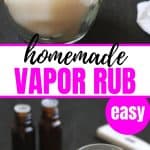
This Homemade Vapor Chest Rub is an affordable, easy recipe that's made with all natural ingredients.
It can help relieve discomfort associated with stuffy noses, coughs, and chest congestion, so you and your family can feel better fast and everyone can get a better night's sleep.
Also, I've put together a child-safe version so you can have confidence you're using a product that's gentler for young children when used properly.

Most of us remember the soothing smell of Vicks from when mom brought it out during cold and flu season. The menthol scent basically kind of makes you feel better just smelling it.
What you might not know, however, is that the ingredients in commercial vapor rubs, while not super toxic, are not the best.
Thankfully, this homemade vapor rub recipe works just as well as “the real thing” and it's made with only 100% clean ingredients.
Making your own natural products is great since you can customize them as needed while choosing better options for ingredients than what's used in most over the counter products.
Our DIY Chest Rub Experience
One night, our youngest son's nose was completely stuffed up. It was allergy season, so a bit of sniffling was normal, but a fully-clogged nose was not.
He was pretty miserable.
I reached for my trusted saline nasal spray and encouraged lots of nose blowing, but he still couldn't breathe well.
I quickly experimented, whipped up a batch of this rub and put some on my son's chest.
About ten minutes later, he was asleep.
Is Vicks Vapor Rub Safe?
The truth is, store bought Vapor Rub isn't great, but it's not worthy of a hazmat suit either.
Compared to spraying glyphosate on your weeds (that's been heavily linked to cancer) and using perfume-laden products Vicks Vapor Rub isn't that bad.
For example, one blogger refers to Vicks as “deadly vapor rub”, but really that's just way too harsh.
However, here are some ingredients in Vicks you might want to avoid by making your own homemade vapor rub instead.
Petrolatum – Derived from petroleum, which is known to be often contaminated with PAHs, which have been classified by the European Union as a carcinogen and are also linked to skin irritation and allergies.
Synthetic Essential Oils – Vicks clearly states that the camphor oil in their product is synthetic. While they claim it's just as effective as natural camphor, it's still, in my opinion, best to avoid that and use pure essential oils instead.

Ingredients
Here's a basic list of the simple ingredients used for this DIY Chest Rub. For the full details and measurements, see the recipe card below.
- carrier oil
- eucalyptus essential oil
- peppermint essential oil
- lavender essential oil
- rosemary essential oil
- tea tree essential oil
- beeswax (optional)
Instructions
Following are the basic instructions for making this chest rub. For more detailed information, see the recipe card below.
Melt the carrier oil, if needed.
Add essential oils and optional beeswax, and stir.
Store in a glass container.
Menthol Crystals and Camphor Oil
While I don't use them in this formula, there are some posts about DIY vapor rubs out there recommending the use of menthol crystals and camphor oil. While you can of course use either of these in your rub, here are a few things to consider.
Menthol crystals are very intense and some people have reported discomfort while using them. If you choose to try them, you would only need to use about 1/8 teaspoon of crystals for this formula. A little bit really goes a long way.
Note that camphor is toxic. Though it's truly only toxic in large amounts, it's still best to use caution, especially with children. You can read more about camphor toxicity here.
How to Use
Of course the typical use for a chest rub is–on your chest! Pretty clever, huh?
It's great to keep in your natural medicine cabinet to help open airways, address and more. However, vapor rub is also known for helping with sore muscles and joint pain, and even more. See this post for more alternative uses for vapor rub.
How to Make a Kid-Safe Chest Rub
Since you're likely going to be using this DIY chest rub on kids, it's crucial to know the following safety information about essential oils use for kids.
The type and concentration of the oils used makes a lot of difference.
Eucalyptus, peppermint, and rosemary are well known for respiratory support, but you have to be very careful using these around young children.
Eucalyptus, rosemary, and peppermint all contain 1,8, cineole, which can sometimes cause problems with the temperature receptors in kids' lungs leading to breathing difficulties. I could get into a lot more details, but here's some basic information.
Rosemary, isn't recommended for kids under 10.
Most forms of eucalyptus (eucalyptus globulus and eucalyptus radiata) aren't considered to be safe for kids, however Eucalyptus Dives is fine, but is harder to find.
Peppermint is also problematic for the above reasons.
Thankfully there are other oils that support respiratory function that can be used for kids, some of which are lavender and lemon. I provided a kid-safe option in the recipe card, but you can make your own knowing the following basic math details.
There are 295 drops in a tablespoon. 3 drops of an essential oil in 1 tablespoon of a carrier oil (replacing the carrier oil) would be a 1% dilution. 6 drops would be a 2% dilution, and so on)
Here are the safe dilution details for different age groups.
Ages 2-5: 1%. Can use up to 3% for short periods of time
Ages 6-9: 2-3%. Can use up to 6% for short periods
Under Age 2: Diffuse only
Best Essential Oils for Vapor Rub
For adults, common options include eucalyptus, peppermint, rosemary, lavender, and tea tree. For kids, I prefer gentler oils like lavender, frankincense, lemon, and tea tree in a very low dilution.

Homemade Vapor Rub with Kid-safe Options
Equipment
- Small Jars
- Small Pan for heating
- stainless steel bowl
Ingredients
Older Child / Adult Version
- ⅛ cup coconut oil (see notes for alternatives)
- 4 drops eucalyptus essential oil
- 2 drops peppermint essential oil
- 2 drops lavender essential oil
- 2 drops rosemary essential oil
- 2 drops tea tree essential oil
- 1/2 tablespoon beeswax (optional)
Kid-Safe Version (Ages 2+)
- ⅛ cup coconut oil (or other carrier oil)
- 2 drops lavender essential oil
- 1 drop frankincense essential oil
- 1 drop lemon essential oil
- 1 drop tea tree essential oil (optional)
- ½ tablespoon beeswax (optional)
Instructions
- Melt the coconut oil (or other solid carrier oil) in a small pan over low heat, if needed. If using shea butter, use a double boiler or alternative.
- Heat until just melted, then remove from heat.
- Allow mixture to cool for about 5 minutes so that it's still liquid, but not as warm. This will allow you to blend the essential oils into the mixture without damaging the oils' healing qualities.
- If using beeswax, stir into the rub after removing from heat.
- Add essential oils and blend well.
- Pour blend into a small glass jar.
- To use, rub mixture on chest or wherever needed.
- Store closed jar in a dark, cool place for up to 1 year.
Notes
- Essential Oil Safety: For children, always use essential oils with caution and proper dilution. This recipe includes a gentler version suitable for ages 2+, but avoid applying near the face, nose, or mouth. For children under 2, do not apply essential oils directly to the skin unless advised by a qualified professional.
- Dilution Guidelines: This recipe uses about 2 tablespoons of carrier oil. For a milder, kid-safe version, use fewer total drops of essential oil. Lower dilution is best for children, especially for short-term use.
- Kid-Safe Oils: Some essential oils commonly used for respiratory support—such as eucalyptus, peppermint, and rosemary—can be too strong for young children. For a gentler option, stick with oils like lavender, frankincense, lemon, and tea tree in small amounts.
- Texture Tips: Beeswax is optional but helps create a thicker, more traditional vapor rub texture. Without it, the mixture will remain softer and more like a balm.
- Storage: Store in a sealed container in a cool, dark place for up to 6–12 months.
I'd love to hear how this works for you!
Actually turpentine has been used for many years (historically speaking) as it has many curative properties. It used to be included in salves & creams for raw, chapped skin as well as for healing sores on the skin, so it’s not as “yuck” as you think! Think pine resin, which it is made from. Herbalists still use some of these ingredients & there is a company (whose name I forget) that still makes it’s age-old salve for chapped hands & such with turpentine in it. I’ve found it to heal very well. After all, a lot of our DIY now are falling back on the ways things were done before modern Western Medicine. Sometimes we forget that with products (such as Vicks) which have been around for a very long time. The camphor, turpentine, menthol, etc. all have curative properties. Vick’s has been around since the 1890’s and was made under the name “Vick’s Family Remedies”, which is exactly what you are doing, yes? Here’s more info on the history of Vick’s
(Link deleted by Whole New Mom due to it not working anymore.)
I love natural remedies and am so happy to find one that replaces Vicks! Can’t wai to try it out! Thanks heaps.
I currently have a sinus and upper respiratory infection I am using YoungLiving Essential oils. I am using Eucalyptus, Raven(blend), RC(blend)Thieves(blend) and peppermint oil. and it is working great!
I do this with Tei Fu oil. It has also worked WONDERS for my asthma. I dilute it with grapeseed oil or jojoba oil, rub on my chest, put a warm moist towel over it, followed by a dry towel and wrap up in my robe. It can have a warming and cooling affect like icy hot and relaxes the chest muscles and makes it so much easier to breathe. I’ve spared myself a few asthma ER visits this way!
Never heard of Tei Fu – what is that??
It is an oil blend and judging by the website I found it has a lot more uses than I would have suspected! This is the link I found with information on it, including an ingredient list:
https://www.theherbsplace.com/product/tei-fu-soothing-blend-100-essential-oils/
Although, now that I’m reading it I feel a little sketchy about it not being used during pregnancy. I don’t know enough about oils to understand but since being pregnant I developed this attitude that if it’s no good for pregnancy and breast feeding chances are, it’s probably not the best product I could be using. I just barely starting to recover from my pregnancy (I was very ill through most of it) so I seem to have paranoia brain about anything that can’t be used during such a sensitive time.
Hi Erin! I know this post was from a while ago, but if you haven’t already found the answer I just wanted to let you know that certain essential oils cannot be used during pregnancy because they could cause contractions, early labor, complications, etc. Stuff that you wouldn’t have to worry about not pregnant. And during breastfeeding the reason is that babies/children can’t handle the same stuff adults can because their bodies aren’t developed enough and whatever we ingest, comes out in breast milk.
I want to caution about using TOO much EO in your blend in small children, it can stop their breathing. With that said this does work well! Also, can I suggest another more affordable option to YL’s oils? I don’t care for their prices or their sales pitch stating you can ingest EO’s safely. A small mom and pop “company” I have been ordering from for years has been really amazing when it comes to prices, quality prices, and customer service. Please check out https://birchhillhappenings.com/. I am in no way affiliated with the company, nor do I get a kickback for naming them. I have just really been pleased as I stated above.
Thanks . I did look at them but I am forgetting now what I was concerned about. I think it was that some of their oils appeared to be priced below wholesale which would likely indicate adulterating. But thank you!
I use YL oils for 3 years now, and love it!
Terpentine- A volatile pungent oil distilled from gum turpentine or pine wood.
it’s natural, and I wouldn’t be afraid to use it on the skin. I like the smell of pine, and even terp. LOL just not alone.
would tea tree oil work
Tea tree would be a great addition. Thanks for the reminder. I need to re do this post!!
Have any of you ever tried Winter Green…VS…..Tylenol…..great for reducing fevers and aches and pains caused by the fever….just rub it all over…..used it since I was a kid, used it on my daughter and she would tell you it works…
Hi Adrienne,
Can you tell me if you ever revised your recipe for the vicks rub. I am interested in making some myself for my family and noticed that you mentioned you were rethinking the recipe. Please post new recipe if you have a new and improved one 🙂
Thank you.
Maggie
Hi Maggie!
I am sorry but I had a recipe picked out that looked super effective. If you need it right away, you can drop me a line at wholenewmom at gmail dot com I’d be happy to share w/ you. I am in the midst of a great search for the best essential oils and will hopefully post after that :-). I will probably revise it but I can give you what I have for now.