
DIY Natural Vapor Rub with Kid-Safe Version
This post may contain affiliate links from which I will earn a commission. Learn more in our disclosure.
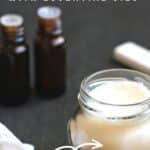
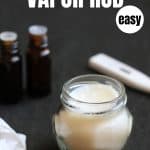
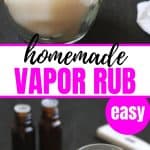
This Homemade Vapor Chest Rub is an affordable, easy recipe that's made with all natural ingredients.
It can help relieve discomfort associated with stuffy noses, coughs, and chest congestion, so you and your family can feel better fast and everyone can get a better night's sleep.
Also, I've put together a child-safe version so you can have confidence you're using a product that's gentler for young children when used properly.

Most of us remember the soothing smell of Vicks from when mom brought it out during cold and flu season. The menthol scent basically kind of makes you feel better just smelling it.
What you might not know, however, is that the ingredients in commercial vapor rubs, while not super toxic, are not the best.
Thankfully, this homemade vapor rub recipe works just as well as “the real thing” and it's made with only 100% clean ingredients.
Making your own natural products is great since you can customize them as needed while choosing better options for ingredients than what's used in most over the counter products.
Our DIY Chest Rub Experience
One night, our youngest son's nose was completely stuffed up. It was allergy season, so a bit of sniffling was normal, but a fully-clogged nose was not.
He was pretty miserable.
I reached for my trusted saline nasal spray and encouraged lots of nose blowing, but he still couldn't breathe well.
I quickly experimented, whipped up a batch of this rub and put some on my son's chest.
About ten minutes later, he was asleep.
Is Vicks Vapor Rub Safe?
The truth is, store bought Vapor Rub isn't great, but it's not worthy of a hazmat suit either.
Compared to spraying glyphosate on your weeds (that's been heavily linked to cancer) and using perfume-laden products Vicks Vapor Rub isn't that bad.
For example, one blogger refers to Vicks as “deadly vapor rub”, but really that's just way too harsh.
However, here are some ingredients in Vicks you might want to avoid by making your own homemade vapor rub instead.
Petrolatum – Derived from petroleum, which is known to be often contaminated with PAHs, which have been classified by the European Union as a carcinogen and are also linked to skin irritation and allergies.
Synthetic Essential Oils – Vicks clearly states that the camphor oil in their product is synthetic. While they claim it's just as effective as natural camphor, it's still, in my opinion, best to avoid that and use pure essential oils instead.

Ingredients
Here's a basic list of the simple ingredients used for this DIY Chest Rub. For the full details and measurements, see the recipe card below.
- carrier oil
- eucalyptus essential oil
- peppermint essential oil
- lavender essential oil
- rosemary essential oil
- tea tree essential oil
- beeswax (optional)
Instructions
Following are the basic instructions for making this chest rub. For more detailed information, see the recipe card below.
Melt the carrier oil, if needed.
Add essential oils and optional beeswax, and stir.
Store in a glass container.
Menthol Crystals and Camphor Oil
While I don't use them in this formula, there are some posts about DIY vapor rubs out there recommending the use of menthol crystals and camphor oil. While you can of course use either of these in your rub, here are a few things to consider.
Menthol crystals are very intense and some people have reported discomfort while using them. If you choose to try them, you would only need to use about 1/8 teaspoon of crystals for this formula. A little bit really goes a long way.
Note that camphor is toxic. Though it's truly only toxic in large amounts, it's still best to use caution, especially with children. You can read more about camphor toxicity here.
How to Use
Of course the typical use for a chest rub is–on your chest! Pretty clever, huh?
It's great to keep in your natural medicine cabinet to help open airways, address and more. However, vapor rub is also known for helping with sore muscles and joint pain, and even more. See this post for more alternative uses for vapor rub.
How to Make a Kid-Safe Chest Rub
Since you're likely going to be using this DIY chest rub on kids, it's crucial to know the following safety information about essential oils use for kids.
The type and concentration of the oils used makes a lot of difference.
Eucalyptus, peppermint, and rosemary are well known for respiratory support, but you have to be very careful using these around young children.
Eucalyptus, rosemary, and peppermint all contain 1,8, cineole, which can sometimes cause problems with the temperature receptors in kids' lungs leading to breathing difficulties. I could get into a lot more details, but here's some basic information.
Rosemary, isn't recommended for kids under 10.
Most forms of eucalyptus (eucalyptus globulus and eucalyptus radiata) aren't considered to be safe for kids, however Eucalyptus Dives is fine, but is harder to find.
Peppermint is also problematic for the above reasons.
Thankfully there are other oils that support respiratory function that can be used for kids, some of which are lavender and lemon. I provided a kid-safe option in the recipe card, but you can make your own knowing the following basic math details.
There are 295 drops in a tablespoon. 3 drops of an essential oil in 1 tablespoon of a carrier oil (replacing the carrier oil) would be a 1% dilution. 6 drops would be a 2% dilution, and so on)
Here are the safe dilution details for different age groups.
Ages 2-5: 1%. Can use up to 3% for short periods of time
Ages 6-9: 2-3%. Can use up to 6% for short periods
Under Age 2: Diffuse only
Best Essential Oils for Vapor Rub
For adults, common options include eucalyptus, peppermint, rosemary, lavender, and tea tree. For kids, I prefer gentler oils like lavender, frankincense, lemon, and tea tree in a very low dilution.

Homemade Vapor Rub with Kid-safe Options
Equipment
- Small Jars
- Small Pan for heating
- stainless steel bowl
Ingredients
Older Child / Adult Version
- ⅛ cup coconut oil (see notes for alternatives)
- 4 drops eucalyptus essential oil
- 2 drops peppermint essential oil
- 2 drops lavender essential oil
- 2 drops rosemary essential oil
- 2 drops tea tree essential oil
- 1/2 tablespoon beeswax (optional)
Kid-Safe Version (Ages 2+)
- ⅛ cup coconut oil (or other carrier oil)
- 2 drops lavender essential oil
- 1 drop frankincense essential oil
- 1 drop lemon essential oil
- 1 drop tea tree essential oil (optional)
- ½ tablespoon beeswax (optional)
Instructions
- Melt the coconut oil (or other solid carrier oil) in a small pan over low heat, if needed. If using shea butter, use a double boiler or alternative.
- Heat until just melted, then remove from heat.
- Allow mixture to cool for about 5 minutes so that it's still liquid, but not as warm. This will allow you to blend the essential oils into the mixture without damaging the oils' healing qualities.
- If using beeswax, stir into the rub after removing from heat.
- Add essential oils and blend well.
- Pour blend into a small glass jar.
- To use, rub mixture on chest or wherever needed.
- Store closed jar in a dark, cool place for up to 1 year.
Notes
- Essential Oil Safety: For children, always use essential oils with caution and proper dilution. This recipe includes a gentler version suitable for ages 2+, but avoid applying near the face, nose, or mouth. For children under 2, do not apply essential oils directly to the skin unless advised by a qualified professional.
- Dilution Guidelines: This recipe uses about 2 tablespoons of carrier oil. For a milder, kid-safe version, use fewer total drops of essential oil. Lower dilution is best for children, especially for short-term use.
- Kid-Safe Oils: Some essential oils commonly used for respiratory support—such as eucalyptus, peppermint, and rosemary—can be too strong for young children. For a gentler option, stick with oils like lavender, frankincense, lemon, and tea tree in small amounts.
- Texture Tips: Beeswax is optional but helps create a thicker, more traditional vapor rub texture. Without it, the mixture will remain softer and more like a balm.
- Storage: Store in a sealed container in a cool, dark place for up to 6–12 months.
I'd love to hear how this works for you!
Great post! You can also get menthol at Mountain Rose Herbs – that is how I make my vapor rub. Menthol, camphor, eucalyptus, bees wax and olive oil (although coconut oil would work fine too.) I love that you are making yor own!
I’ve just recently started reading labels and I am really shocked at what is in them.I use Vicks quite alot but, I have not read its label yet.
I will have to try your chest rub!
Thanks for sharing !!
I am a newbie at using essential oils… when you say “don’t apply directly to skin,” you mean undiluted oils, right? Because the oil-plus-essential-oil concoction gets rubbed directly onto the skin? Just checking… 🙂
Thank you so much for this! We have used Vicks for really bad colds, but I’m glad to have a natural alternative to try next cold season. One question though…I really like that the Vicks has menthol and camphor too, to help ease coughing and throat pain. Are those natural and available, or should I stick to eucalyptus oil?
We also put Vicks (and now, we will use this!) on the soles of our feet – especially for young ones. It works nicely.
You are right about not applying undiluted oils directly to your skin. I will go back and change the post :-).
I saw that Vicks has camphor and menthol as well. You can get camphor in essential oil form (and I plan to do that), but I am not able to find menthol. According to wisegeek.com, menthol is “an organic compound naturally occurring in mint plants. It is also synthetically manufactured. Menthol is widely used in a number of products and features certain therapeutic qualities. It was first isolated from peppermint oil in 1771 in the West, but it may have been in use in Japan for much longer.”
I am going to email two friends who have pretty good essential oil knowledge and find out what they know.
The menthol is in the eucalyptus and the peppermint essential oils. I make this rub using coconut oil and a mixture of eucalyptus, peppermint, and lavendar (which also improves breath and has the added benefit of general calming). Also, when I have a sore muscle or tendon I take a little of this rub, add a few drops of arnica tincture, and rub it on the sore spot. It really makes a difference quickly. Beware, though, that arnica can be an irritant, so use with caution.
Thanks for the recipe. I will definitely be trying this.
I’d love it if you linked this post to my Making a Home linky! 🙂
Linda @ Linda’s Lunacy
https://www.lindaslunacy.blogspot.com
Enjoyed your post on vapo rub. Wanted to also tell you about a natural, organic soap giveaway for bloggers! I am just starting out selling my soap and need some help in the way of reviews. See my blog for details.
https://homemadenaturalsoaps.blogspot.com/
I also have another blog, daily life, health & food you might enjoy reading.
https://mylifeinwhichhehasplacedme.blogspot.com/
Oh…I’m excited to make this! I use Vicks just about every night and always wondered if it would hurt me. Now I’ll just use this…I know it’ll be fine for me! Thanks!
WOW! 🙂 I’m so excited! I need to stock up on essential oils.
Adrienne…Wow, my daughter and I were in the kitchen making our shower gel, body butter and deodorant last night since we needed to stock up! This is timely with the congestion rub. I usually use Badger Balm mixed with eucalyptus and oil of oregano. Your recipe is much less expensive! Thanks. Here is a super easy body butter we’ve had good luck with: 4 T. shea butter, 2 T. coconut oil…just mash them together till mixed well and then add whatever EOs you choose..or keep it plain. Not too greasy and natural and inexpensive, too. Have a great weekend!
I am so glad to have helped! Thanks for the body butter info. Does it stain? Speaking of good timing, I have been meaning to order shea butter (refined, right?) to make my own hard lotion bars. Does your lotion stain?
Also, would you mind sharing your shower gel info? I had a reader ask about that awhile ago when I posted my recipe for homemade foaming soap.
A couple of years ago I read somewhere that if you were coughing a lot at night, schmear Vicks VapoRub on the bottoms of your feet and then put socks on….it would help stop the coughing. It worked! Now I will try this recipe…far better for you, I am sure!
Thanks, Adrienne!
Now…any ideas on what to put on our cats nose? She has had a bad cold the past few days and keeps shaking her head to clear the snot out. Then she licks her poor nose. It is now raw and very tender. I put a dab of chapstick on it earlier…any thoughts?
Hey Cindy!
Try refined shea butter! Lanolin is another option, but some people (and perhaps cats too) don’t do well with it.
I recommend Vicks for balls of the feet
This really does work. I have made this with peppermint. Smearing a small bit under the nose also works well.