
Homemade Sugar-free Marshmallows
This post may contain affiliate links from which I will earn a commission. Learn more in our disclosure.
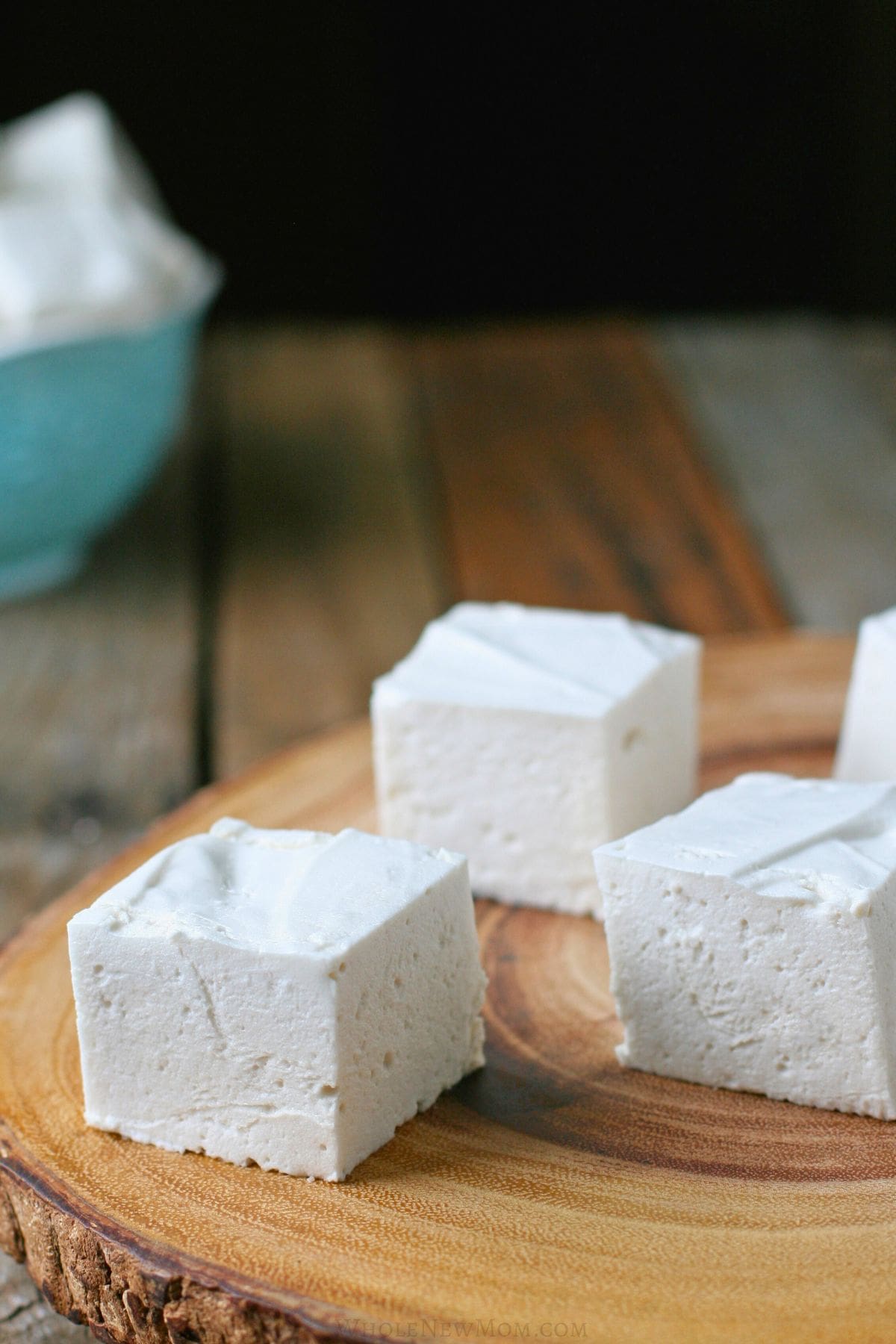
These sugar free marshmallows are light, fluffy, and easy to make. They’re a great alternative to store-bought marshmallows when you want a sweet treat without all the sugar.
They’re perfect for hot cocoa, snacking, or homemade s’mores—and you can adjust the sweetener to fit your dietary needs.

If you’ve ever wondered whether you can make marshmallows without sugar, the answer is yes—and they’re surprisingly delicious.
Making marshmallows at home is also a lot of fun. It’s amazing to watch a simple mixture transform into thick, glossy fluff and then set into soft, pillowy squares that taste even better than the packaged kind.
I love fun treats, but store-bought marshmallows often contain a lot of sugar and unnecessary additives. Making them at home gives you full control over the ingredients.
We used to make these marshmallows with sugar, but now that we've gone low-carb, those days are over. But you can substitute the low-carb sweetener with a regular one if you'd like.
I love making these marshmallows with our sons. What fun to see water, sweetener, and gelatin turn into white fluffiness in a bowl, and then seeing them turn into marshmallows that tasted much better than anything I'd ever bought in a bag.
Why Make Homemade Marshmallows
- Control the ingredients: Skip additives, dyes, and sweeteners you’d rather avoid.
- Lower sugar option: A great alternative to traditional marshmallows when you want a sweet treat without all the sugar.
- Flexible for special diets: Works for low-carb, keto, paleo, and more depending on the sweetener you choose.
- Fun to make: Watching the mixture whip into fluffy marshmallow is part of the magic.
- Perfect for treats: Great for hot cocoa, s’mores, or just enjoying on their own.
- Save Money: Sugar-free marshmallows cost a small fortune. Making them at home is so much less expensive.
We’ve even used these to make homemade s’mores (using homemade chocolate bars), and they were a huge hit with an organic skincare expert and friend who was visiting from Australia. She'd never had s'mores before!

Why This Recipe Works
- Uses allulose for proper structure: Helps create a soft, fluffy texture similar to traditional marshmallows
- No egg whites needed: Keeps the recipe simple and more allergy-friendly
- Balanced liquid ratio: Allows the marshmallows to whip up thick and set properly
- Whips to the right consistency: Creating that classic glossy, stable marshmallow texture
Best Sweetener for Sugar Free Marshmallows
Allulose works best for making sugar free marshmallows because it creates a soft, fluffy texture and allows them to melt and brown more like traditional marshmallows.
If you prefer a sweeter result, you can use an allulose blend (such as allulose combined with monk fruit or erythritol), but the texture may be slightly firmer.
Erythritol alone is not recommended, as it can result in a firmer, less smooth texture.
Frequently Asked Questions
Will These Sugar Free Marshmallows Roast?
Yes—if you make them with allulose, they can actually roast and brown nicely. They do tend to soften and brown more quickly than regular marshmallows, so keep a close eye on them.
Most other low-carb sweeteners will not roast the same way, though they can still get soft and gooey.
Can You Make Marshmallow Shapes?
Yes! These marshmallows work well in silicone molds.
Lightly grease the molds, then spoon or pipe the marshmallow mixture in. Let them set fully before removing.
Can You Use Other Sweeteners?
You can experiment with different sweeteners, but the results will vary.
Allulose typically gives the best texture and roasting performance. Erythritol alone does not work well, so it’s best to start with the sweetener recommended in the recipe.
What Kind of Gelatin Is Best?
Look for a high-quality, grass-fed gelatin if possible. This helps give the marshmallows the best texture, structure, and nutrition.
Substitutions for Special Diets
- Vegan option: Agar may work in place of gelatin, but I haven’t personally tested this version, so results may vary.
- Sweetener options: Different sweeteners can work, but texture and sweetness level will change. See recipe notes for best results.
- Glycerin substitution: Another sweetener may work in place of glycerin depending on the version, but some experimentation may be needed.

Flavor and Coating Variations
It’s easy to customize these sugar free marshmallows with different flavors and/or coatings.
Cocoa Marshmallows
For a light chocolate flavor, add 1–2 tablespoons cocoa powder when mixing in the vanilla. You can also dust the finished marshmallows with cocoa powder for a richer chocolate coating.
Coconut Marshmallows
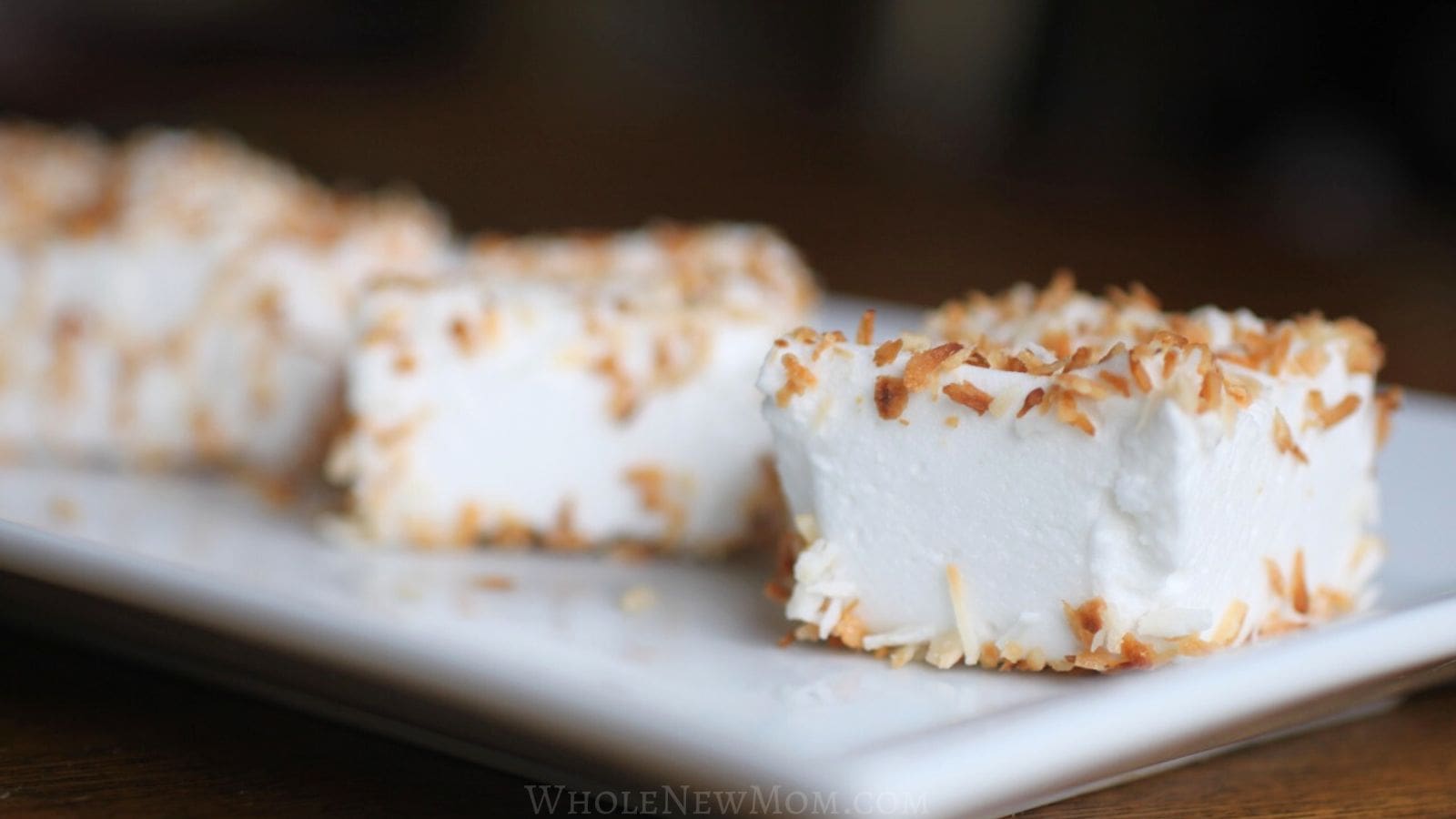
Roll or sprinkle the finished marshmallows with unsweetened shredded or toasted coconut for extra texture and flavor. This works especially well for a slightly firmer, less sticky exterior.
Berry Marshmallows
For a naturally flavored option, grind freeze-dried berries (like strawberries, raspberries, or blueberries) into a fine powder using a spice grinder. Either mix the powder into the marshmallow mixture at the end of whipping or dust it over the finished marshmallows for a light fruit flavor and a nice burst of natural color.
Start with a small amount and adjust to taste, as freeze-dried fruit powders are concentrated.
Powdered Sweetener Coating
Lightly dust the marshmallows with powdered low-carb sweetener to prevent sticking and give them a classic look.
Mixed Coatings
Try combining coatings for variety—some plain, some cocoa-dusted, and some rolled in coconut. This is a fun option for serving or gifting.
Ways to Use Sugar Free Marshmallows
- Add to hot cocoa
- Make homemade s’mores
- Enjoy as a snack
- Cut into smaller pieces for dessert toppings, like on pudding or ice cream, or add to cookies or chocolate bark.
More Homemade Healthy Pantry Recipes
If you like this recipe, you'll likely enjoy these recipes too!
- Powdered Sugar / Powdered Sugar Substitute
- Powdered Egg-Replacer (like Ener-G)
- Homemade Taco Seasoning
- Soft Pumpkin Cookies (these taste amazingly like Enjoy Life)
- Homemade No Bake Almond Joy Bars
These sugar free marshmallows are easy to make with just a few simple ingredients. Do make sure to review the notes below for the best texture and results, especially when choosing your sweetener.

Sugar-free Marshmallows
Ingredients
Instructions
- Add the cold water to a large mixing bowl. Sprinkle the gelatin evenly over the top and let it sit for 5–10 minutes to bloom.
- In a small saucepan, combine the allulose and hot water. Heat over medium heat, stirring until fully dissolved. Continue heating until the mixture reaches 240–245°F (soft ball stage).
- With the mixer running on low speed, slowly and carefully pour the hot mixture into the bloomed gelatin.
- Increase speed to high and beat for 8–12 minutes, until thick, glossy, and fluffy. The mixture should hold its shape and form soft peaks.
- Mix in the vanilla extract (and salt, if using).
- Beat on high until the mixture form stiff peaks (almost like beaten egg whites).
- Pour the mixture into a lightly greased or parchment-lined 8×8 pan, or into molds. Smooth the top quickly, as it will begin setting fast.
- Allow the marshmallows to set at room temperature for several hours, or until firm. You can refrigerate to speed this up, but avoid freezing.
- Cut into squares using a greased knife. If needed, lightly dust with powdered sweetener or starch to reduce stickiness. Dusting with cocoa powder will do the same and will add nice flavor as well.
- Store in an airtight container and try to keep your kiddos out of them!
Notes
- Use allulose for best results: It creates the softest texture and allows the marshmallows to melt and brown more like traditional ones.
- Whip until thick and glossy: The mixture should hold its shape before transferring to the pan.
- Work quickly: Marshmallow mixture sets fast once whipped, so pour it into the pan or molds right away.
- Grease well: Lightly oil your pan, spatula, and utensils to prevent sticking.
- Let fully set: Allow to set in mold or pan for several hours for best texture and clean cutting.
Nutrition
Nutritional information is provided as a courtesy and is an estimate only. It may vary depending on ingredient brands, substitutions, and preparation methods. Optional ingredients are not included. Net carbs are typically calculated by subtracting fiber and sugar alcohols (such as erythritol) from total carbohydrates. This information should not be relied upon for medical or nutritional purposes.
Tips for Perfect Sugar Free Marshmallows
- Use the right sweetener: Allulose gives the best texture and allows the marshmallows to brown when roasted. Other sweeteners may not perform the same.
- Whip long enough: The mixture should become thick, glossy, and hold its shape. This is key for that classic fluffy texture.
- Work quickly: Once whipped, the mixture sets fast, so transfer it to your pan or molds right away.
- Grease everything well: Marshmallow mixture is very sticky—lightly oil your pan, spatula, and even your hands if needed.
- Let them fully set: Give the marshmallows enough time to firm up before cutting for clean edges.
Are you a S'more or marshmallow lover too?
I’m sorry but I don’t “get” the instructions for making sweetener substitutions and would appreciate your help in figuring out the amount of sweetener I need to use and the amount of water for the substitute sweetener I need to use. In this marshmallow recipe I want to use a granulated sweetener from Wheat Free Market called “Virtue”. It is a mixture of monk fruit extract and Erythritol. It is 4 times as sweet as sugar. So, 1/4 cup Virtue is equal to 1 cup of sugar. Is the 1 1/2 cup of granulated sweetener in the recipe the same as 1 1/2 cup of sugar which means I would substitute 6 Tablespoons of Virtue sweetener for it? I also want to substitute granulated Virtue sweetener for the 1/2 cup liquid sweetener in the recipe. Is the 1/2 cup liquid sweetener in the recipe the same sweetness as 1/2 sugar meaning I would use 2 Tablespoons of Virtue sweetener? Would this substitution necessitate any increase in the amount of water I would need to use? Thank you for your help.
I see that I made a boo-boo in my post above. The sentence about the liquid sweetener, should read: Is the 1/2 cup liquid sweetener in the recipe the same sweetness as 1/2 cup sugar meaning I would use 2 Tablespoons of Virtue Sweetener? Sorry for the confusion.
No problem :).
I don’t think you need to change the liquid for a marshmallow recipe. I made these w/ stevia and I don’t think we altered anything. Maybe try a small batch and see :).
Hi!
I tríed making these tonight. First put cold water and gelatin together to bloom. Then in a saucepan I put rice syrup and stevia together with hot water. Got it up to 240 and still didn’t see it turning into the soft ball stage. Let it rise to 250 still nothing. I waited it out for a bit but never seemed to get it. So I added them together and hoped for the best. Guess I was t lucky. What did I do wrong? It’s just a liquid consistancy. Thanks!
Hello there. Did you try making the marshmallows regardless of what it looked like?
Yes I did. They turned oUt to be marshmallow flavored jello 🙂
What can I change for next time?
Hi there. I’m sorry that happened to you. Perhaps just take it off the heat when it reaches 240. I wonder if the excessive heat caused a problem.
Could I use the honey in place of the liquid sweetener, and if so would I use less honey and add water to make it thinner?
I don’t think you need to add water but you can use the honey. Enjoy!
do you think you could use silicone molds to make them? Or would it stick too much?
I think that would work. Let me know if you try! You could coat them with a topping first if you like.
I got all excited when I saw this recipe for vegan marshmallows, but was very disappointed when I saw that the first ingredient was gelatin.. Gelatin is not vegan! It is made from the bone marrow of cows. No thank you. I will keep looking.. You do have some great recipes th Hough.
Hello Helena. Thanks for commenting. I added agar as an option so should be fine now. Thanks again – I had noticed that before and got sidetracked and didn’t finish it.
Oh! Thank you so much!! I will definitely try them now!
This recipe is a total dud. I’ve made regular marshmallows many times, as well as ones where I leave the corn syrup but sub in Splenda or erythritol in for the granulated sugar (Splenda tastes much better and no bloating). I tried this recipe exactly as stated using Splenda for the granulated sugar with the vegetable glycerine for the liquid, accept adding a pinch of salt as recommended by Alton brown. The vegetable glycerine, besides being quite bitter, is much much sweeter than sugar. The marshmallows turned out sickeningly sweet, and slightly bitter, which were inedible. I’m a huge fan of sweet deserts and have eaten chocolate frosting from the can, so “too sweet” is not something you’ll normally hear me say.
I tried again using an extra half cup Splenda instead as instructed as an alternate for the liquid sugar. The flavor was much better. However, you need to add about a 1/2-1/4 cup extra water since your not using a liquid sugar. And, while the mixture did heat up to 240 with the vegetable glycerine, it does not go past 200 with just Splenda. The first time I tried, leaving the pot covered, the water ended up boiling off without ever getting hotter than 200 and I had to start over.
Thirdly, most recipes with 3 packets/tbsp gelatin for this amount of water which I believe works better.
Lastly, do not try mix-ins like peanut butter powder or cocoa powder which work well with the regular or reduced sugar marshmallows. The volume drops to about half after adding anything in and doesn’t return.
Ultimately, I’ll be going back to the corn syrup/Splenda marshmallows. Even the best version of the sugar free marshmallows was not at all satisfying, while the ones with corn syrup are very close to real.
Hi Anna. I’m so sorry you felt that way. Can I ask, however, don’t you think that real marshmallows are also too sweet? As for Splenda, I am very concerned about the health issues that I have read about that sweetener – they are a big red flag to me, plus did you notice that there are sweeteners in there that are an issue for diabetics? I know several diabetics who have had diabetic symptoms after eating Splenda.
Sorry again – we do like this recipe albeit that they are too sweet. But to us, so are regular marshmallows. Thanks and hope to hear back from you.
Hi Adrienne, thanks for the reply. I don’t find regular marshmallows or the ones I make with corn syrup and Splenda to be too sweet, but the one with glycerine to me was inedible. I didn’t realize when I initially made it that glycerine still has a ton of calories. My primary concern is keeping sugar/calories down and your recipe would definitely be better for diabetics, so that may explain our differing opinions. Maybe not a bad recipe, just not what I was looking for! Sorry to judge so harshly initially.
You are so welcome. Apology accepted. So – to be clear, you made them with only glycerine?
I made the recipe using erythritol as the granular sugar substitute and liquid sucralose as the liquid (12 drops=1/2c sugar). They came out very sweet and grainy. I have some pure powdered stevia, but it leaves such a bitter aftertaste. I also have some powdered erythritol. I wonder if that would take away the graininess. Anyway, I need to try this vegetable glycerin. That is a new one on me, but my online research shows it is most popular with the vaping crowd.
Yes, powdering should help -sounds like it didn’t dissolve. I’m not recommending vaping, but glycerine is helpful for desserts that don’t feed candida.
Thanks for the recipe. I will have to try it. I don’t have a stand mixer, so I hope my ancient hand mixer will do the trick. As for a low carb, gluten free “graham” cracker, here is a recipe I came up with that worked really well. I used my food dehydrator to get them to the “cracker” state, but you may be able to do it in the oven at very low heat for a couple of hours.
Ingredients: 2 cups golden flax meal, 1/2 t salt, 1 t cinnamon, 1 c sugar equivalent (I use liquid sucralose), 2 T coconut oil (kind that is liquid at room temp.), 1/2 c (or a bit more) water, 5 large eggs.
Directions: Mix dry ingredients in medium mixing bowl. Beat liquid ingredients in a separate bowl until well mixed. Mix wet and dry and stir well. Let sit about 5 minutes while oven preheats to 350 Degrees F. Line a cookie sheet with parchment paper. Spread batter onto paper as evenly as possible, pushing all the way to the edge. Bake at 350 for 25 minutes. When cool, cut into cracker sized pieces. Place on food dehydrator at 145 degrees F for a few hours until they reach a cracker-like crispness. Store in air tight container.
Thank you!!!
About how long did you have to beat the mixture for it to form peaks?
About 10 minutes. Enjoy!
Can this marshmallow mixture (non-sugar) be used in Krispy Treats?
YES! We’ve done it many times. Enjoy!