
Vegetables You Can Regrow in Water (What Works and What Doesn’t)
This post may contain affiliate links from which I will earn a commission. Learn more in our disclosure.

Did you know you can regrow some vegetables in water using scraps you’d likely normally throw away? It’s a simple way to reduce waste and stretch your grocery budget—but it’s important to know that it's not quite as magical as it sounds.
In this post, I’ll show you which vegetables actually regrow in water, how to do it, what to realistically expect, and how to make it work better (including some things most people don’t tell you).
Some vegetables regrow much better than others, and I’ll show you which ones are worth trying first.
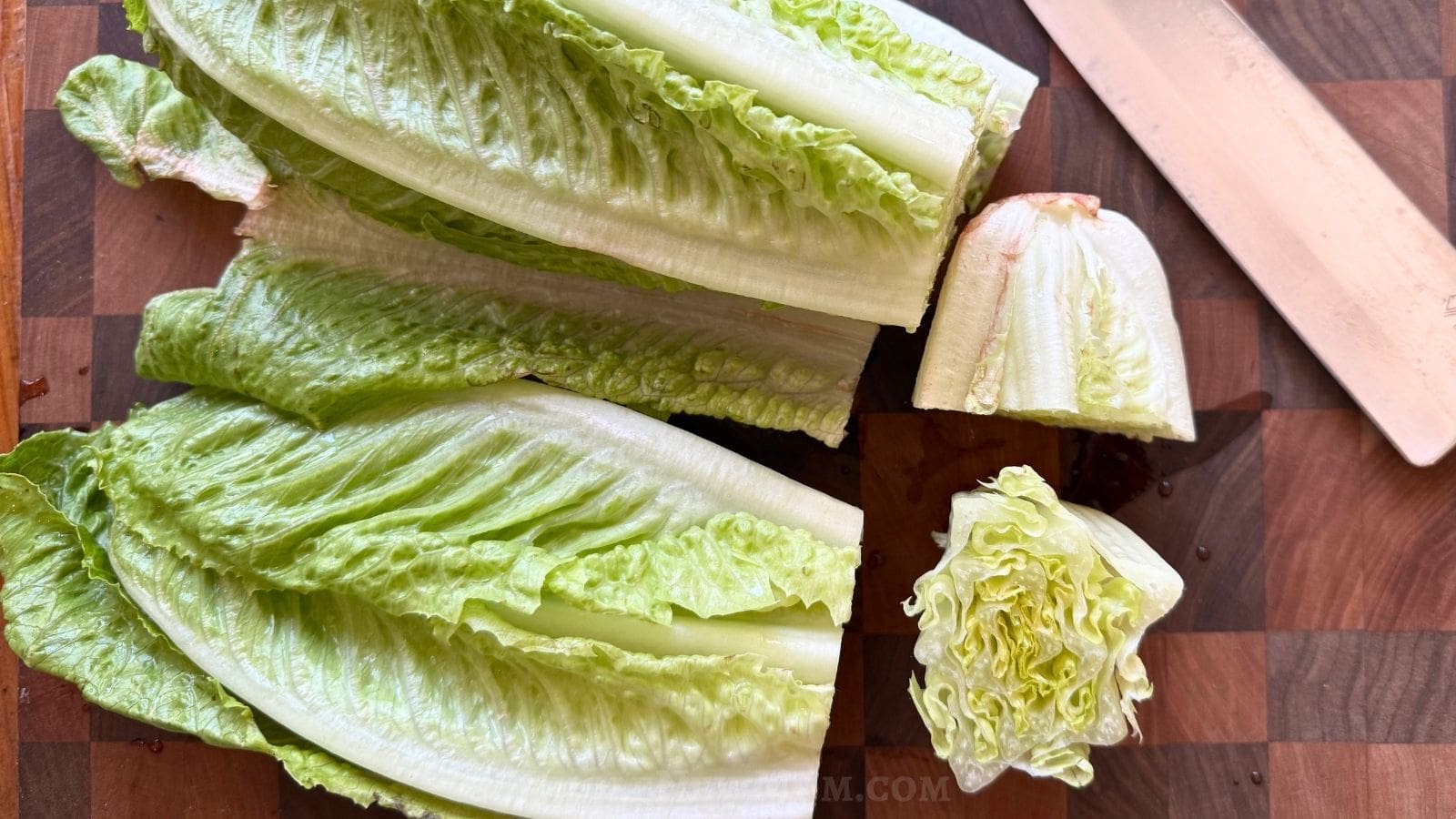
Growing your own food is a great way to save money on healthy groceries, but not everyone has the space or the green thumb to have a big garden.
Here are the ins and outs of a very simple garden you can start in your kitchen, from literal kitchen scraps! And all you need is a few bowls, some light and water.
Vegetables You Can Regrow in Water
You can regrow these vegetables in water from kitchen scraps:
- Lettuce (romaine works best)
- Celery
- Bok choy
- Cabbage
- Fennel
- Leeks
- Lemongrass
- Green onions (also called scallions)
- Garlic (for greens, aka scapes, only)
Other onions (like red, white, and pearl onions) can also grow green shoots in water, though they won’t regrow a full onion bulb.
Easiest Vegetables to Regrow in Water
Some vegetables regrow more easily than others. These are the best ones to start with:
- Green Onions
- Lettuce
- Celery
- Bok Choy
These vegetables are some of the easiest to regrow in water because they grow from a central base. When you cut off the bottom, the growing point is still intact, allowing new leaves to form from the center.
Their base stores energy that helps push out new growth more quickly than other plants.
Since these are mostly leafy vegetables, they don’t require a full root system to begin growing again, which makes them especially well-suited for simple water regrowth.
Green onions are especially great for beginners because they regrow quickly and can often regrow multiple times.
What to Expect When Regrowing Vegetables in Water
This is where many guides leave things out, but understanding these limitations will help you get better results.
Most vegetables will not fully regrow.
In many cases, you’ll only get partial growth—like new leaves or shoots rather than a full plant.
Lettuce regrows from the center only.
When regrowing lettuce, only the inner leaves will continue to grow, so you’ll typically end up with about half a head rather than a full one.
Some vegetables produce greens, not the original vegetable.
For example, carrots won’t regrow into new carrots, but they'll instead grow leafy tops that can be used to make pesto, chimichurri, or can be sauteed.
Growth slows over time.
Even with the best care, most vegetables will only regrow once or will produce smaller yields after the first round.
Water alone has limited nutrients.
Since plants normally get nutrients from soil, growth in water will likely be slower or less robust unless additional nutrients are added.
How to Regrow Vegetables in Water
Here are the simple steps to regrow any of these veggies in water.
- Cut 1–2 inches from the root end of the vegetable
- Place root end of the vegetable in shallow water
- Keep leaves above water
- Set near sunlight
- Change water every 1–3 days
- Transfer plants to a larger container or into soil if you want continued growth beyond the initial regrowth stage
Lettuce Regrowth Timeline
Here's what you can expect to see when regrowing romaine lettuce in water.
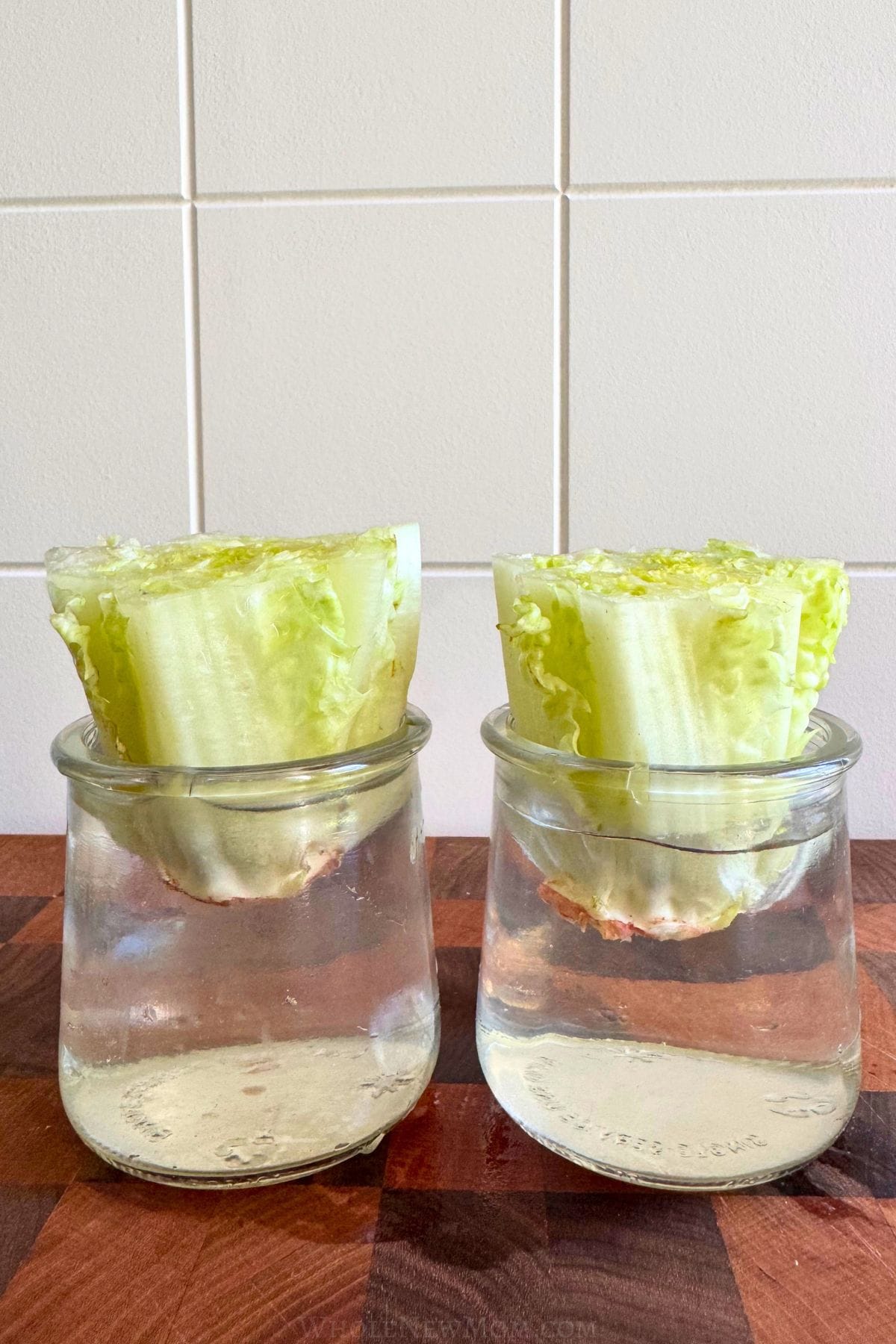
Day 1
Freshly cut romaine bases placed in water.
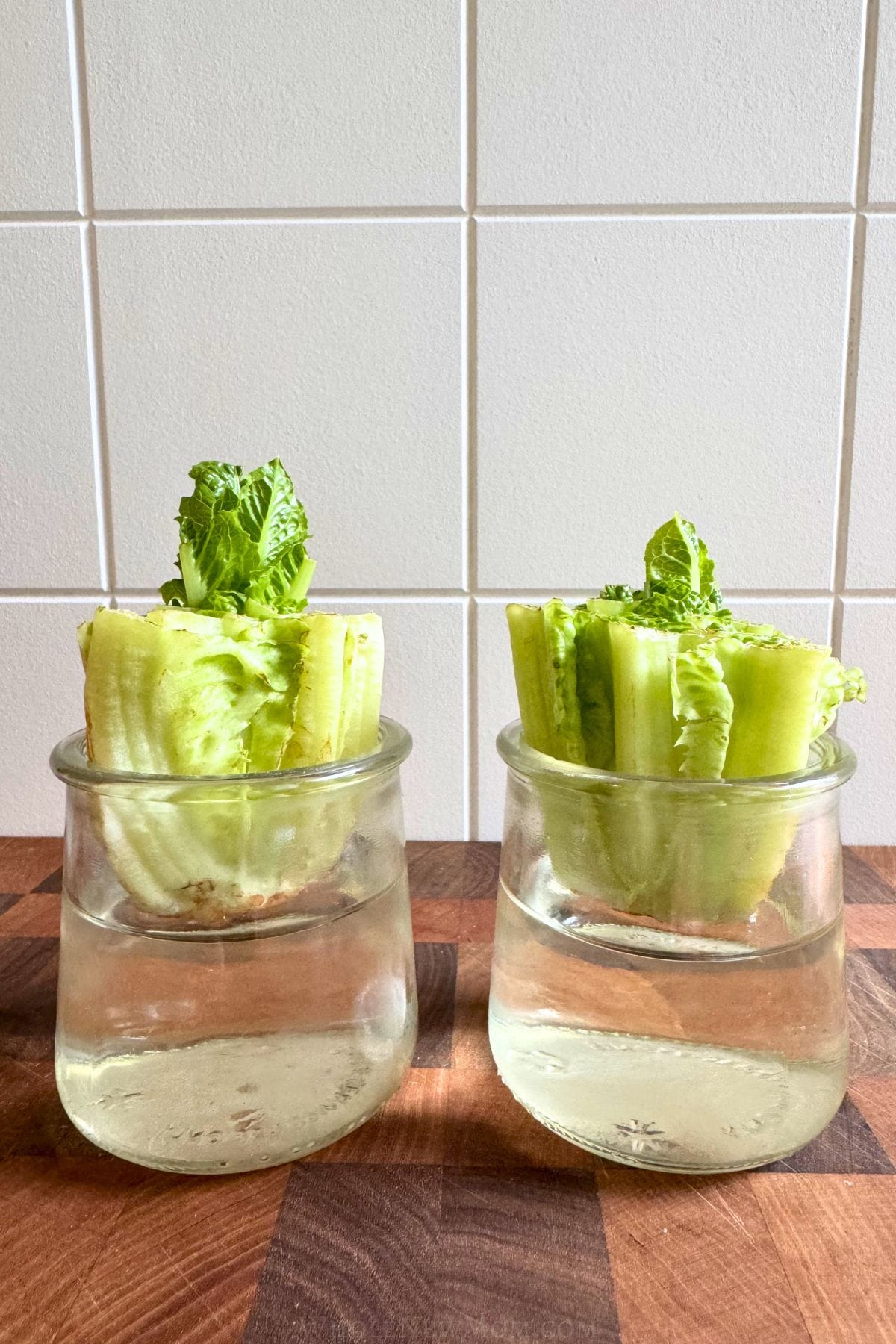
Day 4
Small new leaves begin emerging from the center.
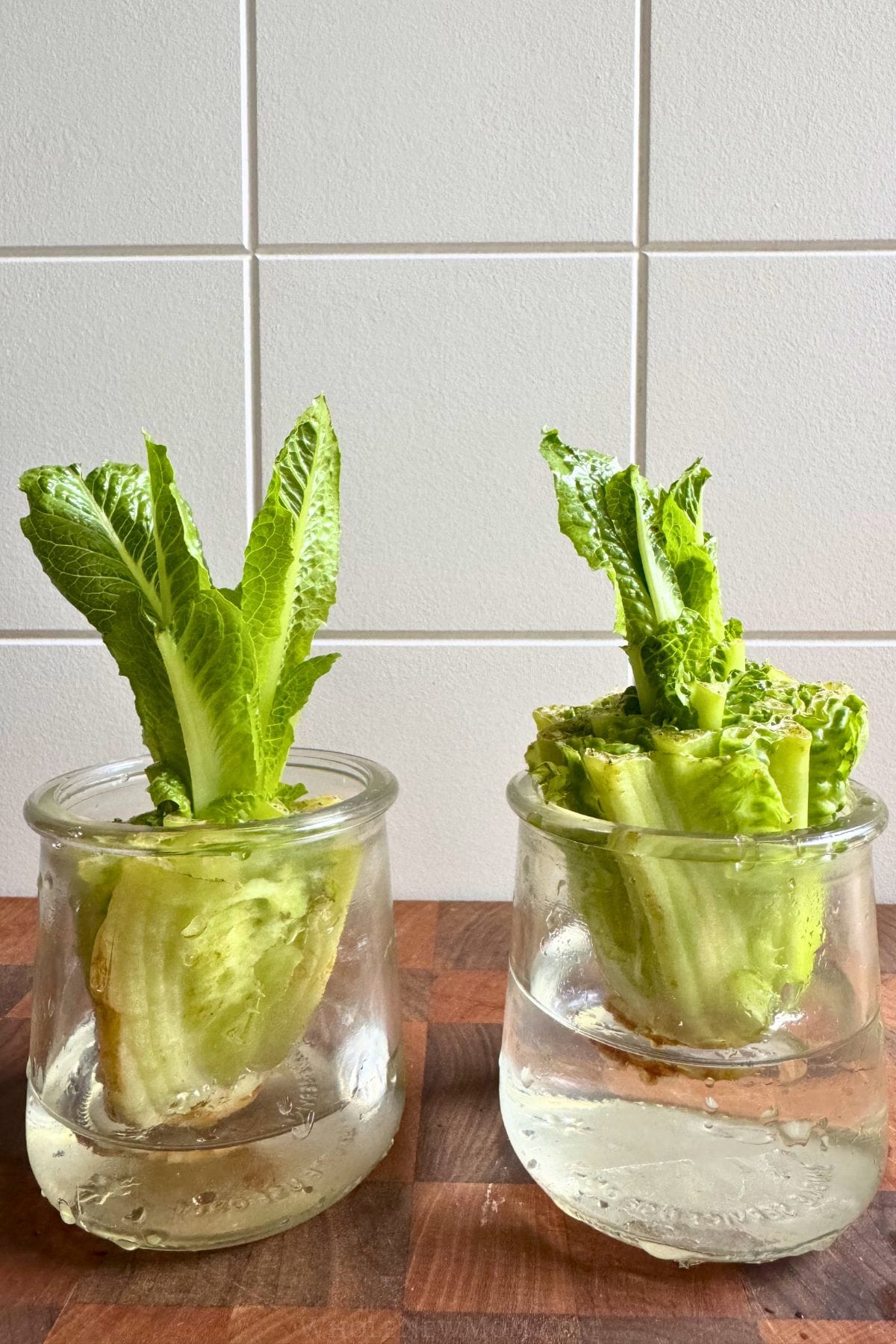
Day 8
Noticeable regrowth from the center of the lettuce base. The outer leaves did not regrow, which is why lettuce typically produces only a partial head when regrown in water.
Should You Add Minerals to the Water?
While vegetables can regrow in plain water, it’s important to remember that plants naturally rely on minerals from soil to grow well.
Because of that, regrowth in water alone is often slower or produces smaller results, and may not be as nutrient-rich as produce grown in soil or with added nutrients.
Some people choose to add a small amount of nutrients to the water, such as diluted fertilizer, hydroponic nutrients, or trace mineral drops to the water. While this may help support plant growth, my own experiment did not show an obvious difference, though I only tested this on a small scale.
However, I do think that using filtered water is an obviously better choice than using tap water.
More Frugal Gardening Tips to Help You Save Even More
- Save Money Starting Seeds
- 14 Ways to Get Free Plants for Your Garden
- 27 Tips for Gardening on a Budget
I'd love to hear how this works out for you!
I am growing lettuce and celery in my kitchen window. It is doing great.
I need to try this. Thanks for the reminder.
Seriously?! This is crazy! I’m going to try this. Thanks so much for sharing 🙂
Unbelievable, huh? Hi Trisha!
I have been trying this ever since you posted this blog. imine have been getting slimy and don’t grow very high, maybe one of the bunch will grow a couple of inches if that. maybe due to being in the hot arizona or too much water? any tips? thx!
Hi Kim! I haven’t run into this issue before, but my best guess would be the combination between heat and moisture causing additional growth. I live in a very temperate climate, but an increase in temperature makes all of my indoor growths (fermentations included) a bit more slimy. Maybe try to find a cooler spot, in the shade, using less water or maybe putting an ice cube in the water can help!
Kim, I have the same problem and I live in Wisconsin! We’re certainly not too hot here! I’ve never been able to re-grow anything in water, and have had minimal success regrowing in soil. As much as I would love to do this, I think I’ll have to stick with seeds! Great idea for those who can pull it off, though!
I’m definetly going to try this with celery and leeks. You’ve inspired me! Thanks!
You’re welcome Suzanne!
I love the idea but unfortunately don’t have a good windowsill or counter space near a window. Do you think this could work outside? If anyone has tried it, any precautions to be aware of?
Hi Jennifer,
You could certainly do this outside! A spot with protection from extreme weather elements, i.e. too much wind, too cold, etc., and the average garden pest would be great. Also check the water more frequently since warmth from the sun may cause a quicker rate of evaporation. Good luck! ~Tiffany
Thank you.
Hi Adrianne,
I loved this article and wondeirng if I can re-post it on my site (with links and credit of course)?
I would also like to send you a copy of my video set “Grow Your OwnGroceries” to review. Drop me an email with your address…
Thanks
Marjory
Hi there. I am open to an excerpt but not the whole article as that will impact SEO. Google doesn’t like duplicate content on the internet. Most likely your SEO would be the one impacted the most but please don’t do it anyway. I’ll try to get to you later – thanks!
Thank you so much, several ??? I had about other plants to regrow besides my Romaine lettuce were celery,onions,cabbage-woohoo. I am growing Romaine right now in several glasses at different stages. I have to say it is exciting and rewarding. Ditto on another comment where collecting the water from shower/bath before the water gets hot works with little or no effort at all. I really enjoy finding and reading ways to be green and eco :0)
Thx for commenting. Be careful about that shower water though….tap water is filled with icky stuff. Check out my link in the post :).
Yes indeed, that is what were looking into-whole house-fluoride and chlorine filtering 🙁 we have a filter undersink and icemaker/w/o fluoride and chlorine total 0% or at least 90% and are heavily researching for the best whole house that does all that’s needed. We rely heavily on reviews of systems and want the best filter. It’s mind boggling yet the research will continue. Thank you for the heads up, so far I just water outside plants with it. I also rinse my glass coffee/tea carafe with filtered water and keep for outside plants, water from container from celery kept in frig-it all adds up. :0) Any helpful info on personal happy with there filter system would be much appreciated and most welcome.
I have a Cl filter but not whole house Fl. I have info on the company I like in my Water Safety post. There’s a link in this post :).
It’s fun to regrow food and while it may save a little money I’d be concerned about the nutrient content of plants growing only in water. I think that is why you can only regrow them one time. The inner leaves probably use up any nutrients left in the outer leaves, then all is depleted. You may end up with more nutrient rich veggies if you stick it in a pot of good soil after you see roots appear or just put it in the soil from the start and keep moist. I’ve done it the latter way.
Hi Gay,
You make a good point on the nutrient content. If I remember correctly hydroponic farms add water-soluble nutrients in order for their plants to grow with relatively the same nutrients as those grown in soil. If I had a garden or even a pot with soil then transplanting it would be ideal. However, for those where that simply isn’t an option (like me), water will just have to do.
I also consider though how many nutrients could come out of a single green onion or a single half-head of lettuce fully grown in soil in comparison. I’d venture to say that none of us are expecting to get a large number from that single item anyway, and since you’re really only eating that half a head of lettuce every six weeks, regrowing in water is more of a fun (and free) way to get just a bit more bang for your buck. 🙂
Yes, that’s right. I was looking into hydroponics and found you could buy the nutrients or make them yourself. So that’s one thing you could add in if you want.
I love it! the pic of the 1/2 size grown lettuce head looked like it had dirt in it. do u transplant it into dirt at some point? thx!
Thanks Kim! The picture showing the larger cup is still in water… just dirty water. 😉
I started the bottoms of green onions in a cup about two weeks ago. Now they are almost 7″ tall. It’s really amazing. I also started romaine lettuce, celery, and leaf lettuce. The Romaine and celery are slowly growing (about 2-3″), but the other lettuce is doing well. I finally put the onions in some potting soil and I think they’re doing much better.
Wow – neat!!!
I am so going to try this. I have romaine in my fridge right now…
Thanks!!
Anything to save a few cents here and there 🙂
I hope to try it with celery – can’t wait!