
Is Borax Safe?
This post may contain affiliate links from which I will earn a commission. Learn more in our disclosure.

Borax is recommended for a lot of DIY “green cleaning” products around the house, but is borax safe? In this post, we'll cover the basics about borax safety so you can make a more well-informed decision about whether or not to use borax or borax containing products in your home.
When I was a brand-new mom, I thought I would save our family money by using a non-toxic laundry detergent recipe.
Laundry explodes when you have a family, especially a little one who spits up a lot. And if you are using cloth diapers? That's a whole other story.
I had quit my job to become a stay-at-home mom and my husband was a PhD student which meant very little income and lots of tightening of the budget.
One way I worked hard to save us money was by making my own laundry detergent. I tried a few formulas including liquid and a powder made with Fels Naptha soap, and more.
However, along the way, I started hearing concerns about borax safety and wondered if I was causing myself and my family harm with my laundry DIY projects. The more I researched borax, the more confused I became. Some sources treat it like a dangerous poison, while another seem to think concerns were completely overblown.
Borax Safety Ratings
Though it's not perfect, EWG is a one place that many natural-minded people turn to evaluate the products that they make or use.
Upon checking the safety of some of the ingredients in my homemade detergents, I got an unwelcome surprise.
A D!? Yikes! What's even worse, EWG used to rate borax with an F!
Let's talk about what borax first.
What Is Borax
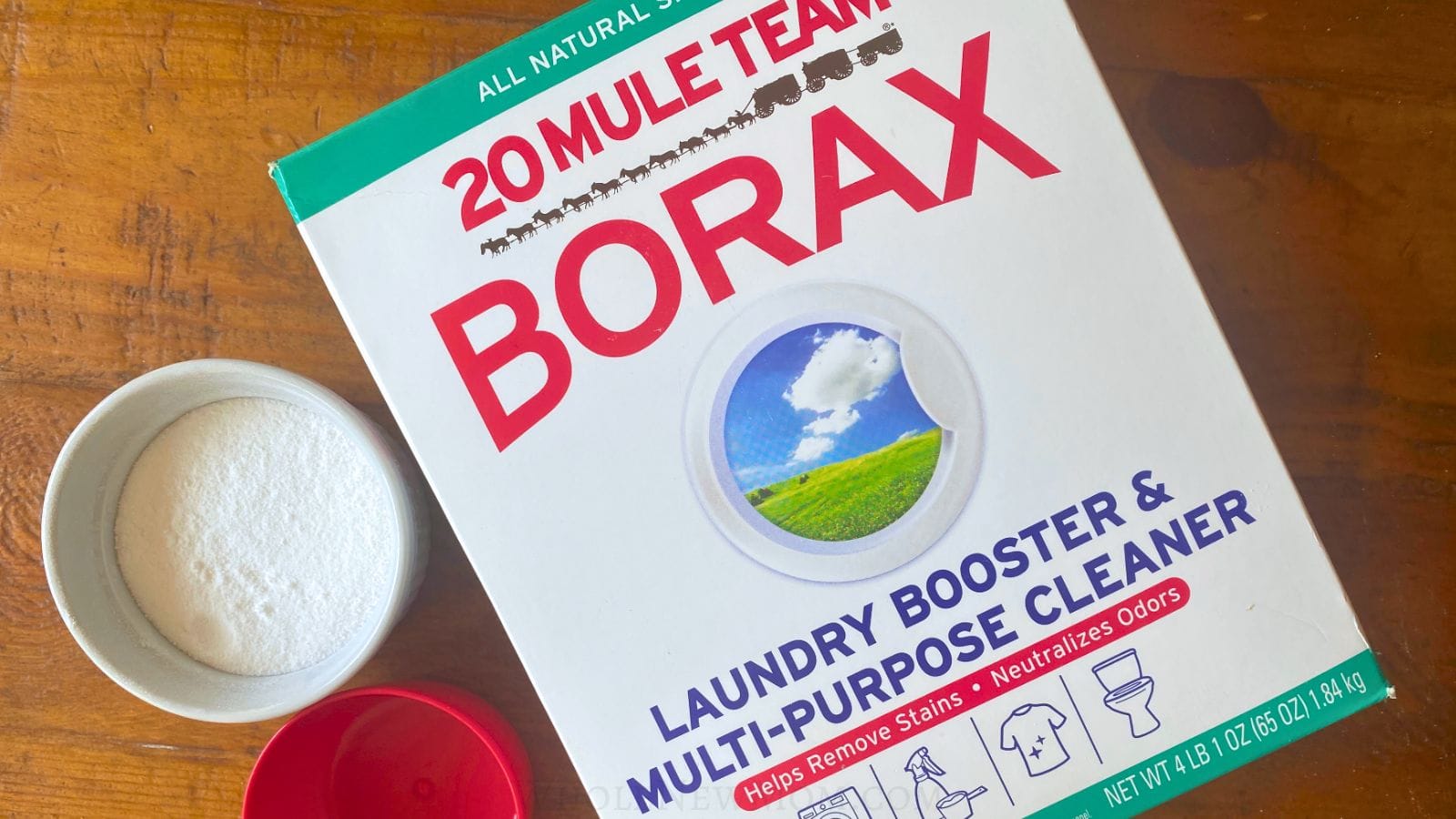
Borax is a naturally occurring mineral compound made primarily of sodium, boron, oxygen, and water. Its proper chemical name is sodium tetraborate.
Borax is mostly sold as a white powder and has been used for decades in laundry products, household cleaners, and some industrial applications.
Borax is related to boron, a naturally occurring element found in soil, water, and certain foods. However, borax and boron are not the same thing chemically. Borax contains boron in the form of borate compounds.
When dissolved in water, borax forms borate compounds in solution. Its alkaline nature and water-softening properties are part of what make it effective for cleaning and deodorizing.
Borax vs. Boron: What's the Difference?
Boron is a trace mineral found in foods and supplements. Borax is a mineral compound that contains boron along with sodium, oxygen, and water. Although related, they are not the same thing, and much of the confusion surrounding borax stems from discussions about boron's potential health benefits.
Why Does Borax Work?
Borax is highly alkaline, with a pH of around 9–9.5, which helps it break down grease, deodorize fabrics, and improve cleaning performance.
One reason borax is used in laundry is because it softens hard water. Minerals in hard water can interfere with detergents and leave residue behind, while softened water allows soaps and detergents to work more effectively.
Borax is also often used to help address odors, mildew, and buildup in laundry and washing machines or in damp or mold-prone areas of the home. Some people spray diluted borax solutions on surfaces as part of temporary mold-cleaning routines because borax is alkaline and has mild antifungal properties.
That said, I don’t consider borax a complete solution for significant mold problems or ongoing moisture issues, which need to be addressed at the source.
In addition, borax has mild insecticidal and antifungal properties, which is why it has historically been used in some pest-control and mold-cleaning applications.
Borax Safety Concerns and Precautions
While borax itself is not generally classified as a carcinogen, some regulatory agencies in Europe have raised concerns about reproductive and developmental effects from boron compounds at certain exposure levels.
Borax is also considered a skin and eye irritant, and breathing in the powder can irritate the respiratory tract.
Most concerns about borax safety relate more to repeated exposure and ingestion than to occasional household use.
Why Does EWG Give Borax a Poor Safety Rating?
One reason borax creates so much debate in natural-living circles is that organizations like the Environmental Working Group (EWG) give it relatively poor safety ratings.
These ratings are largely based on concerns about irritation, ingestion risk, and animal studies at certain exposure levels.
Some critics argue that EWG ratings occasionally blur the distinction between hazard and real-world exposure. In other words, a substance may be capable of causing harm under some conditions without necessarily posing the same level of risk during normal household use.
Personally, I think borax is one of those products where context, exposure, and how it’s actually used matter a lot.
Is Borax Safe for Laundry?
Borax has been used for laundry purposes for decades and is often an ingredient in homemade laundry detergents because it can help soften water, reduce odors, and improve cleaning performance.
Many people use borax in laundry without problems, particularly for musty towels, heavily soiled fabrics, or washing machines prone to mildew and odor buildup.
Borax is generally considered color-safe for most washable fabrics when used appropriately, although delicate materials should always be spot tested first.
Because borax is powdered, one of the main practical concerns is avoiding unnecessary dust exposure while handling it.
Why I Use Borax for Laundry
One reason I use borax in laundry is because washing machines—especially front loaders—can develop mold, mildew, biofilm, and persistent musty odors over time.
I’ve found borax helpful for odor issues, laundry buildup, and fabrics exposed to damp or mold-prone environments. I typically dissolve it in hot water before adding it to the wash.
Is it Safe to Ingest Borax Water?
Some people in natural health circles use very small, diluted amounts of borax as a source of boron, often calculating doses to match typical boron supplement levels.
While this approach is based on the fact that borax contains boron, borax itself is not intended or studied as a dietary supplement.
One important note about DIY borax water ingestion protocols is that concentration, dilution, storage, and consistency can vary widely, making it difficult to know exactly how much exposure one is getting over time.
Now, I don't personally think that every natural or traditional practice needs perfect standardization or expensive clinical testing to have value, and I can understand the reasoning behind using very small amounts of borax water as a boron source. However, some of the higher-dose or escalating intake recommendations that are sometimes promoted online give me pause.
Personally, I prefer moderation and obtaining boron primarily from food or supplements intended for consumption.
Common Questions About Borax
Is borax non-toxic?
Borax is often marketed as a more natural cleaning ingredient, but the term “non-toxic” can sometimes be misleading. While borax is generally considered lower risk than many harsh chemical cleaners when used properly, it can still irritate the skin, eyes, and lungs and should not be ingested.
Is borax safe for laundry?
Borax is commonly used in laundry to help with odors, stains, and hard water issues. Many people use it safely for their laundry, though it’s still smart to avoid breathing in the powder while handling it.
Is borax environmentally friendly?
Borax is a naturally occurring mineral and is sometimes considered more environmentally friendly than certain synthetic cleaning ingredients. However, “natural” does not automatically mean harmless, and large amounts of boron compounds can affect plants and aquatic environments.
Is borax carcinogenic?
Borax is not generally classified as a known human carcinogen. Most safety concerns around borax relate more to irritation and potential reproductive or developmental effects at certain exposure levels.
Is borax safe for colored clothes?
Borax is generally considered color-safe for most washable fabrics when used appropriately, though it’s always best to test delicate fabrics first.
Is Borax Safe? My Personal Conclusion
After researching borax more thoroughly, my own view has become more nuanced than simply labeling it “safe” or “unsafe.”
Borax isn’t the extremely dangerous substance it’s sometimes made out to be—but I also don’t think it should automatically be considered completely harmless simply because it’s natural.
Like many household ingredients (and most other things in life) context matters:
how it’s used, how much exposure there is, and whether basic precautions are taken.
I’m personally comfortable using borax for laundry and some household cleaning purposes, while still being mindful about handling it carefully.
For me, the most sensible approach is neither fear nor blind trust, but informed and thoughtful use.
I'd love to hear your thoughts about borax after reading this post.
Thank you so much for this post. This was a big question for me, I am a chemist and researched detailed. For my baby and my family I don’t prefer to use borax. I love soapnuts and soapworts.
This is good news, actually – because I can’t seem to find Borax where I live. So I do grated soap and washing soda for my detergent and it works quite well. Thank you for sharing the health aspects of Borax.
I’m so glad you sent this… After researching for months on “flea-remedies”… Borax sprinkled on the carpet & left for 30 minutes or so, then vacuumed up looked interesting! NOW, I will rethink that as 3 of my fur-babies are cats & they keep their tongues so busy grooming, I’d hate for this TOXIN to be ingested at all!!! It is in a baggie in the kitchen & will probably wind up in the GARBAGE since I have septic that wouldn’t like it either… All I can say is “perfect timing”!
God bless!!
I really wish this would crash and burn. There have been discussions bout this all over the net. There is an excellent article here ; (Link deleted by Whole New Mom due to it not working anymore)
make sure you read the comments for the people that had worked in those mines most of their lives with no problems.
There is a LOT of articles that don’t take much to find. Comfrey is exceptionally good for many reasons and yet the government said it does harm to your liver. Do the research and you will find that it just isn’t so. I have been using it and consuming it forever and I am still here to talk about it. It is excellent animal fodder as well and my animals will tell you that.
I take borax for pain and have for year and I am not dead. Yes, borax. You NEED this mineral in your body. You can take this cheap version or pop for it at the health food store. There are so many WONDERFUL natural remedies that have been unjustly vilified and borax is no exception. EWG is trying to pound a tack in with a sledge hammer.
You want to bash something that is killing everyone? Pick on SUGAR! It is FAR more toxic than borax and is in darned near anything consumed. It has killed FAR more people through disease than borax ever has. It would be great if the scare mongering would stop but I doubt it will.
Water is toxic if consumed in high enough amounts! There was a radio station in California several years ago that had a contest to drink as much water as you could to win a video game station. One woman did it to win one for her kids and now that woman is 6 feet under and her kids have no mother. Look it up. The DJ’s were fired and the story is out there.
Borax is a wonderful MINERAL and it cleans well and safely. It never hurt my kids or me or my mother or my grandmother. If you need to worry about something harming your health, then sugar is definitely the thing to worry about.
By the way, if one does the research on commercial detergent, you would find borax in most of them as well. it’s just hidden better because it IS so insanely cheap.
The sky is not falling people. Let’s stop beating this dead horse. Where is the evidence that this supposedly harmed, maimed or killed people?? I have not seen a single head line about how people have been hurt by this but you can see the evidence of sugar doing harm EVERYWHERE! Just look under diabetes and obesity and cancer. They are always in the headlines and that is just a few problems it causes.
I do agree with you, Cindy, that sugar is causing so much harm. Just imagine how much healthier people – especially in the US – would be without consuming so much of it!
Thank you Cindy for your words and posted sites! They were exactly the ones I was going to post. I have known people who have cured themselves from Lupus, depression, candida, psoriasis and all sorts of problems with borax. And honestly, if people fear it… they can certainly take the homeopathic of Borax. (As for Comfrey, the government only bashed comfrey because a man in California overdosed on it and ruined his liver. What the news failed to mention was that this man had liver disease and liver failure in the first place… and was taking obscene amounts of comfrey to try to heal his toxic liver. ) I think Borax and Comfrey are incredible and I applaud you for speaking you mind. We are all entitled to our feelings of course, but I think others would do well to read the sites you posted.
I’m curious, Joyce and Cindy … do you swallow a spoonful of Borax? Or mix it in a glass of water?
Hilary,
If you read the links that Cindy posted, you wouldn’t even have to ask that question. Just sayin’.
The Borax Conspiracy is a very good read!
Hilary, Whatever you do, don’t digest Borax. I found Cindy’s message to be so aggressive and unusually defensive of Borax. It sounds like she invented the stuff or is a paid agent.
And she went on and on and on defending it. Alarm bells!
As Joyce said…Thank you Cindy for your posted words and sites. I too believe in Borax, and have used it as a pain reliever for arthritis. It seems to me that Hilary’s comment/questions after your posts were stated in a “mocking” manner. That doesn’t seem too “of God” to me. Praise our Lord for the freedom of speech and the right to choose what we put in our own bodies. OH BTW I have used it for fleas, insects, and laundry too! 🙂 What it does to fleas, is basically dry them up by drawing out their body moisture due to the amount sprinkled on them. Who says GOD didn’t give us natural minerals to use for multiple purposes when used by a variety of doses?!!! GOD IS SO GOOD!!
I didn’t feel that Hilary was mocking at all – and I am pretty careful about that kind of stuff. I am sure she will be back to respond. Thanks for stating that you felt that way Cheri, but I don’t think it was the case.
Adrienne was right … I wasn’t mocking, but wasn’t exactly sure how else to word my question. I am sincerely curious if you take a sodium borate supplement or just Borax. While we’re on the subject, I’ve also been curious if it’s a home remedy or something your physician has prescribed. Again, these aren’t mocking questions, but honest and sincere ones. Since I’ve never heard of anyone consuming Borax, I’m very curious.
Thank you for posting this information and your choice to not use Borax. I’ve avoided it, sitting on the fence only because I couldn’t find a consensus about it. I also have settled for a dye-free, fragrance-free, blah blah blah detergent that I can find in our organic-friendly grocery store. This might be one of those things for which there is no perfect answer. But you have affirmed my hesitance to go the Borax direction. Thank you.
Bull…..ony! I seriously doubt anyone sits that and consumes the stuff or dumps it on their body and leaves it there. I’ve NEVER heard of anyone overdosing or getting chemical burns or dying from BORAX!
Let’s be nice “B”. I agree there is some murkiness here. But it appears EWG might be caught up in it as well. Let’s keep talking.
It’s a good thing that too much Borax doesn’t cause death or chemical burns! Remember, it’s only known to irritate eyes and skin … and the European Union has found a potential link between sodium borate and birth defects.
For me, the hazard has nothing to do with responsible, rational adults who know how to use a cleaning products – it’s all about kids and pets. Just like I would be careful to keep hazardous cleaners – if I used them – out of the reach of my children or animals, I also would keep Borax away.
The only thing wrong with borax is that it is insanely cheap and no one can make any money off it. It has a lower toxicity than table salt! Look it up– table salt is more toxic and more damaging to reproductive organs in high doses. Many people consider it a health remedy and it has been used as a cure for candida and arthritis. I understand you can even buy it in tablet form(boron). I have a feeling that asking the EWG’s opinion about borax is about the same as going to your doctor and asking about high cholesterol. They mean well I guess…
I’m not suggesting anyone take it internally, but I definitely will keep cleaning my house with it.
I’ll be interested to hear what Hilary has to say about this. What grade does salt have from EWG? Not that I think EWG is perfect about everything.
It’s important to note that Borax is NOT boron, Julie … it’s sodium borate.
I do agree that table salt would be toxic and damaging in high doses … but isn’t just about everything? Ingesting too much water is harmful, and drinking too much white vinegar, another common cleaner, would definitely cause a lot of harm. Like I wrote in the post, Borax certainly is safer than bleach. And I know that some health-conscious individuals will gladly clean with it, but others may choose to avoid it.
I absolutely agree with you that Borax is cheap, but so is washing soda … and the EWG gives that natural cleaner an A rating.
I just don’t think it is appropriate to be scaring people about reproductive harm etc etc when those studies required rats to ingest large amounts of something as toxic as salt. Do you hide the salt from your children? Creating a hazard score is a good way for the EWG to scare people but in your reply you admit that it is all in the dose. Used in the proper way there is exactly 0% chance borax will hurt you. And it is very effective. I started reading this blog because I thought that it would provide a broader perspective. Before citing one source as the definitive answer maybe you should investigate the other side first? Or write about both sides and let the reader decide?
Actually, I do keep salt away from my children. I learned the hard way, after my toddler poured out an entire container of table salt I had used for cleaning on our kitchen floor. Since then, I’ve switched over to cleaning system where I don’t have any cleaning products in my home (I only use Norwex cloths and tap water).
I’m sorry you didn’t feel my post encouraged readers to decide for themselves – I truly hoped that it would. After cleaning with toxic cleaners for most of my life, I fully embraced green, homemade cleaners – but I had wrongly assumed that these homemade remedies were completely safe. (As we both know, I could write posts questioning the safety of cleaning with white vinegar or table salt. And maybe, someday I will on Accidentally Green.) That’s why the insecticide aspect of Borax came as such a shock to me. I wanted to share with others who might also have similar assumptions as I did.
Thanks for the insightful post!
Thank you so much for this information. I used to clean with borax as well. I don’t anymore based on a lot of the information you covered. I’m glad there are safer options for our households with kids.
I’ve wondered about Borax for a while and really appreciate that you shared EWG’s findings on it! I hadn’t realized it received an F and really trust their findings. Thanks again!
Given that so many people trust it as a natural cleaner, the F rating is pretty surprising, isn’t it!?
So what do we do for laundry detergent? I want to make my own but now I don’t know what is the healthiest and cheapest way to do it. Any suggestions?
~K
This is what I do but Hilary will get back to you as well. https://wholenewmom.com/whole-new-budget/why-i-dont-make-my-own-laundry-detergent-a-super-sale/
Kierstyn, I agree with Adrienne. I also use Soap Nuts and they are completely natural, safe and fairly affordable. But I also love using Molly’s Suds … they receive an A ranking from the EWG, and they’re also affordable. I’m averaging about 6 cents a load on Molly’s Suds, and five years ago my homemade detergent cost 4 cents a load.