
How to Soak Nuts and Seeds (Step-by-Step Guide)
This post may contain affiliate links from which I will earn a commission. Learn more in our disclosure.

Wondering how to soak nuts and seeds properly and why you might want to do it? This post shares the simple steps to a traditional way to improve digestibility and address phytic acid in nuts and seeds. Here’s exactly how to do it, a soaking time chart, and an explanation of the benefits.
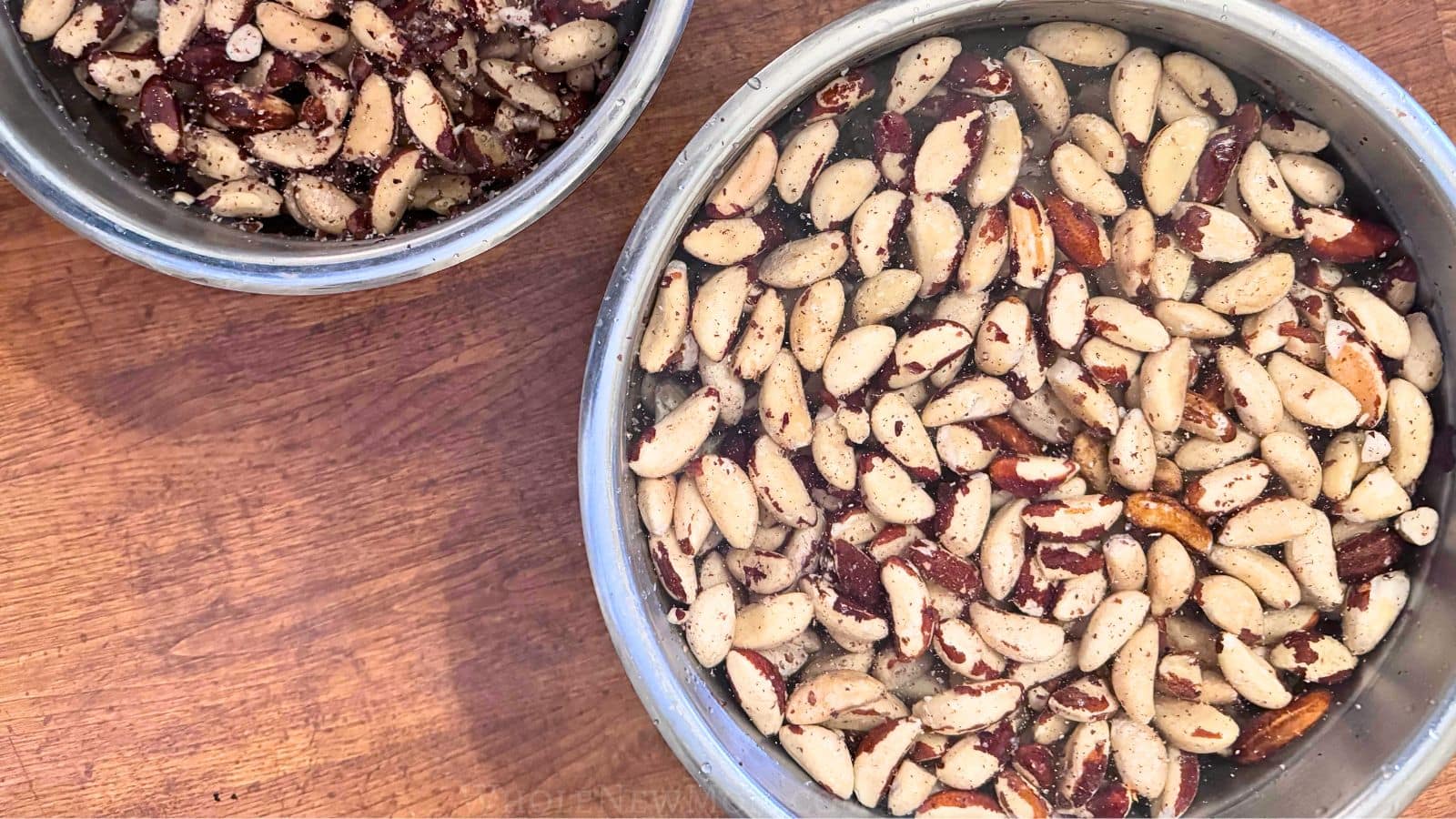
I've been soaking nuts and seeds for years since I learned about the likely benefits. During that time, I've heard that it might not be as beneficial as I originally thought, but the soaked nuts are lighter and crispier, the touch of salt is just perfect, and they taste fantastic.
So the truth is, regardless of the benefits, I'll keep soaking our nuts and seeds no matter what.
Do You Need to Soak Nuts?
Good question and the short answer is: not always—but it can help in some situations.
Soaking nuts is often recommended to reduce compounds like phytic acid and make them easier to digest. However, there's more research on the benefits of soaking grains and beans than on soaking nuts, and not everyone notices a difference.
Here’s a simple way to think about it:
- You might benefit from soaking nuts if:
- nuts feel hard to digest
- you eat them frequently or in large amounts
- you’re following a traditional foods or gut-healing approach
- You might not need to soak nuts if:
- you tolerate them well
- you eat them occasionally
- you prefer the convenience of using them as-is
In other words, soaking nuts isn’t essential—but it can improve texture and digestibility for some people. And it definitely improves taste.
If you do want to soak nuts and seeds, it's super easy to do so. Here's how.
How to Soak Nuts and Seeds (Quick Method)
Here's all you need to do to soak your nuts and seeds.
- Put nuts or seeds in bowl
- Cover with water (filtered preferred)
- Add salt (optional. Salt enhances the soaking procedure and gives your nuts great flavor.)
- Soak
- Drain
- Dehydrate
Soaking Times for Nuts and Seeds
Use this quick chart to find the right soaking time for various nuts and seeds.
| Nut / Seed | Soaking Time | Notes |
|---|---|---|
| Almonds | 8–12 hours | One of the longest soaking times |
| Walnuts | 4–8 hours | Softer, don’t over-soak |
| Pecans | 6–8 hours | High fat, moderate soak |
| Hazelnuts | 8–12 hours | Longer soak improves texture |
| Brazil nuts | 4–6 hours | Shorter soak works well |
| Macadamia nuts | 2–4 hours | Very soft, don’t over-soak |
| Cashews | 2–4 hours | Can get slimy if over-soaked |
| Pumpkin seeds | 6–8 hours | Common for soaking |
| Sunflower seeds | 4–6 hours | Shorter soak is enough |
| Sesame seeds | 4–6 hours | Small, soak less time |
Soaking times aren’t exact—different sources recommend slightly different ranges. In practice, anything within these time frames works well.
Note that chia and flax seeds should not be soaked this way. Instead they are used as egg substitutes and are mixed with water right before using. Flax seeds are usually ground before mixing to make flax eggs while chia seeds can be used as chia eggs either whole or ground.
Special Notes About Cashews
Cashews are a bit different from other nuts. In their raw state, they contain naturally occurring undesirable compounds in the shell that are removed during processing, which is why cashews are typically sold pre-treated.
Because of this, they’re already ready to eat as-is and don’t behave the same way when soaking.
When soaked:
- they soften very quickly
- they can become slimy if soaked too long
- they don’t dry into a very “crispy” texture
- If you choose to soak cashews, keep the soaking time short—about 2–4 hours is usually enough.
Why You Should be Soaking Nuts and Seeds
- It helps with digestibility
- It's easier and takes less time than you think
- They just plain taste better this way!
Nuts and seeds are a wonderful addition to your diet. However, they can also be a bit rough on your stomach. That's because they contain phytic acid and enzyme inhibitors that may make them harder to digest for some people.
For some people, soaking nuts can make them easier to digest and improve texture. While it’s not essential for everyone, it’s a simple step that many find helpful.
When seeds and nuts are planted in the ground, the warmth and moisture in the soil around them break down their skins so that they can germinate and grow into plants. Likewise, soaking nuts and seeds breaks down the encasing of these great sources of energy and make the nutrients more available.
Most of the time spent soaking and dehydrating is hands-off time. You just put the seeds or nuts in a bowl, transfer them to the dehydrator (or oven), and then take them out when dry.
What About the Soaking Water?
After soaking, the water may look cloudy. That’s normal—it can contain small amounts of natural compounds from the nuts along with fine particles from processing.
Some people prefer to rinse nuts after soaking to remove this residue. Others skip this step, especially if they are drying the nuts afterward.
In my experience, both approaches work. I usually skip rinsing for simplicity and flavor.
How to Dry Soaked Nuts
After soaking, drying the nuts is what gives them that crisp texture and helps them store well.
Spread the soaked nuts in a single layer on dehydrator trays or baking sheets. If you're drying seeds, they can be piled a bit more since they dry faster than larger nuts.
Dry at a low temperature until completely crisp. In a dehydrator, this is typically around 115–125°F. Drying time varies depending on the type of nut, but most take anywhere from 12–24 hours (sometimes longer).
You can also use an oven set to its lowest temperature. Just keep in mind that ovens tend to run hotter and may not dry as evenly.
So while you don't need a dehydrator to dry soaked nuts, it's a much easier way to do it than using an oven. In my post about the benefits of dehydrating I share a lot of tips including how to choose a dehydrator that meets your needs.
Notes and Tips
- Temperature control is one way in which the dehydrator is a much better option than the oven. Typically the lowest temperature for an oven is high enough to destroy the enzymes in the nuts/seeds, therefore diminishing their healthful qualities. However, if you're not ready to invest in a dehydrator, using your oven is a great starting point.
- Dehydrator Temperature. There is debate about what temperature to dehydrate at to preserve the enzymes in your food. For now, I am comfortable with 125. I am not an ardent raw foodist, and after researching this I found that the temperature of the food in most dehydrators is significantly below the temperature of the air around it. Thus, if the setting of the dehydrator is 125, your food temperature is almost certainly in the raw food range which is 115 or below.
Roasting Nuts and Phytic Acid
Roasted nuts are popular because they taste great—but roasting and soaking are not the same thing.
Roasting may reduce some compounds like phytic acid and can make nuts easier to digest. However, it’s unclear how much of a difference it really makes, and results vary depending on temperature and cooking time.
In contrast, soaking is designed specifically to help break down enzyme inhibitors and support digestibility before drying.
Another thing to consider is how store-bought nuts are processed. Many “roasted” nuts are actually cooked in oils, which may not be ideal depending on the type of oil used (most often they are cooked in seed oils).
If you enjoy roasted nuts, a better option is to roast them yourself at a lower temperature. This gives you more control over both the ingredients and the process. Nuts can be more prone to going rancid when roasted at higher temperatures (source). Also, roasting almonds at a higher temperature causes almonds to form a significant amount of cancer-causing acrylamide (source).
Should You Soak Nuts Before Roasting?
If you plan to roast nuts, you may wonder if soaking them first is worth the extra step.
There isn’t strong evidence comparing soaking vs. roasting directly. However, soaking and drying nuts first is a simple way to support digestion—and it gives you flexibility.
You can:
- eat them as “crispy nuts” after drying
- or roast them afterward for additional flavor
In my experience, soaking first and then roasting gives the best balance of texture and digestibility.
How to Use Soaked & Dried Nuts aka “Crispy Nuts”
- Eat them plain
- Make Homemade Nut or Seed Butter
- Make Nut or Seed Milk – Here's the Easiest Almond Milk Ever
- Make a healthy trail mix.
- Yummy Chocolate / Carob Nuts.
I'm sure you'll agree that your nuts and seeds are much tastier and lighter than before. You will never go back again.
This simple method works for most nuts and seeds. See the soaking chart above for specific timing.
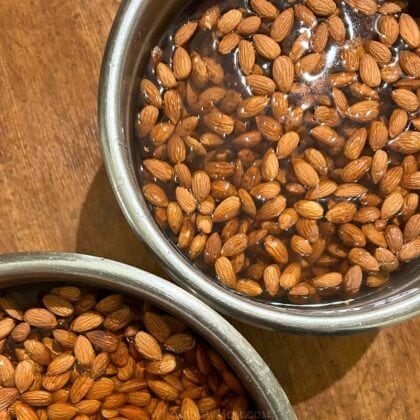
How to Soak Nuts and Seeds (aka – How to Make Crispy Nuts)
Ingredients
- 4 cups nuts or seeds
- water
- 2 teaspoons salt
Instructions
- Add nuts or seeds to a bowl. Use about 4 cups, or whatever amount fits your dehydrator.
- Cover completely with filtered water.
- Add salt.Use about 2 teaspoons salt per 4 cups of nuts or seeds.
- Soak for 7–12 hours (overnight works well).
- Drain (and rinse if desired).
- Spread in a single layer on dehydrator trays or baking sheets (nuts should be in a single layer, whereas seeds can be piled slightly).
- Dry at low temperature: Dehydrator: ~125°F Oven: lowest setting
- Dry until completely crisp. Cool and store for later use.
Notes
- Salt Amount: Some sources recommend different salt amounts for different nuts/seeds. I just keep it simple and use the same for all of them.
- Cashews: Soak only 2–4 hours—they soften quickly and can become slimy.
- Seeds dry faster: Pumpkin, sunflower, and sesame seeds may be slightly piled on dehydrator trays whereas nuts should be dried in a single layer.
- Drying tip: Nuts should be fully dry and crisp before storing to prevent spoilage.
Nutrition
Nutritional information is provided as a courtesy and is merely an approximation. Optional ingredients are not included and when there is an alternative, the primary ingredient is typically used. We cannot guarantee the accuracy of the nutritional information given for any recipe on this site. Erythritol carbs are not included in carb counts since they have been shown not to impact blood sugar. Net carbs are the total carbs minus fiber.
More Food Preparation Posts
Like this post? Here are some more you'll likely enjoy:
I'd love to hear how the soaking and drying works for you!
What about soaking seeds and nuts that you bought already roasted and salted? Can or should we soak those?
That wouldn’t be a help since roasting addresses phytates, but roasting isn’t necessarily a good idea since roasting may alter and damage polyunsaturated fats in nuts that can lead to oxidation.
Thanks for the article. FYI the setting on the Excalibur dehydrator is the food temp with surrounding air temp being warmer. So a 125 setting is what your food is at. This is according to their website.
Thank you so much! I can’t believe I never knew this and I could swear I talked to them about it but not 100% sure. Editing the post now!
I only knew because I have recently been researching soaking nuts. I have had an Excalibur for years and used it for garden produce. Soaking nuts is new to me so I am happy to see your crispy nuts recipe. Can’t wait to give it a try! Thanks.
I’m sooo happy you shared this. Soaking will change your life LOL. Please do let me know how it turns out for you! Someone told me recently that her excalibur caused her food to mold. I have no idea how. I have been interested in other machines but I don’t see how that happened.
Is cashews when soak a good choice for a plant base milk
Actually cashews don’t need to be soaked bc they are all heated to remove toxins, but they do make a delicious milk–I think I covered that in the post? They are higher in carbs, though, than other nuts.
What’s your take on cashew milk I soak the nuts in refrigerator overnite and then drain and rinse before blending
Hi there – what would you like to know?
Thanks for this post. Since reading an earlier version of this post and another from Dr. Axe which echoed a similar theme I’ve been soaking and roasting various nuts and seeds. This has coincided nicely with many seeds being a byproduct to my change in diet…lots of squash seeds: pumpkin, butternut, etc. that I salvage and then soak and roast. The cloudiness of the water after an overnight soak is convincing in and of itself. The crud at the bottom of a bowl of cashews soaking for 12 hours was…shall we say…enlighting.
I’ve found that it takes a good 3 hours to roast cashews in my oven at the minimum 170F.
Another benefit of home soaked & roasted nuts is that you do not need to use oil, or otherwise can avoid the not so good for you sunflower, canola, safflower, etc. oils,
Great point–just added it to the post :).
Can you maybe give an estimate for say a regular size almond that you buy in the store? I have no idea at all for any kind of dehydrator drying time. I would like to try soaking and drying. I do have a 9 drawer excalibur and I will use the 125 degree time. I have a manual timer so I will have to check the time on my own..Thanks for your help!
Hi there. Denser nuts take longer – almonds, macadamias, and brazil nuts take a good amt of time. Some say 12-24 hours but I have never had them done in 12 at 125 degrees. I think it’s taken us well over 24 hours each time at that temperature. Hope it works well for you. I would just set the timer for longer and then go and check. This is one reason I don’t have a timer on our current dehydrator is that I didn’t think it was worth the extra money as things vary so often.
How long should the nuts be in the oven?
I am not sure how long it takes – I always use the dehydrator and it varies by size.
Nice dear!
Hi- do you recommend soaking and drying for “raw” nuts or for those labeled as “roasted” or both?
Hi there. It doesn’t really make sense to soak roasted nuts b/c roasting technically reduces the anti-nutrients as well. But it can create free radicals so I prefer eating non roasted nuts when possible. Hard to know what to do b/c people bake with almond flour (including me sometimes).