
Best Non-Toxic Homemade Laundry Detergent
This post may contain affiliate links from which I will earn a commission. Learn more in our disclosure.

Looking for the best non toxic homemade laundry detergent recipe that actually works? This easy powdered DIY laundry detergent is natural, effective, HE-safe, and made without artificial fragrances or harsh chemicals.
It’s easy and inexpensive to make and helps reduce unnecessary toxins in your home.

Why You Should Make Your Own Detergent
If you're like me, you care about your budget, your family's health, and the environment. When thinking about healthy living, it's easy to focus heavily on diet, but it's crucial to think about your home as well.
Because things that come into contact with the outside of your body are just as important to healthy living as the things that you put inside your body.
And think about it. You wear clothes 24/7, so what you wash them in matters!
I've tried out all kinds of homemade laundry detergent formulas over the years but was never really happy with them. In fact, you can read in this post about Why I Stopped Making Laundry Detergent.
Literally, I stopped trying and switched to a natural brand I liked, and also tried soap nuts, but unfortunately, the brand was discontinued, and my son and I seemed to develop a rare allergy to soap nuts so back to the drawing board of formulating a DIY Laundry Soap I went.
And now we have a winner!
This recipe makes a powder detergent, which I personally prefer over the mess of liquid laundry detergent.
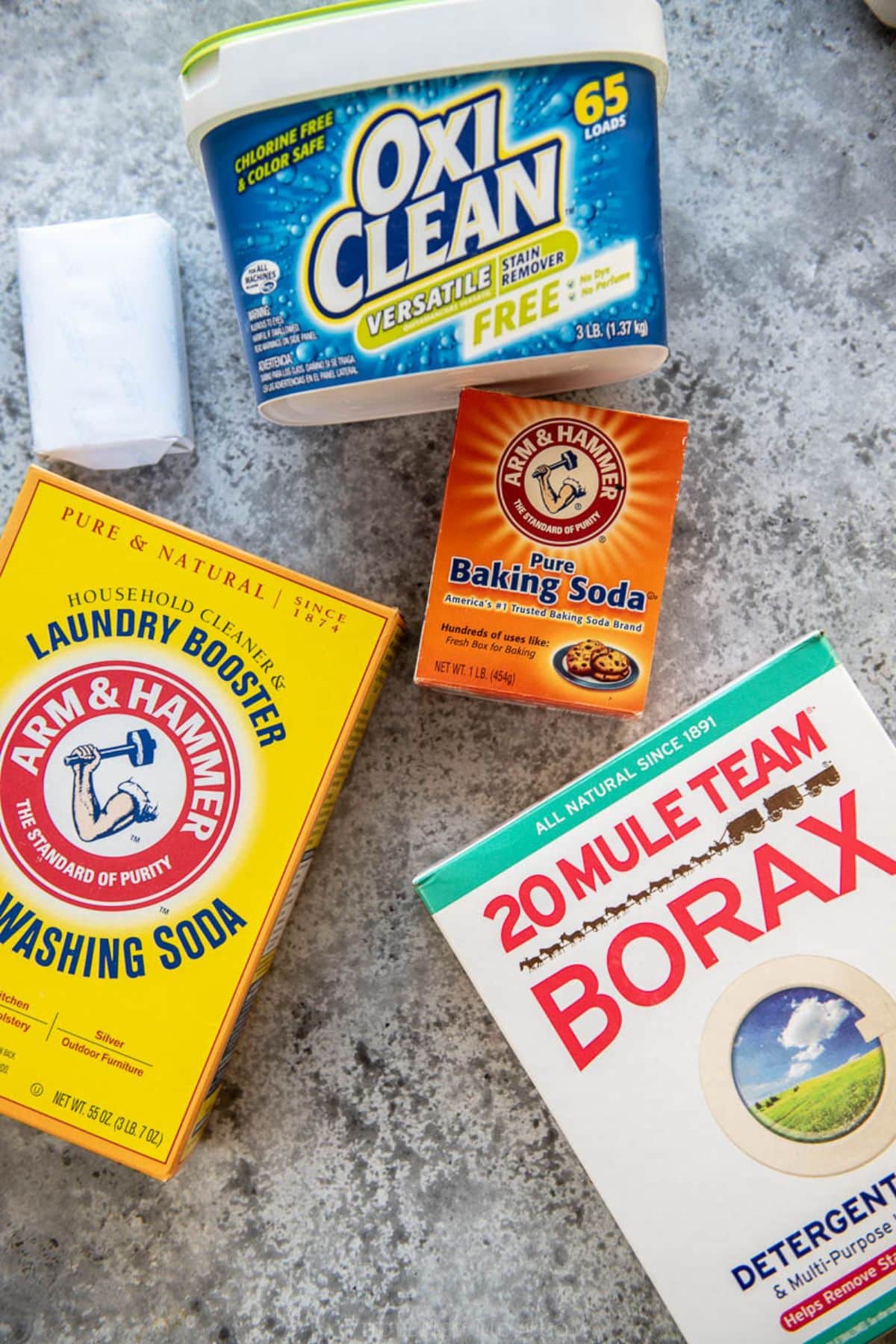
Ingredients
- castile soap I use Kirk's brand
- borax
- washing soda
- baking soda
- OxiClean Free or sodium percarbonate
Following is more on each ingredient including the role each one plays in creating a safe and effective detergent.
Castile Bar Soap
Castile soap is made with fruit or vegetable fats (usually coconut or olive oils) and is helpful with removing dirt and stains from clothes. Because it's not made with animal fats, it's safe to use with HE washers or washers that drain into a septic system.
Borax
This recipe calls for 1 3/4 cups of borax (a.k.a. sodium borate, sodium tetraborate, or disodium tetraborate), which is a natural mineral compound that converts some water molecules into hydrogen peroxide, giving it the ability to clean and bleach.
Some sources say that borax is best in hot water, but other sources say it doesn't matter. If you're concerned about using borax, this post about borax safety can help.
Washing Soda
You'll also need 1 3/4 cups of washing soda). Washing soda (aka sodium carbonate or soda ash) is an effective stain lifter that doesn't stain (or “bleach”) clothes.
Since it's highly alkaline, it's also effective it helps treat hard water, allowing the detergent to work properly so that clothes get clean and don't build up residue during washing.
Baking Soda
Baking soda works to dissolve dirt and grease and soften clothing thanks to its mild alkaline qualities. And it's a great deodorizer, working to remove odors, fabric softener, and cleaning agent that won't bleach your clothes.
OxiClean Free (or Pure Sodium Percarbonate)
OxiClean is an oxygen-based, chlorine-free, and color-safe stain remover. It can be used on any machine-washable fabrics. OxiClean is basically sodium percarbonate with additives so you can just purchase straight sodium percarbonate and use less of it (as mentioned in the recipe card).
If you can find pure sodium percarbonate, that's my preferred choice because it's a single-ingredient product. I list OxiClean Free in the recipe card because it's much easier to find.
I used to add essential oils to this detergent for fragrance, but I now usually leave them out. In powdered detergents, the scent often fades during washing and drying, and adding oils can sometimes cause the powder to clump. If you'd still like to use them, especially if you hang your clothes to dry, add just a few drops at a time while making the powder and mix thoroughly.
Directions
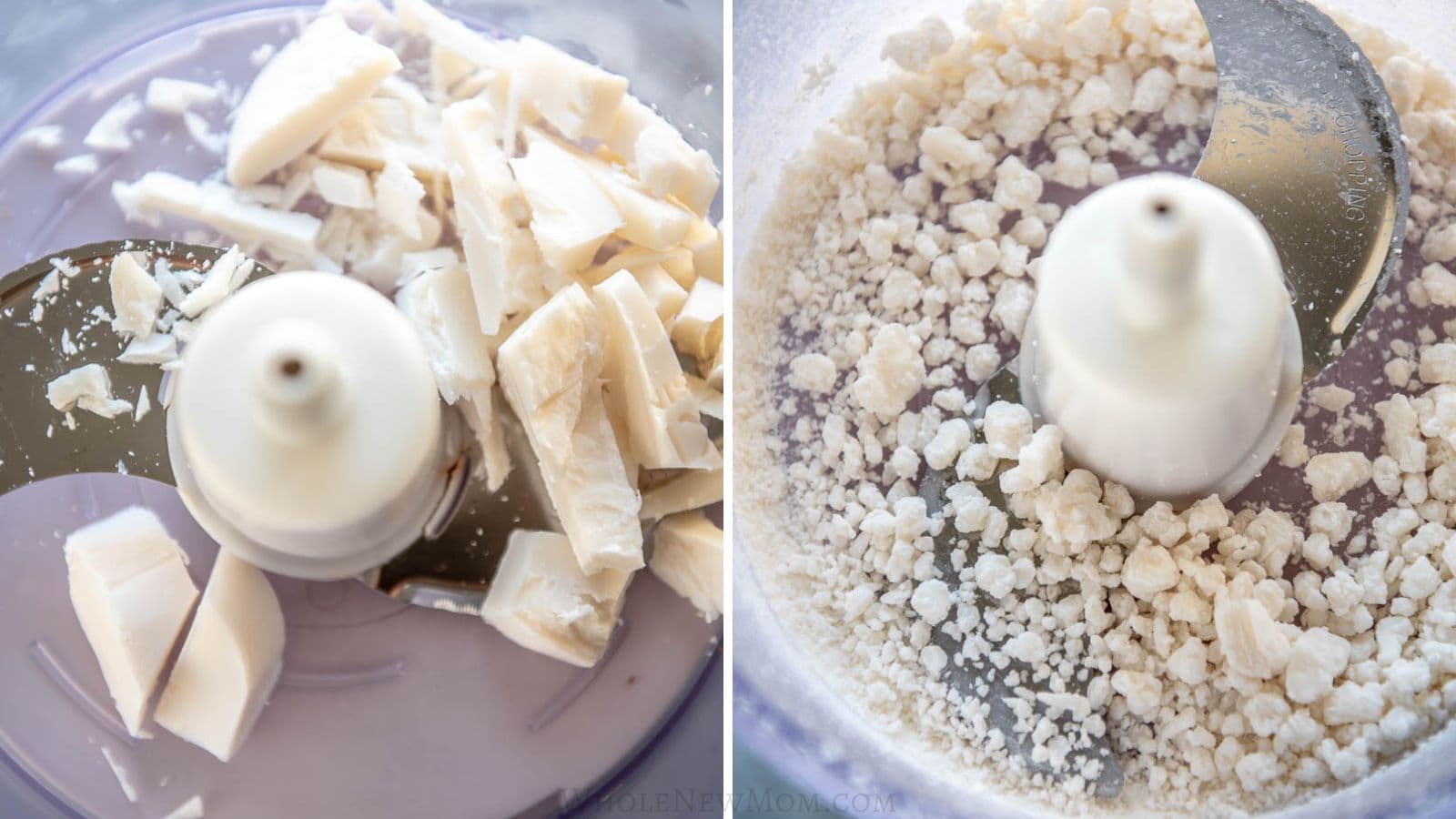
- Chop up the castile soap bar to make it easier to process.
- Put the chopped soap pieces into the bowl of a food processor and pulse.
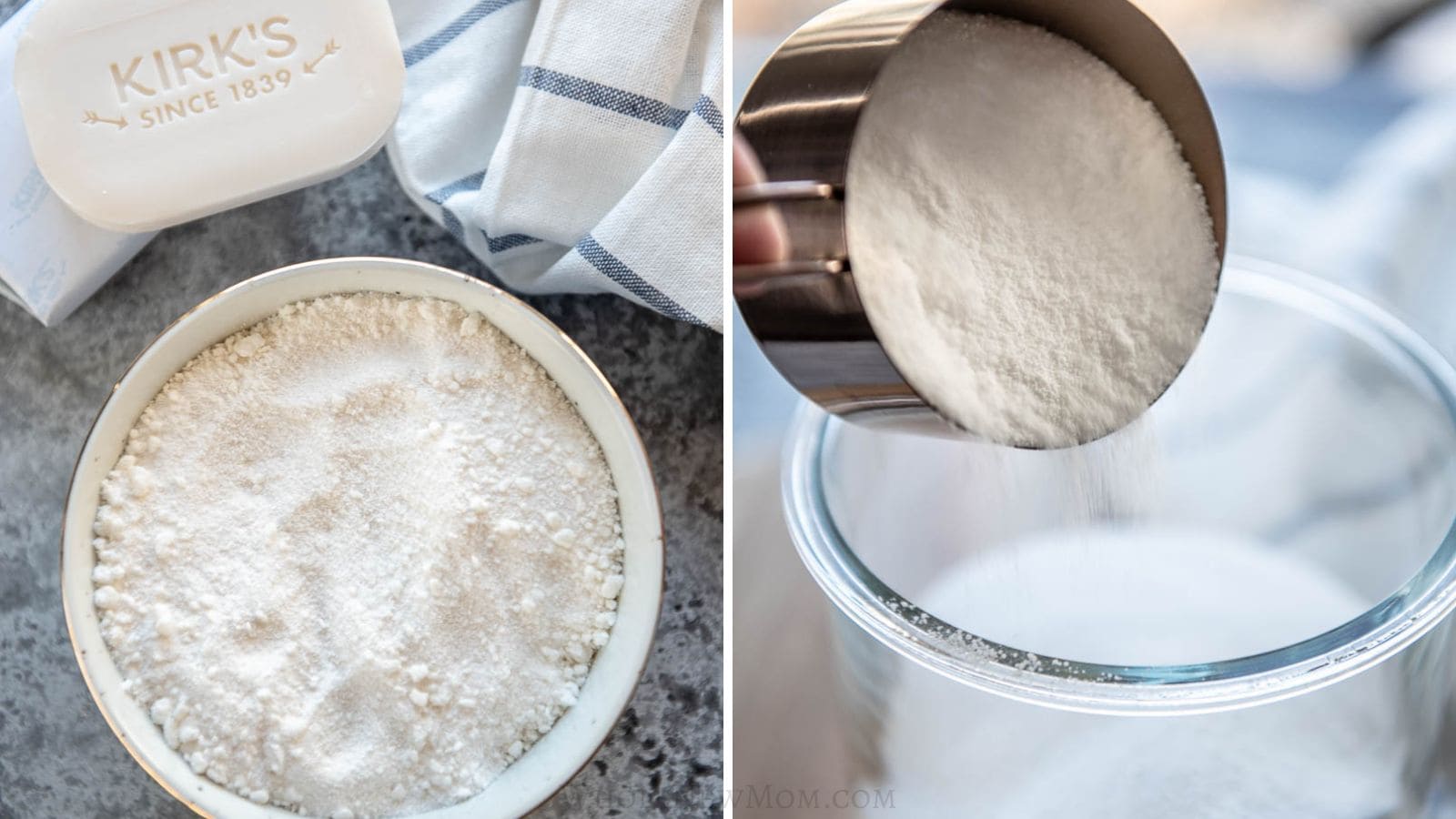
- Add the baking soda and pulse.
- Add remaining ingredients and pulse to a powder.
- Store in an airtight container.
How to Use
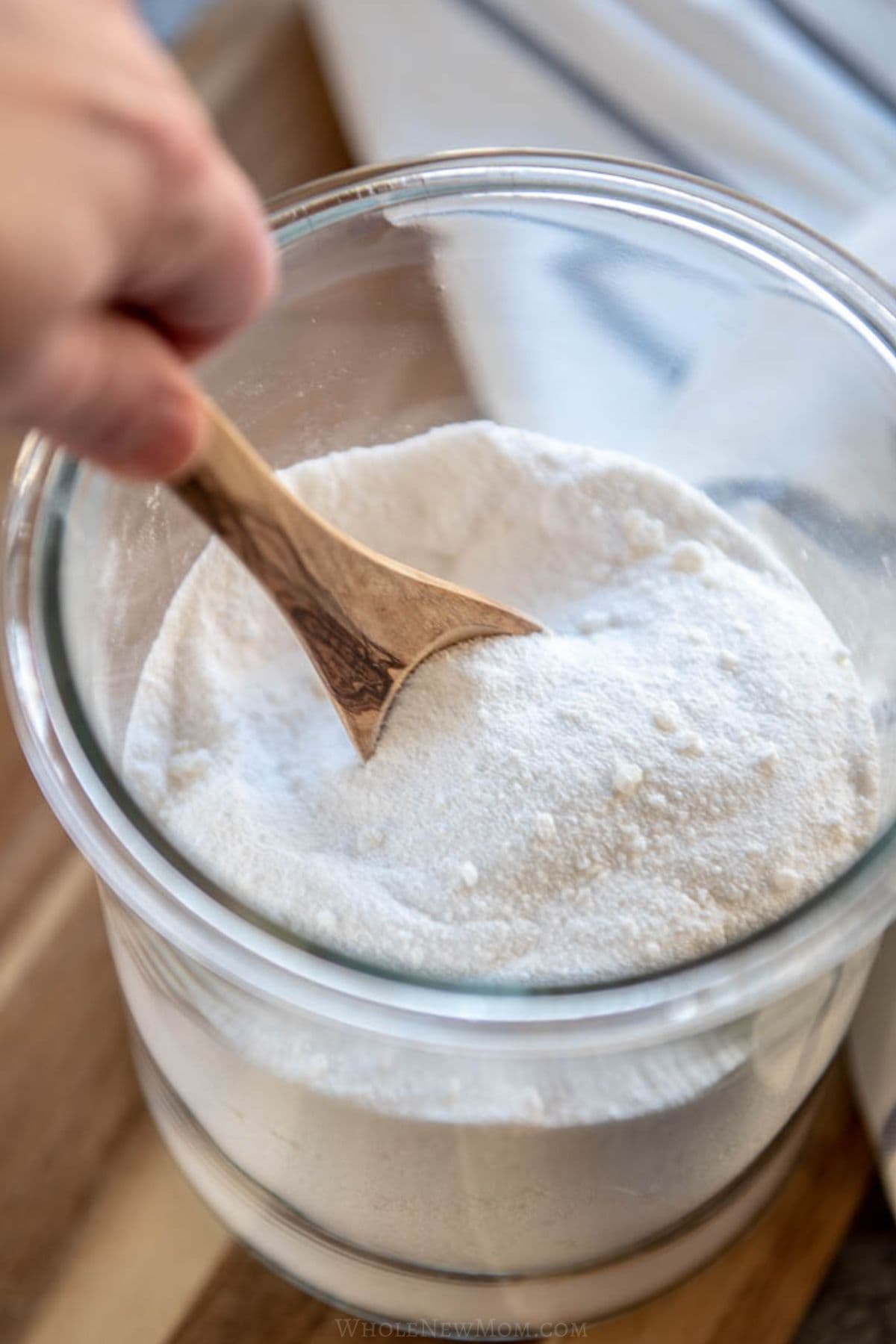
To use this detergent, simply add about 2 tablespoons directly into your washer bin with your clothes (you might want to only use 1 tablespoon for HE front loaders. Easy peasy. Add more, if desired, for larger or more heavily stained loads.
FAQs
Here are the most common questions regarding making DIY laundry detergent, along with their answers.
What's the best bar soap to use for this detergent?
While many detergent recipes recommend using fels Naptha soap, I personally don't recommend it since it has some ingredients (like artificial fragrances) that I don't want on my clothes.
Castile soap works great for this recipe, but you could also use any other natural, non-toxic bar soap.
Can you use this homemade detergent in an HE (high-efficiency) washing machine?
Yes. When used in the recommended amounts, this recipe is low-sudsing and works in front-loading HE machines.
Will this homemade detergent irritate sensitive skin?
We haven't had any problems at all (and we have had issues with sensitive skin). The ingredients included are natural and usually safe for all skin types. However, everyone is different, so I recommend trying a small batch to test before committing to this larger batch size.
If you prefer, you can use this gentle laundry detergent for babies and sensitive skin.
Where can you buy ingredients for this homemade detergent?
I've included Amazon links to help you find everything you need. You can also find these ingredients at Walmart, Target, and some grocery stores. I buy my baking soda in large bulk bags at Costco since we use it for all sorts of things.
Do you need to use a fabric softener with this homemade laundry detergent?
You shouldn't need to since the alkaline properties of baking soda and washing soda soften fabric. However, if you want to soften more, you can use plain distilled vinegar as a natural fabric softener, and the smell washes out so you won't smell it at all!
How much DIY laundry detergent does this recipe make?
This recipe makes approximately 7 cups of detergent, which works out to about 56 loads. Could you double or triple that if you wanted to? Sure!
However, this recipe makes a good amount so that you don't have to make it once a month and yet it doesn't take up too much storage space.
How do you keep homemade laundry detergent from clumping?
If you live in a humid area, your DIY detergent may clump sometimes. Here are some tricks to help you prevent (or break up) clumping:
- store your detergent in an air-tight container.
- place a dessicant in with your detergent.
- pop your detergent back into the food processor if you do end up with a few clumps that don't break up easily.
What's a good OxiClean alternative?
OxiClean is basically sodium percarbonate with additives so you can just purchase straight sodium percarbonate and use less of it. You would want to use about 1/4 the amount of the percarbonate, so for this recipe, that would be 5 tablespoons.
Since you are therefore reducing the amount of bulk of the entire recipe you might think you should use less detergent for each load, but it's basically just reducing the amount by about 1/24, so that's not likely worth trying to do.
Is homemade laundry detergent safe for washing machines?
Some people make the claim that homemade laundry detergent isn't safe for washing machines, and can void the warranty and cause all kinds of issues.
Let's clear that up.
I looked into this and found that there are reports of people using homemade detergents for many years with no issues. It seems that the problem isn't using these products, but using too much of them. Instead of throwing out the laundry soap with the bathwater, just use less, starting with 1 tablespoon of detergent per load.
Is borax safe to use in homemade laundry detergent?
There’s a lot of confusion online about borax safety. After digging into the research myself, I personally feel comfortable using borax in homemade cleaning products like this one. You can read more about the research and safety discussion here.
When used properly in cleaning applications, borax has been used safely for decades. As with any cleaning product, it should be handled responsibly and kept out of reach of children.
What can you use instead of borax in homemade laundry detergent?
If you prefer not to use borax and/or you just don't have it in your home, you can use more baking soda in its place. I haven't tried this, but it should work out fine since baking soda has similar properties to borax of softening water, deodorizing, and boosting laundry detergent.
Why don't my clothes smell clean after washing them?
First of all, you could be using too much detergent, which leads to buildup, which leads to bad smells.
There are ways to clean your washing machine (more on that later) but one thing I use is HOCl with either the Force Of Nature machine or the Ecoloxtech device (uses only salt and vinegar): no expensive capsules needed.
I spray the inside of the machine every other load, along with following the manufacturers directions for cleaning the machine.
How can you prevent buildup from homemade detergent in a washing machine?
Some people (especially those in cloth diapering groups) have reported that washing your clothes in a homemade detergent that has soap in it will leave deposits/residue on your clothing. Others say that this isn't a problem.
I noticed it for a short time, but I was using too much “detergent” for my washing machine (the white streaks didn't look great on my black top–not the best fashion statement). Once I stopped that, the problem stopped.
One way to address this by adding in about 1/4 cup borax to your load. Borax has other benefits, such as addressing mold, so it's great to do this anyhow.
You can also occasionally run an empty, large laundry load with 2 – 4 cups of white vinegar added, depending on the size of your machine.
Again, make sure to only use the recommended amounts to each load.
Other Healthy Home Helps
This Homemade Laundry Detergent will save you money and is a great way to reduce toxins in the home. Here are some other great ways to clean and green up your home:
- No Streak Glass Cleaner
- Homemade Baby Laundry Detergent
- 17 Natural Green Cleaners
- Natural Dishwasher Rinse Aid
- Homemade Cleaning Paste
- Homemade “Soft Scrub”
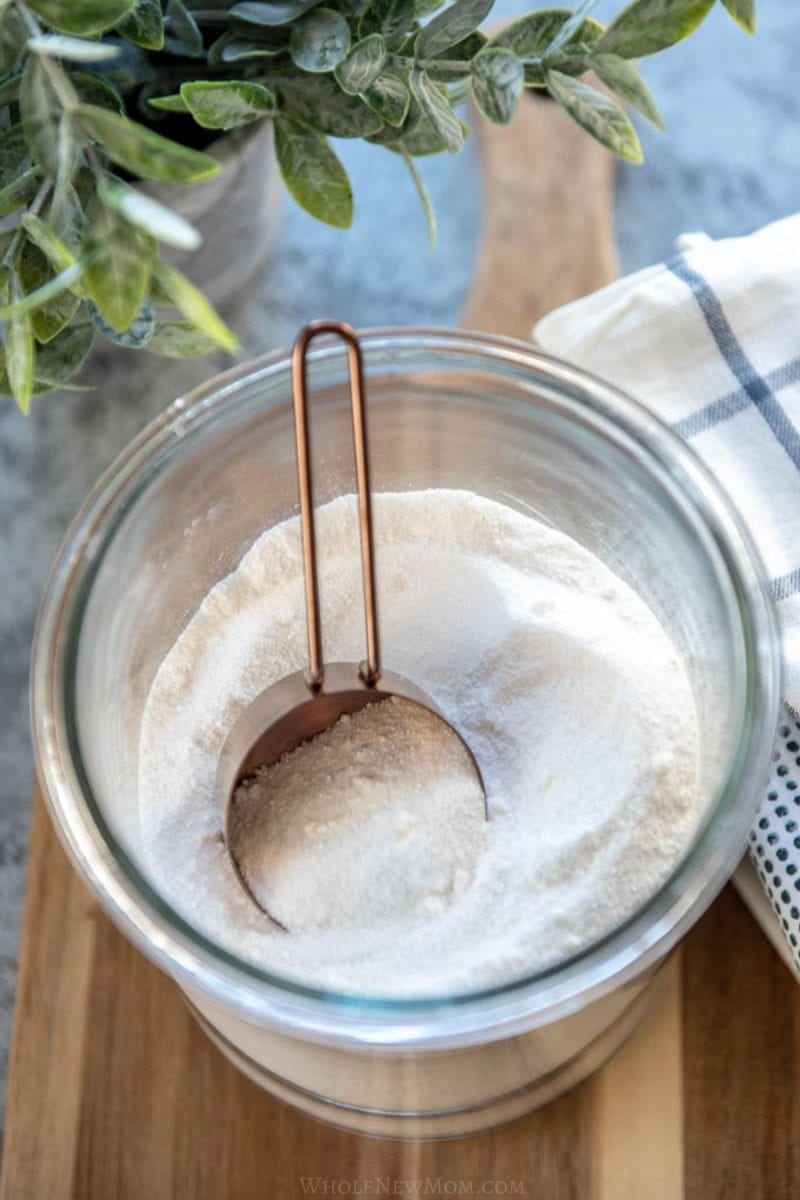
Making your own laundry powder is fast, easy, and inexpensive, helps keep toxins out of your home and the environment, and gives you total control over the ingredients!
I really think you'll enjoy this. One of my readers likes it so much, she gifts it to others for Christmas, and all of the recipients have liked it too!

Best Non-Toxic Homemade Laundry Detergent
Equipment
- Airtight container like small bucket, large mason jar, or other glass jar
Ingredients
- 1 4 oz bar Castile soap (I use Kirk's brand)
- 1¾ cup borax
- 1¾ cup washing soda
- 1½ cup baking soda
- 1 1/4 cup OxiClean Free (or 5 tablespoons sodium percarbonate; my preferred option)
Instructions
- Grate the castile soap with a grater.
- Put the grated castile soap pieces in a food processor bowl. Pulse until only large crumbs (no chunks) remain.
- Add remaining ingredients to the food processor and alternate pulsing and blending until well combined.
- Store detergent in an air-tight container to help avoid clumping.
- Simply add about 2 tablespoons directly into your washer bin with your clothes (you might want to only use 1 tablespoon for HE front loaders). Add more, if desired, for larger or more heavily stained loads.
Notes
Don't Feel Like DIYing?
I've tried a few natural detergents over the years, but recently I found one that I LOVE. It's Rowe Casa's Liquid Laundry Detergent.
It's very reasonably priced for being a liquid and it's in a lovely container as well. The bergamot lavender scent is so pleasant that it and the bottle make doing laundry actually an unexpectedly nice experience. Get 20% off your first order with code WNM.
Can't wait to hear how this laundry detergent works for you!
As usual, Adrienne, you are so thorough with your explaining. I haven’t yet tried making laundry soap but you’ve encouraged me to try once I use up all the Truly Free pouches on hand. As for fears of Borax: do you know many of us are low in boron (which detoxes fluoride!), and I found a “recipe” to make it using Borax in a very weak solution with water from a reliable follower of Weston A. Price. You are so good to share what you’ve learned by trying – and this old girl learns a lot from you. Thanks for your work and time.
Hi there! Awww you are too kind. I worry that people want short posts so it’s hard to know what to do. I think you’ll like this but I’m also working on one that doesn’t have soap. How does the Truly Free smell to you? It was very very strong when it started and I couldn’t use it. I found out at the time that they had aldehydes in there but I’m pretty sure they removed them. I have heard about borax and that issue. Is there a reason to dissolve it and not just take a pinch which would be much simpler.
I always bought the unscented laundry soap from Truly Free until it seemed no longer an option. Now it’s very lightly scented with lavender which I don’t actually notice, though a houseguest (a man) asked what I washed my sheets with. He loved the scent. As for the DIY boron, my source is VERY detail-oriented and as a WAP member is specific about measurements: “To make the solution, dissolve one teaspoon borax in one quart of filtered water. The 20 mule team brand from the supermarket is fine as all borax is food grade.Take one teaspoon per day of this concentrated solution diluted in a glass of water. This provides 3 mg of supplemental boron. This is a very safe amount, fully in line with the study of boron in humans (citation). Continue this for a minimum of three weeks or up to three months if you have severe fluorosis (with one week off a month in line with the scientific study).”
Hi again! I can send you an email about this I guess. I have seen boron supplements in a number of places is all that I was referring to – and they aren’t requiring that you make water with them.
I was thinking about purchasing a precision scale to measure out the essential oils. Do you have a link for one?
Hi Jill! Yes, I love this one. https://amzn.to/3PblzgF (affiliate link) Hope that helps!
Can I make this without borax?
Hi there. Are you concerned about borax safety or just don’t have it?
Just don’t have it
Hi again – I just updated the post with some information about that that should be helpful for you – hope it works well for you!
Thanks I ended up finding a box of borax and just made the recipe how it was intended.
Do you have any good dishwasher soap recipes?
Great! I’m working on that actually! You can learn more about us and sign up for updates here if you’d like…..
This recipe works great for my laundry! I’ve been using this about a year and half I think, and have made it two or three times in that timeframe (double batch one time). It lasts awhile which is nice. I use about 1 1/2 tablespoons of the powder mixture and a little less than 1/4 cup of my homemade liquid Castile soap. I do like to put the power mixture in a measuring cup and mix it with hot water to make sure it dissolves before adding to machine, especially using cold water. I don’t put the essential oils in the powder mixture, but I like to put a few drops of essential oils in the washer before adding the clothes. I like using cloves, cinnamon, scotch pine in addition to the essential oils listed in the recipe. The clothes come out clean and smells nice! I don’t use fabric softener or fabric sheets, just wool dryer balls.
Hi Rachel! I’m so glad to hear this! Thanks for taking the time to share and so interesting you’re adding castile soap too – can you tell me why you are doing that? I think that’s a great idea about dissolving it first. I have some other things I want to share about laundry soon so stay tuned! If you aren’t subscribed you can do so here if you’d like – wholenewmom.com/about-me/. Thanks again!
I have been making my own coconut oil bar soap and homemade laundry detergent for over a year now. The soap I make for the laundry is a cleaning bar with no superfats, meaning there are no extra fats left after saponification (chemical reaction that make fats and lye into soap). My recipe uses 4 – 5 oz grated soap and 2 cups washing soda processed until soap is very fine (helps to dissolve better in cold water). We use about 1 – 2 Tbsp each load. This has been the best laundry detergent I’ve made for our large family. It gets out my older kids smelly sweat smell great. The cleaning bar soap also can be used as a strain pretreatment.
I used to use salt and vinegar only, which worked great as well, but my husband told me I couldn’t use salt in my new washers with stainless steel tubs because they would rust.
Great comment yet again. I haven’t heard that about stainless tubs…..I guess something else to consider. That was regular salt?
What do you think about others saying that it might take longer but eventually you will have buildup of the soap?
HI ADRIENNE!
I came across your blog post for homemade laundry powder as I’m looking for a foul proof do-it-all recipe that is great for all temperatures and all washer types. I wanted to know if you ever added sea or epsom salt to your recipe(s) and do you have any thoughts on that? I have been reading on the benefits of adding this to homemade powder. Also, will any castile soap work? I have been using Nels but recently switched to Dr. Bronners only because I cannot find Kirks’ FF locally and I wanted to make a make a batch. You mentioned an issue w/company; can you share what that is?
Hi there!
I have never done that…what benefits were you reading about? I just did a little research but wasn’t sure what to think.
You should be fine with any castile. I read a few things about Dr. Bronner’s that upset me. Mandating certain things and taking stands on cultural issues that I found quite distasteful. I can’t avoid these types of things in all arenas of my life, but in this case, it’s an easy switch so I made the decision to avoid. Hope that helps and hope the detergent works out for you!
Last night I was reading more on added salts ..sea is good, natural softener but Epsom, not so good (something about magnesium and hard water so I’ll forgo this as precaution.) I just ordered a bulk qty so will need to use as body scrubs instead. Good to know about Bronners, I understand what you mean! Sigh…one more company off my list.
I read that about epsom too – there were mixed reviews / sets of information on it. You can use epsom for LOTS of things: https://wholenewmom.com/epsom-salt-uses/ 😉
Yes, Bronners got a lot of heat for some of the stuff including very odd things written on their labels about some of it. Take care and again I hope the recipe works well for you!
Be aware, If you have a stainless steel tub, salt can make it rust.
This is very similar to my homemade laundry soap that I’ve made for many years and recently stated selling. The soap I use is my own pure coconut oil soap. It works great! I usually only use 1 T. per load.
I have made something very similar to this for many years now (almost 10!) and it has worked wonders for us. I make a very large amount that fits into a very large glass container. It will last me almost a year or more!! I bought a 2 pk. of coffee scoops at the Dollar tree and they are perfect for 2 Tbsp. of detergent or 1Tbsp. if need be. I have an HE front load machine and most of the time use a 2 Tbsp. amount as my husband “attracts” dirt when he’s working! 😉 So it works great. I also have one of those “downy balls” and put my vinegar in that so it dispenses at the proper time. I also make my own “stain remover” by taking a spray bottle and adding 3/4 of it with hydrogen peroxide and close to 1/4 of DAWN Blue dish soap. Be careful with it though as it will suds!! It turns blue due to the dish soap but will go clear after a little while. My 96 yr. old father “tinkles” in his underwear and I spritz them with this and throw in the washer with the detergent and they come out like new!! LOVE using natural things to wash with!!
So glad it is working well for you! I love it too. The stain remover idea is very interesting!! The vinegar too – what are you using the vinegar for in the washing machine? I want to do a DIY stain remover soon!! I love more natural things too…though Dawn isn’t really natural so I would like to find an alternative for that part :). Thanks for reading and commenting!
Adrienne,
I have a plastic “Downy Ball” dispenser that I bought at Walmart. It has a stopper in the top. There are a few lines on the side. Here is a link to the downy ball dispenser at Walmart: (Link deleted by Whole New Mom due to it not working anymore). I put my vinegar in there, seal it up, and throw into the washer when it starts. I understand that the Dawn isn’t really natural, BUT it mixed with the peroxide gets stains out very well. I can’t use store bought stuff as the smells are so overpowering to me, that they give me migraines. Hope this helps!
Interesting! So is the vinegar a fabric softener for you?
I have heard about the Dawn working well for that – I haven’t bought it yet however b/c I can’t stand thinking about buying that, but that’s just me! The scents are simply toxic–good for you for not buying them!
Here’s more info for you on that…. https://wholenewmom.com/dangers-of-fragrances/. (so toxic!)
Hi Adrienne,
I simply can’t do fragrances anymore. Perfume just sends my nose into a tizzy!! I have an over sensitive nose that even my husband had me to come outside one time to see if I could smell any natural gas under our house! He says, who needs a bloodhound with my nose!!
Hahahaha. Yes, I am kind of that way. The fragrances are really bad. I have been trying to wake people up about it b/c they are just so toxic. I’ll remember who to call if we need additional help, however LOL!
I accidentally found a wonderful stain remover! I purchased authentic African Black soap (liquid). I had been reading about it and wanted to try it out. It is an all in one product, and wanted to try it as a shampoo. I didn’t like it as such, so was using it as a dishwashing soap. I do not buy white shirts!!! I ALWAYS seem to drip oil on them or stain them in some way. BUT I found these bamboo tank/camisoles and just HAD to have them, of course they are white! they were supposed to go under my other tops as another layer as I don’t have heat in my house. I do use space heaters and one day was a bit warmer than usual, so I took my top off and of course immediately spilled oil on my white camisole. I put a blob of the African Black soap on it and used a scrubber to rub it in, washed it and….VOILA! no stain….I mean NO STAIN. I will be buying more of this as a stain remover. (it happened again a day later, and worked, again…) Sorry this is so long, but wanted to give details…this works
Wow no way!!! Does it remove any kind of stain–off to check it out!
I was extremely surprised when it got the stains completely out. I really don’t know if it will work on other types . I have heard that oils will remove oils from fabric (kind of weird, I know), and this soap has a lot of shea butter and palm kernel oil in it. My guess is it will remove a lot of stains…as oil/grease are the worst! Even if it doesn’t, you can still use it as body wash, shampoo (you may like it) or dish soap!!!
I got it at Natural Grocers, if you have one near you.
Good luck!
Thanks! I am going to try it and makes sense if you read this (needing to be redone) post: https://wholenewmom.com/jojoba-and-rose-water-natural-facial-cleanser/
Thank you! I don’t have that store but I’ll find something ;).
I just found a link on Amazon for the Alaffia brand that I have:
https://www.amazon.com/s?k=alaffia+african+black+soap&crid=25RTRHBWISLA&sprefix=alaffia%2Caps%2C469&ref=nb_sb_ss_ts-doa-p_9_7
There are several of them, I have the Rosewater Peony one.
I was looking at that one as well as a few others – thank you!
Here’s my affiliate link in case anyone else wants to try it. Amazon has severely decreased our commissions but every penny or two helps ;). https://amzn.to/3J1expE
Do you mind sharing your recipe? Tks.
Lee, I used 3 bars of Fels Naptha soap. Cut I chunks and then put in a food processor to powdered form. I added a box of 20 Mule Team Borax and a box of Arm and Hammer Washing soda. I think it was Arm and Hammer. Anyway, mix it all together and use 1 Tablespoon for a large load of laundry. I use about a quarter to a half a cup of vinegar in the rinse cycle.
Curious if Bronners Liquid Castille would work as well? 🙂
Thanks kindly Adrienne for your great posts! 🙂
I have never tried this with a liquid soap. I think it would of course be a very different consistency. Side note, I personally avoid Bronner’s now due to a number of their policies. It’s not possible to avoid everything but in this case it’s easy to find another option without sacrificing quality. Super easy fix!
My go to now! Works great. I like to add a splash of white vinegar (as added softener) after I toss the detergent directly in the frontloader. Makes clothes clean and keeps the washer fresh. Thanks for sharing!
Sooo happy you like it as much as we do :)!
Ok, I am back again to give a well deserved 5 star review. I am almost done with my first batch of detergent and planning on making my second batch. So far it has worked great! I was concerned about how little detergent is used, especially when we are used to dumping a big scooper full from the boxed brands. I saved one of those scoopers and measured out the suggested amount for an extra large load and marked it on the scooper with a Sharpie marker. So we still have the convenience of the plastic scooper, but we can easily see how much we need. Everything comes out so clean! Even though it was kind of a hassle finding all of the ingredients….once you have them they make many batches and I probably will have laundry soap for the rest of the year! Love it, highly recommend!
You made my day – so glad you liked it!!