
How to Make Baking Soda Cleaning Paste
This post may contain affiliate links from which I will earn a commission. Learn more in our disclosure.
This baking soda cleaning paste is one of the simplest and most effective natural cleaners you can make. With just a few ingredients, you can create a powerful scrub for sinks, tubs, stovetops, and more—with no harsh chemicals.
In this post, you’ll learn exactly how to make baking soda paste, how to use it, and when it works better than store-bought cleaners.

How to Make Baking Soda Paste
To make a basic baking soda paste, mix baking soda with castile soap until it forms a thick, spreadable consistency.
For tougher stains or buildup, you can add a small amount of cream of tartar if desired.
Why Baking Soda Cleaning Paste Works
Baking soda and soap work together to tackle different types of messes.
Soap helps break down grease and oils so they can be rinsed away, while baking soda acts as a gentle abrasive to scrub away stuck-on residue.
Because baking soda is slightly alkaline, it can also help neutralize odors, making it especially useful for kitchens and bathrooms.
Why You'll LOVE This Baking Soda Paste
I love making DIY everything from spice blends, to kitchen substitutes, to beauty products and home cleaners as well. Basically, if there's something I need, I often wonder if there's a way to make it cheaper and make it cleaner/healthier.
And when it comes to cleaning products, most of the ones in the stores are full of things I don't want in my house, and you likely shouldn't have them in yours as well.
Even some of the more “natural” companies have “fragrance” on the ingredient list which, if you don't know, can be a coverup for all kinds of nasty chemicals.
While you could go in the direction of buying very clean products, DIY options like this baking soda paste are so simple and inexpensive, there's really no reason to spend your money on a store-bought cleaning paste at all.
You don't even need to make this paste ahead of time because it's so simple. Just whip it up when you need it.
Take a look at these shockingly simple ingredients.
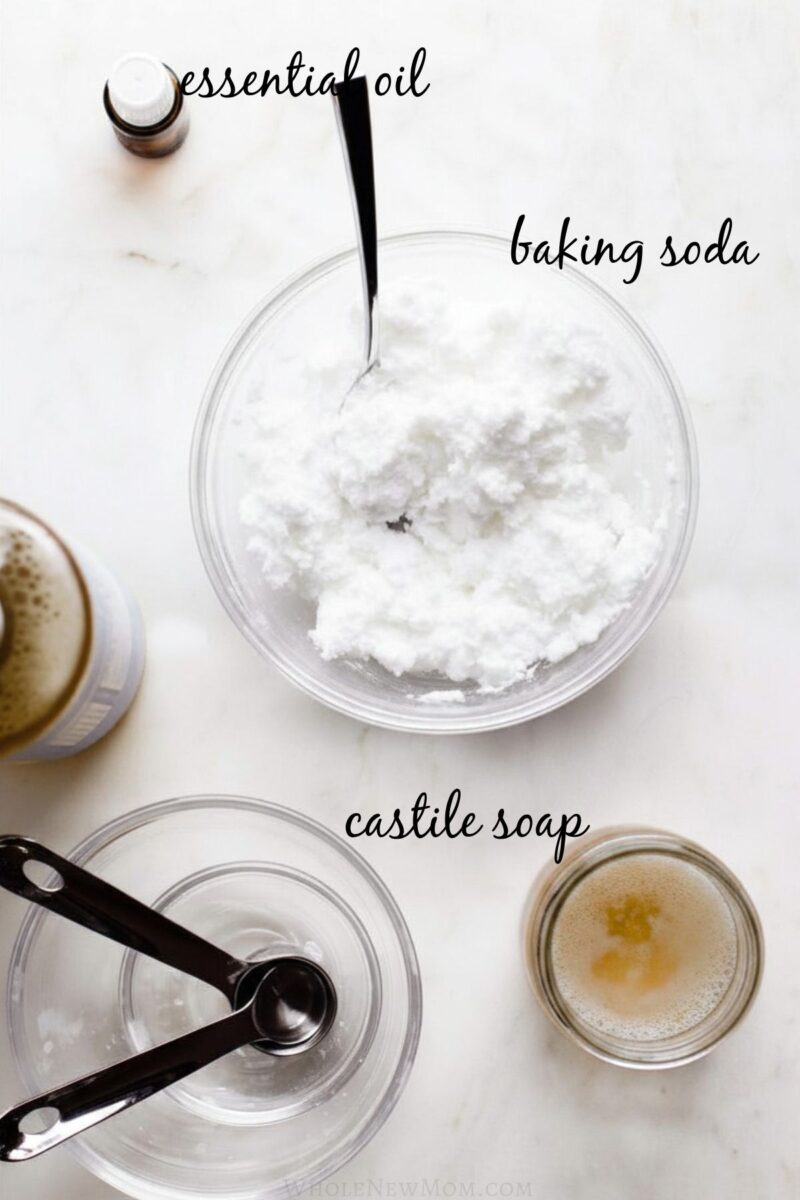
Ingredients
- baking soda
- castile soap
- essential oils (optional)
Tips
If you plan on storing some of this cleaning paste, make sure to keep it in a very air tight container so it doesn't dry out.
You also might wish to leave some air space at the top in case it does dry, since that will cause it to expand. It's no fun having a container break–especially if you use a glass one!
Does This Cleaning Paste Kill Germs?
While this cleaning paste is great at cleaning all sorts of areas, it's not technically a disinfectant. It will help addressing dirt, grease, and buildup, however.
If you're wanting something that's guaranteed to kill germs, you might want something specifically for that purpose like HOCl from Force of Nature or Ecoloxtech, for example.
How to Use
Scoop out 1-2 Tablespoons of the paste (more or less, depending on the job) and apply with a sponge, scrub brush, or cleaning rag, and scrub. Rinse thoroughly (warm water will make rinsing easier).
Ways to Use Cleaning Paste
- Clean, polish and protect chrome, stainless steel, porcelain and similar surfaces
- Remove label residue off of glass containers
- Kitchen and bathroom surfaces, including the tub and shower, sinks, hardware, and even the toilet)!
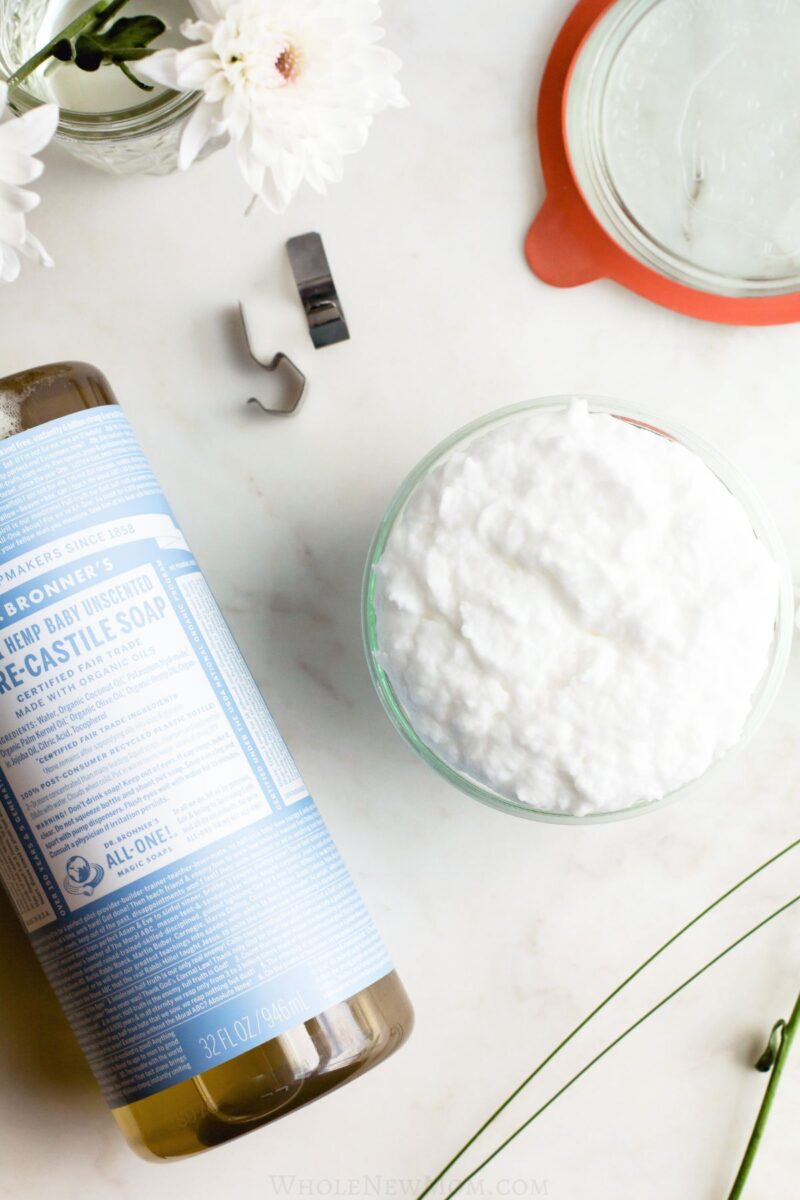

Baking Soda Cleaning Paste
Ingredients
- 1 cup baking soda
- 2-4 teaspoons liquid castile soap
- 10-20 drops essential oils (optional)
Instructions
Instructions
- Add baking soda to a small bowl.
- Slowly add castile soap, mixing until a thick paste forms.
- Adjust consistency by adding small amounts of castile soap or water as needed.
- Stir in essential oils, if using.
- Use immediately or store in an airtight container.
To Use
- Apply to surfaces with a sponge or cloth, scrub gently, then rinse clean.
Notes
Other Non-Toxic Household Products
Here are some more great non-toxic healthy home products you can easily make yourself.
- Sensitive Skin/Baby Laundry Detergent
- Non-Toxic Laundry Detergent
- No-Streak Window Cleaner
- DIY Dishwasher Rinse Aid
- Best DIY Fly Trap
- Homemade Soft Scrub
I'd love to hear what you think about this cleaning paste after you try it!
Hey Adrienne!
I’ve been looking for a way to clean my extremely etched old bathtub, since a bathroom reno is just not in the cards right now. It’s been super challenging / impossible to get the scratches clean, and I very much didn’t want to get into some of the more extreme suggestions I’ve found online. (Toilet bowl cleaner, oven cleaner.)
One application of this paste plus about 20 minutes of scrubbing lifted 90% of the grime from the bottom of the tub. I wish I took a before and after picture, because the transformation was so dramatic! I’m really happy with it. I took a swipe at the similarly ancient sink and some of the calcium buildup in the toilet too, which lifted right away. I’ll have another go at the tub to get it all the way clean, but I’m feeling so much better about the bathroom now.
All of this is to say THANK YOU!!!! This recipe is genius.
xo
Melissa.
Wow – I can’t tell you how much this blessed me today! We have a lot of tough things going on (as many do) but this week has been a doozy….so happy to hear how much this helped you. Thanks so much for taking the time to share…and I have 2 very old bathtubs too….one in particular. I need to break more of this out :). Thanks again!
Adrienne: since you are having a hard day, I would just like to tell you how much I appreciate all that you do here on your blog!!! You gift your readers with insight, information that must take you a lot of time and trouble to look up (since some of us won’t do the hard work ourselves!!! LOL), great ideas and then you share it all for free!!!
THANK YOU, from my heart.
Although most of us don’t say it, we really do appreciate that you take time to share with us. AND often have to deal with horrible people in the process!
I plan to try this soon on MY old tub (at least 40 years old!!!)
Carol, bless you for being such an encouragement to me. Truth is it’s been more than a day. Today just had more in it than expected…..so much thanks from the bottom of my heart. ♥️
Thanks for sharing this DIY recipe–very useful!
You’re welcome! Sorry I had to delete your name since you seem to be looking for promotional space here :).
Is the Wendyl’s Green Baby Laundry Powder suitable for HE (high efficency) waching machines?
I’ll see if I can get a hold of the author – thanks!
Hi Sara, I’m afraid I couldn’t say for sure. Maybe you could contact Wendyl through her website.
Thank you so much for the free books! I am going to make some purchases from vitacost soon I am very interested in the coconut oil deals. I am also interested in soap nuts even though I can’t figure out how nuts can wash clean. I am trusting you here! Thanks again and have a great weekend.
Thanks Rhoda. Happy to help w/ the soap nuts order – would you like me to email you?
I just put them in a mesh bag and throw them in the wash. However, for a ‘cleaner’ use, you can just put them in a large pot, and simmer them and use the liquid. I did that and got literally gallons of liquid soap. I re-simmered the same nuts several times. It got a bit weaker each time, but I got ALL the soapy-goodness out of them for sure!
Since it is, literally, an infusion of the soap nuts, you may want to refrigerate it. I did at first, but then left it out and had no real issues, but be aware it could mold.
I now do everything in my power to avoid those toxic chemicals I believe are harmful to my family’s health. You can make your own cleaners with items from your pantry that work just as well and smell better! I would have added essential oils, like tea tree oil, lavender oil, eucalyptus oil also. 🙂
We do too. Thanks!
The bathroom cleaner sounds great, can’t wait to try it, but I do have a question. Is it safe for tile and grout? I am new to trying all natural cleaners and we just had our tub converted to an all tile shower and I am trying to find a safe and effective natural cleaner and/or daily shower spray using essential oils . Thanks so much!
I will have Sarah reply – thanks!
Hi Rene, I don’t have either surface at my home so can’t speak from experience, but I did a bit of googling and there are numerous recommendations for using baking soda for cleaning tiles and grout, with no noted issues. I can vouch for the fact that it is definitely an effective cleaner though 🙂
Hi Adrienne. Thanks very much for posting these recipes. I’m writing to suggest another typo correction. I became suspicious about the proportion of liquid to dry ingredients in the cleaning paste recipe, so I followed the link to Wendyl’s site to see the original recipe. I discovered that the liquid amount was reproduced correctly, but the cream of tartar is significantly overstated above. The recipe on Wendy’s site indicates 1 tablespoon rather than 1 cup.
Unfortunately I had already mixed 1/2 cup each of baking soda and cream of tartar, so I have quite a bit more CoT than I need in mine. Fortunately I was only planning to make half a recipe, so I didn’t use a whole cup of CoT! Guess I’ll just cut my mixture with more baking soda and save some for a future batch. 🙂
I’ll have Sarah respond – sorry!
Hi Diane – oh no, that was a typo, so sorry! Glad you were able to save it, and thanks for letting us know.
Hi Adrienne,
Thank you for the wonderful post. Can you tell me what is Washing soda? I have never heard of it before.
You are so welcome! It’s sodium carbonate – and I will put a link to it in the post. Thanks!
Does the peppermint oil in the cleaning paste have any other properties besides the smell? I have a cat with a neurological condition (don’t ask) and he can’t tolerate the smell of my peppermint oil even a day after I use it (found that out the hard way). It’s very likely he won’t be able to tolerate many other essential oils, either, as scents set him off. Unless you know one that soothes hot-wired kitties and scrubs bathroom surfaces at the same time?
Hi Kris. I am thinking Sarah will chime in late but I am thinking you could use whatever scent you like. Lemon would have some antibacterial qualities which would be nice :). Maybe try catnip oil :).
I’m just starting my essential oils journey so I don’t know much, but I did read last night that all citrus and pine oils are bad for cats. I know they all hate anything citrus with a passion. As for catnip … it’s banned from our house. 🙁 Somewhat like a hyperactive or autistic child, my cat is overstimulated by sensory input. When problems are mild he’s poorly-behaved, and when he goes haywire, every nerve in his body turns to fire and he exhibits signs of pain and panic, and he begins to twitch and spasm so hard sometimes he can’t even stand up. The vet has him on skullcap and passion flower oils in his food, and a flower essence mist to spray over him when he’s starting to act up, and that really, really helps. Fortunately we already lived an unscented life before we got him, so I didn’t have to get rid of anything but the catnip toys. If I bring anything scented into the house, like cleaning supplies, they need to be calming scents that soothe the nervous system. Maybe I could ask his vet what oils I could use – he’s a holistic vet and will know what’s safe. Should have thought of that first.
I can ask the owner of Native American as well to see if he has any thoughts…
From the owner at Native American: You should not use essential oils on cats because they are too powerful for them. Just by having them on your person or in the air is enough. If you want to try to experiment, use the Calming oil and see if that will assist. I know it works wonderful for my dog.
Have a great day.
Wow, that was fast.
I looked up the calming oil and two of the ingredients are citrus, but the last one is patchouli, which I have on hand. I can try having the scent out and see how my cat behaves before mixing it into the cleaning solution. I also have geranium oil on hand – it’s not rose (thanks, Sarah) but it is anti-bacterial. We’ll see if my hubby wants the bathroom to smell like old lady. 😉
Make sure to let me know how it works out :).
And … we have a winner! Here’s my scientific method: I had my husband smell the patchouli and the geranium, and asked which one he wanted the bathroom to smell like. He grudgingly decided the geranium was less offensive. Next I set the open bottle on the bathroom floor about a foot away from the cat, so he could run away if he wanted. He let me know it was too strong and a bit offensive, but he only backed away a bit. After a minute I capped the bottle and put it away, and we sat back to see if he’d start showing symptoms.
One evening a while back I had put a few drops of peppermint oil in the shower, and while you would think most of it would wash away, in the morning the bathroom smelled pleasantly of peppermint. When the cat came upstairs and smelled it, he went into bounce-off-the-wall hyper-drive, then began to violently attack our other cat. (Aggression is a sign of anxiety and distress.) I know he often reacts badly to strong smells, but it didn’t hit me until just then that peppermint is in the same family as catnip, and catnip stimulates him into hysteria. (We’re talking five days of acute distress, being afraid to walk on the floor, intermittent muscle spasms/twitching, that sort of thing.) I brought him downstairs away from the peppermint and within minutes he was calm and peaceful again.
So after he smelled the geranium, we sat and watched him for hyperactivity, aggression, and twitching. He sat there, highly suspicious, for a couple minutes. “I know that awful stuff is still here somewhere, waiting to sneak up on me!” Then he decided it wasn’t coming back to get him, curled up on the bathmat, and took a nap. Yes! Calmness!
I’ll make a small batch of the cleaner next, just enough to try it out once and make sure it goes well for everyone involved. (My husband might take one whiff and veto the whole idea, but we’ll see.)
Wow – great news! Thanks for taking the time to come back and share!
Hi Kris, yes peppermint essential oil has antiseptic qualities which make it really great in cleaning products. What about rose essential oil? It also has antiseptic properties, and will smell divine.
1 cup for a load for the laundry powder? Are you sure? Seems like this recipe doesn’t make much more than three cups… And the bag she sells wouldn’t last very long…. Maybe it’s a few tablespoons?? Just checking… I really want to try this.
Eeek! Must have been Sarah’s typo that I didn’t catch. Just fixed it (since it’s super early in the morning in NZ right now)- thanks!
Hi Denise, thanks for querying this. The measurements have been adjusted now. Hope you enjoy it 🙂