
Homemade Alcohol-Free Vanilla Extract
This post may contain affiliate links from which I will earn a commission. Learn more in our disclosure.
If you’re avoiding alcohol but want to use vanilla in your recipes, this Homemade Alcohol-free Vanilla Extract is just what you need. It’s simple to make, requires only 2 ingredients and works just as well as the real thing.
In this post you’ll learn to make alcohol-free vanilla extract using just vanilla beans and vegetable glycerin. This easy homemade vanilla extract without alcohol is perfect for baking, gifting, and special diets.
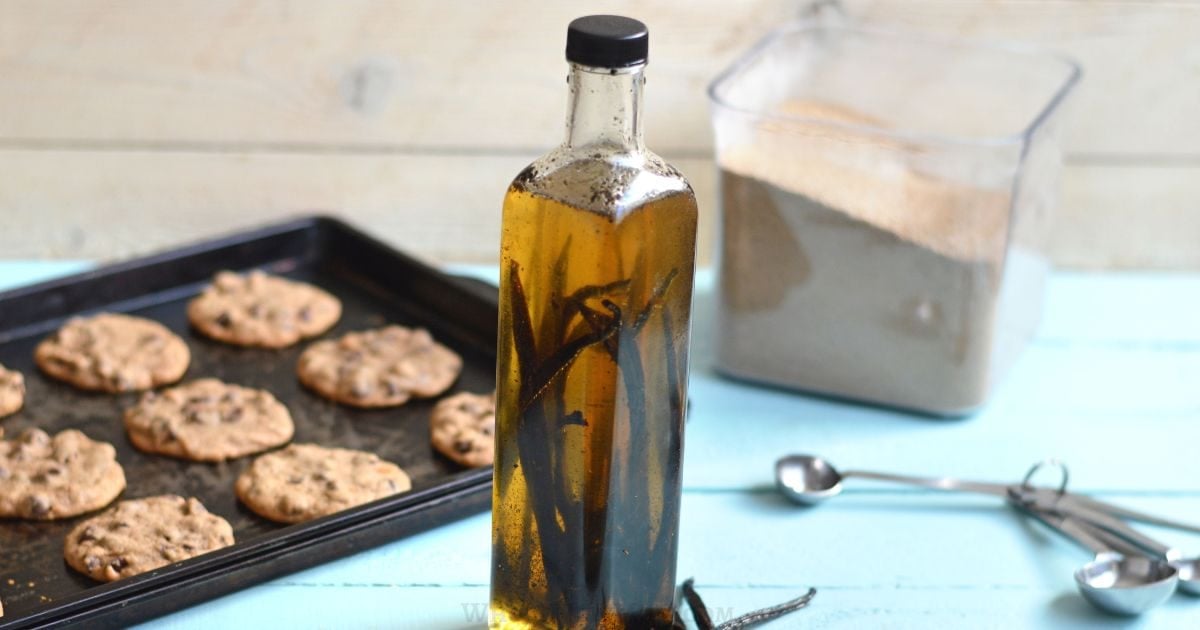
Vanilla adds so much to baked goods and so many other recipes, but it’s pricey. So if you’re like me, saving money is motivation enough to make your own vanilla extract. But there are some other great reasons for making alcohol-free vanilla.
Why Alcohol-Free Vanilla Extract?
- addiction issues – those who have a history of alcohol addiction need to avoid alcohol in all forms, including extracts
- religious reasons – some religions ban the use of alcohol strictly
- dietary reasons – some diets limit or don’t permit alcohol. The candida diet is one such diet, as is the AIP (autoimmune protocol, or autoimmune paleo) Diet. If you’re heating a recipe using alcohol, then it will burn off, but if not, avoiding alcohol is required with such diets.
- health concerns – there is evidence connecting alcohol and breast cancer. While the amount in baked goods and other sweets isn’t likely a concern given the research, some might feel that total avoidance is something that they would like to do.
If you want an alcohol-free vanilla extract, you need vegetable glycerine for steeping the vanilla beans. However, often glycerine is made from corn or soy, so making your own alcohol-free vanilla extract is the way to go so you can source your glycerine without GMOs.
Another bonus for vegetable glycerine-based vanilla extract is that it tastes amazing.
Glycerine is naturally sweet, so this Homemade Alcohol-Free Vanilla Extract tastes lovely just as it is. One of our sons LOVES licking the spoon (and of course so do I) when I bake with it!
Is Alcohol-Free Vanilla Really an Extract?
Technically, alcohol-free vanilla extract isn’t a true extract because alcohol is the standard extraction medium. A more accurate term is vanilla glycerite. However, most people search for “alcohol-free vanilla extract” or “vanilla extract without alcohol,” so that’s the term used throughout this post.
Why Avoid Store-Bought Vanilla Extract
Like most grocery store items, the story is in the ingredients. Like other food labels, the labels on vanilla extract aren’t exactly honest.
Most of what Americans buy at the store is the imitation vanilla. It’s much cheaper than true vanilla extract, so it’s appealing that way. But the ingredients are far from natural, often containing artificial flavors, caramel coloring, and corn syrup. No thanks, especially for something that doesn’t taste anything like true vanilla.
The next option is to buy pure vanilla extract. This is a better option for non DIYers, but there are drawbacks. For example, McCormick brand vanilla extract carries a price tag of $23.20 for a pint. Not exactly budget-friendly.
Caution: even if the label says ”100% pure vanilla extract,” there can still be extra ingredients (like corn syrup!). Shockingly, the term “100% pure” only means that the vanilla flavoring comes from vanilla beans rather than from artificial flavors.
What is Vegetable Glycerine?
Glycerine comes from palm, coconut, corn or soybean oil (that’s why we always buy organic) that’s gone through a process called hydrolysis. The oil is heated under pressure with water until the glycerine splits from the fatty acids and is absorbed by water. Then it’s further distilled to enhance purity.
It’s commonly used in food manufacturing because of its sweet flavor with fewer calories than table sugar. Our bodies also metabolize glycerine more slowly than sugar, preventing a blood sugar spike. Glycerin is used in extracts/glycerites like this, in sugar-free treats, and also in personal care products like this Foaming Soap and in toothpaste.
How Alcohol-Free Vanilla Is Different From Regular Vanilla
Sweetness: Alcohol-free vanilla tastes sweet due to glycerine being sweet. Some people love it while others prefer the “pure” taste of regular vanilla.
Shelf Life: Shelf life information for vanilla extract is a little confusing. There are valid sources online stating that the shelf life of vanilla extract is indefinite.
While the shelf life for alcohol-free vanilla extract isn’t as long, some say it will last only a year, whereas other sources state that the glycerine acts like a preservative and that it should last about 4-6 years. I’ve personally found somewhere in the middle or the longer length to be more accurate.

Alcohol-Free Vanilla Extract: Perfect for Gifting
Alcohol-free vanilla extract is the perfect holiday gift because it’s a great heartfelt gift and you don’t need to wonder if the recipient (or someone they’re baking for) might be avoiding alcohol.
But, remember, the extract takes 2-3 months to make, so if you’d like to make this for gifting, get a head start!
You will need a nifty bottle that holds a pint of liquid. Beanilla has some snazzy bottles, but we bought these bottles off of Amazon.
Recipe Notes
- Vanilla beans: You can use up to 14 vanilla beans for a stronger flavor. It will cost more of course. See the Money Saving Tips that follow for ways to save.
- Types of vanilla beans: Madagascar (Bourbon) vanilla beans have the classic vanilla flavor most people expect. Tahitian beans are more floral and fruity. Either works in this recipe.
- Alcohol version: Use alcohol instead of glycerine if you need to avoid glycerine for any reason. Some say you can use filtered water instead of alcohol or glycerine and store in the fridge to steep, but I’m not at all comfortable with that as bacteria would likely grow very quickly.
Money Saving Tips
- Reuse Vanilla Beans: Let’s face it; vanilla beans aren’t cheap. But thankfully, you can re-use them. After you use them for one batch, simply start a second one. For the best flavor, consider adding a few fresh beans to the second or third batch as the original beans gradually lose potency. After three batches, the flavor isn’t as strong as I would like it to be. You could of course use it for recipes and just use more vanilla that usual. If you aren’t ready to start another batch right away, store the used beans in a small jar like these with about 1 inch of vegetable glycerine in the jar to keep them from drying out.
- Buy in Bulk: You can also save money by buying bulk. If you plan to make vanilla extract regularly, I would buy at least 1/4 pound. Here is a one-pound option as well.
- Use Extract Grade Vanilla Beans: Extract-grade vanilla beans (also called Grade B vanilla beans) are less plump, drier, and can have cosmetic imperfections, but they cost less and work well for extracts.
- Add Some Water: You can substitute some of the glycerine with filtered water, but don’t make it any thinner than 3 parts glycerine to 1 part water, or you will substantially reduce the shelf life. You may notice that some alcohol-free vanilla recipes use a mixture of vegetable glycerin and water, often around 3 parts glycerin to 1 part water. Normally, adding water to a DIY product would require a preservative. However, glycerin has preservative properties when used at a high enough concentration, which is why many glycerite recipes use this ratio. I prefer using all glycerin for simplicity and maximum shelf life, but a small amount of water can make the extract thinner and easier to pour.
No Time to Make Vanilla Extract?
If you’re short on time and NEED vanilla now, try these vanilla extract substitutes on for size!

Homemade Alcohol-Free Vanilla Extract
Ingredients
- 7-10 vanilla beans
- 1 pint non-GMO vegetable glycerine
Instructions
- Slice the vanilla beans vertically. Don’t remove anything, just toss them (bean and everything) in your bottle.
- Add the glycerine, put the lid on, and put it somewhere out of the way.
- Once a week, give the bottle a good shake (after 4 weeks you can shake it 2-3 times per week). Over time, the glycerine will turn dark. It’s ready when you take the lid off and you’re overpowered by the fragrance. As long as you give it least a few months, you’re good.
- Leave the vanilla beans in, and they’ll continue to add flavor the longer it’s stored.
Notes
- Vanilla Beans: You can use up to 14 vanilla beans for a stronger flavor. Either Madagascar or Tahitian vanilla beans work well for this recipe
- Alcohol Version: Use alcohol instead of glycerine if you need to avoid glycerine for any reason.
- Thinner Version: You can substitute filtered water for some of the glycerine to make it more pourable and save on cost. However, don’t add more than 1 part water for 3 parts glycerine or you will affect the shelf life substantially.
Nutrition
Nutritional information is provided as a courtesy and is an estimate only. It may vary depending on ingredient brands, substitutions, and preparation methods. Optional ingredients are not included. Net carbs are typically calculated by subtracting fiber and sugar alcohols (such as erythritol) from total carbohydrates. This information should not be relied upon for medical or nutritional purposes.
Please let me know in the comments how your
vanilla extract making adventures go!
Excellent recipe. Vanilla extract is expensive. This homemade version is cost-effective and easy to make. It tastes good, too!
Thank you! Did you by chance see this list of alternatives? https://wholenewmom.com/vanilla-extract-substitutes/ Hope that is of help too.
I just clicked on the link in the recipe for non GMO vegetable gylcerine, and it has sesame oil and almond oil in it! It is a moisturizer and skin cleanser.
Hi there! I just checked and it’s linking to plain glycerin. Can you please check again and let me know? Thank you!
Adrienne,
Catherine indeed found a bad link. Here’s the link to the Food Grade, Non-GMO glycerine that I’ve been using.
Thanks for the chance to correct my mistake.
Steve
Here’s the link…sorry about that.
(lnk removed by blog owner due to the ongoing problem of broken links causing problems on the blog).
Thanks again, Steve. Just to clarify, I have to spend a lot of time cleaning up links that eventually break and Amazon ones can be a huge problem. So I didn’t want to leave 2 of them in my comments area. I might have to change things and not allow links in comments–hopefully that won’t happen! Thanks again!
Hi again – No problem — come back anytime, but what was wrong with your initial link? I did remove your 4 star review only b/c I thought you downgraded the recipe due to supposed bad information that I supplied, but I in fact didn’t do that. If I was wrong, please let me know. I don’t edit out star reviews or comments without good cause and try to be honest in everything I do on my site. Thanks again for reading!
My review should be 5 star. Your link to the Pure Supplements food grade glycerin is good!
Awww thank you!
Yes, it is correct now. It is a food grade glycerin. Thank you for correcting this.
Sure – this one is the company that I originally linked to. Seems that their listing on Amazon was incorrect re: the other ingredients: site appears to be no longer on the internet
The one that was on Amazon did state Food Grade in the description. So I think, again, that it was an Amazon issue and that either product is fine. Hope that clarifies things!
Catherine, Thank you for catching that link to the wrong style of glycerine.
Here’s the link to a food-grade Non-GMO glycerine:
(link removed by blog owner due to amazon links breaking often….please see follow up comments for more info).
Initially, I made this vanilla extract for personal use. I liked it so much that I made several as Christmas gifts.
Steve
Hi Steve. Thanks for reading and for commenting. I appreciate the input. I did check that link again and it appears that the listing on Amazon is incorrect. There is no soy or almond in the glycerin. Silly Amazon! Anyhow, I’m going to change out the link to yours since it’s a larger container. But on the company’s site, it states that the one that I had been linking to is food grade. There actually are companies that don’t write “food grade” but it is the same products as their food grade line. Go figure! Anyhow- thanks!
Interested in trying this recipe! Has anyone ever pressure cooked this glycerin vanilla extract before? Would it work to speed up the process? Also, is it wise to refrigerate this after making?
I actually just read about that since you mentioned it. I haven’t tried it but not I am going to!! Thanks for the heads up. You don’t need to refrigerate it but you could.
Technically, glycerin is an alcohol too, which is why it works to make the extract. Food-grade glycerin (or glycerol) is a sugar alcohol derived from plants, similar to xylitol or erythritol, so it will impart a sweet flavor as well as a few carbohydrate calories to your extract that vodka or other alcohols will not.
Yes, one could say that but apparently this is making an infusion and not a real extract. But it tastes great. This was according to a vanilla company. Might be an FDA type thing, however. Do you have information to the contrary? Interesting thought.
I think the words are pretty interchangeable in meaning and use. It’s the understanding of “alcohol” that makes glycerin capable of extracting the infusion. (insert smiley face here)
https://wikidiff.com/infusion/extract
Well that’s super interesting. It was the people at Beanilla who told me that vanilla made w/ glycerin wasn’t really an extract. Wonder why they would say that?
You’ve got me. It’s such a minor point, really. These days, I check facts out of habit, you know? I look forward to trying your recipe. It sounds GREAT!
It is a minor point and I guess I didn’t think they would have any reason to tell me b/c it’s not like (that I can see) there would be a financial reason for them to say so. However, I did just not recall that there was a similar conversation that I had w/ this company–you can see their thinking. It’s not that the terminology is different, but the net result is: https://www.herb-pharm.com/pharm-journal/ask-an-herbalist-whats-the-difference-between-glycerin-and-alcohol-in-herbal-extracts/ “Glycerin extracts capture a narrower range of phytochemicals that lie in the mid range between alcohol-soluble and water-soluble.”
I want to thank you for getting me to really think today. The vanilla people might not, but I think I would refer to them both as extracts given the literature.
There are such good arguments for both processes, but I’m with you that alcohol must be used in the industry for a reason… now I’ve got to try them both. Yes, I’m THAT kind of guy.
I will leave you with this thought, though. It comes from the cannabis extraction industry and they say, “Due to the different chemical reactions that are inherent in the two solvents (the way that these solvents break apart the plant material to access their components, or “information” as some like to refer to phytochemicals and nutrients), others argue that glycerin actually delivers a more potent extract because it preserves the protein structures of the information that is sought in the botanical being extracted. Glycerin may capture less information, but the information that it does glean is complete. Alcohol, conversely, has the potential to denature botanical constituents, rendering them inert, because our bodies can no longer “read” or access the information.”
Again, thank you. I love your post and look forward to learning more.
(Link deleted by Whole New Mom due to it not working anymore)
So interesting! Thank you!!
What is your basis for stating glycerine vanilla only has a 1 year shelf life?
You state alcohol based vanilla has 4-6 year shelf life and it has been verified over and over again that it can last 20 years or more. Even celebrity chefs on TV have had theirs going 20-25 years and still be good.
Hi there. Glycerites are supposed to not have as long of a shelf life as alcohol based extracts. That being said, you might see that yours will last longer. Herbal glycerites are typically given a 1 year shelf life. Thanks for reading and hope that helps!
Vanilla Extract (non-alcohol): here are my first time mistakes (offered so others may avoid them…or get a good laugh): #1 didn’t order your recommendation for glycerin–the one I ordered was $2 cheaper, but only 8 oz and per oz. much more expensive. #2 When slicing the vanilla beens, at first, I did not slice through the skin to the beans in the middle…I had merely scored the bean. #3 I should have had a bottle picked out up front…ended up reusing the 8 oz plastic glyrein bottle…which is when I learned of mistake #1. So I’ve got 10 beans soaking in 8 oz. of organic, USP glycerin…at least it will be flavorful. 🙂 I’ll let you know in 2 or so months.
Wow – thanks for all of the details. Look forward to hearing how it goes! Remember to reuse those beans to save money!
How long is it good for?
If made with glycerine–about 1 year.
Good Afternoon, I have a question regarding the glycerin vanilla. I have made a bottle and it is so think and “snotty” that I wonder if it will not be something people will want to use. We are wanting to add a non alcohol option to our Vanilla line. Any suggestions or comments?
Hi there. “Snotty?” You mean it has clumps in it?
Hi! Your recipe says it is grain-free and gluten-free, but I followed your link on the glycerin on Amazon. The comments/questions indicate that this glycerin can be made from corn, soy, palm, or coconut and their sources vary depending on the market. Because of allergies, I can’t have soy, corn (or any grains) or cane or beet sugars at all.
Making vanilla with alcohol uses vodka (made from grains, potatoes or sugar beets), bourbon (from corn or barley), ethyl alcohol (from grains), rum (from sugar cane or molasses), or brandy.
Maybe I can make vanilla using brandy, which is made from wine (grapes or other fruit). Just commenting in case someone else needs this information.
Hi Ellen. Sorry for the delay in responding. I edited that one out and replaced it with a different one. Thanks for pointing that out! Hopefully this worked out well for you!
I just mixed mine and am so excited to see, and taste the results in a few months! Thank you 🙂
You are so welcome!