
Homemade Tooth Powder and Why I Stopped Using Toothpaste
This post may contain affiliate links from which I will earn a commission. Learn more in our disclosure.
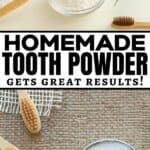
There are so many synthetic chemicals in personal care products these days and there is a growing concern that exposure to at least some of these chemicals is not good for our health or the environment. One of the best ways to reduce your exposure is to make your own products like moisturizing cream, homemade foaming soap, and homemade hair spray.

Of course, making your own personal care products can be simply a fun and frugal project for the whole family.
Whatever your reasoning, making homemade toothpaste or buying more all-natural toothpaste is something you might consider.
Reasons to Try a More Natural Toothpaste
My decision to find an alternative to toothpaste began when a health crisis forced me to reevaluate my personal care regimen. I knew that if I hoped to turn my health around my product choices needed an overhaul. I learned to read labels.
Thanks to the Environmental Working Group (EWG) and other groups, I awakened to the truth that the vast majority of ingredients in toothpaste and other personal care products haven’t been reviewed for safety.
Also influencing my growing aversion to conventional toothpaste was my poor dental health.
Numerous cavities and gum problems haunted me. It only made sense to question my dental protocol.
What's In a Typical Tube of Toothpaste?

1. Sodium fluoride: This is a colorless crystalline salt used to fluoridate our water supply. It is also used as an insecticide as well as in the treatment/prevention of tooth decay. Swallowing fluoridated toothpaste is so hazardous the FDA now requires a poison warning on every tube of toothpaste containing fluoride.
2. Triclosan: This is a chlorinated aromatic compound first registered as a pesticide in 1969. It has been found to be effective against gingivitis but red flags have been raised when it comes to long term health implications. The FDA is currently reassessing its safety.

3. Inactive Ingredients: From propylene glycol to titanium dioxide, to sodium lauryl sulfate, inactive ingredients are added to preserve or facilitate the effectiveness of the active ingredients. The term “inactive” can be misleading as it might be assumed these additives have no implications for our health.
4. Sodium Lauryl Sulfate, for example, has been linked to skin and eye irritations, organ toxicity, development toxicity, endocrine disruption and more. While its presence in toothpaste is quite minor, I’d rather clean my teeth with something that carries no risks or poison warnings.
Homemade Tooth Powder
I ended up experimenting and having a lot of success with this homemade tooth powder that I am sharing today.
It’s been 2 years since I stopped using toothpaste and my gums and teeth feel healthier than ever. I’ve had no sign of decay.
At a recent cleaning, my hygienist noted the improvement in my overall dental health and encouraged me to keep doing what I’m doing – advice I intend to follow.
Natural Toothpaste Options
I also tried other natural, chemical-free toothpaste. EWG offers an excellent list of 679 toothpastes and evaluates each for levels of toxicity. I gravitated to Herbodent, an antibacterial formulation utilizing 21 herbs and I still buy this fro my kids.
Adrienne uses a variety of fluoride-free toothpaste including Theodent. Theodent's active ingredient (based on theobromine, from cocoa) has some very interesting data behind it showing it to be as or more effective than fluoride in protecting teeth from decay.
This remineralizing tooth powder has great reviews as well.
Bubble and Bee toothpaste is another great option that has a glycerin base. Glycerin in toothpaste has been the topic of some heated debates, but the concerns don't seem to be valid at all.


Homemade Tooth Powder Recipe
Ingredients
- 3 ounces sea salt (Here's the brand of salt that I use, and here's a pretty reasonable brand of himalayan salt.)
- 6 ounces baking soda
- dried ground stevia leaves or stevia extract powder to taste (Read more about Stevia and How to Use It here.)
- 1/4 – 1/2 teaspoon neem powder optional
- 5 drops of peppermint and/or wintergreen essential oil (optional. You can see my series on the best essential oils here.)
Instructions
- Mix all ingredients together.
- Stir by hand or use a food processor (if desired) if making in bulk.
- Store in a container of choice, with a lid on.
- You might wish to use a separate container for each member of the family–for sanitary reasons :).
More Non-Toxic DIY Personal Care Products
– Nourishing Lip Scrub
– Homemade Eye Makeup Remover – the best eye makeup remover I've ever used!
– Nourishing Body Scrub – just a few ingredients and wo
– Alcohol-Free Hair Spray – works great!
Please note- Neither Adrienne nor Andrea are dentists so you need to make decisions with your dental professional for your own dental care. Please don't change your toothpaste without consulting your practitioner. Thanks!
What do you use to brush your teeth?

Andrea is a former journalist and the mother of nine children ranging in age from 28 to 12. Following a toxic mold exposure, Andrea and her family discovered the wonders of natural living. Andrea is the founder and president of momsAWARE, an educational organization designed to empower others to live healthy in a toxic world. You can follow her family’s journey at Our Health Journey. She is also the owner of Just SoNatural Products.
My dental hygienist says baking soda isn’t good if you are needing to watch your salt/sodium intake, have you heard any info on this?
Hi there! I’ve been making my own tooth powder for a month or so and I was wondering what is the reason for adding salt to your recipe? Is there some significance for using it? I’m new to this so I’m slowly learning the whats & why’s of things. 🙂 Thank you!
Kayla Buchanan
Kayla,
I think it’s a biochemical issue when it comes to salt. Certain microorganisms cannot thrive in salt, so it adds a certain level of antimicrobial potency. That’s my take on it anyway. Great question.
How about xylitol instead of stevia or does stevia also help rebuild teeth?
I read somewhere that one should dissolve the granules in a bit of water and brush with that. But you are talking about taking the granules straight to your teeth, right? It seems like that is where it might be abrasive until the granules dissolve in your saliva. But you don’t find it so?
Dissolving the granules may work very well for you. I have not had an issue with abrasiveness, but everyone is unique. Good thought for sure!
I was looking to buy Herbodent for my children but then I looked at the ingredients, did you know that Herbodent has SLS and parabens?
The whitening agent in “whitening” toothpaste causes tiny blisters on the sides of my tongue. I thought I was stuck with baking powder and salt, thanks for the recipe!
I have VERY sensitive teeth. I was using a “natural” toothpaste but it was only making my sensitivities worse. How will this effect my sensitive teeth? Thank you!
I had very VERY sensitive teeth before using natural dental care. The tooth powder may have helped but I suspect two reasons my sensitivity improved greatly.
1. oil pulling. I can’t say enough about oil pulling. Definitely helped with my sensitivity
2. gum brushing. I actually use something called a miswak to brush my gums…(definitely a future post) – it’s like skin brushing – only you’re brushing the gums….it strengthens them and helps stimulate circulation.
Will this do any damage to mercury fillings?
Hi Andrea
Thanks so much for your article. I have also been concerned with what I am brushing my teeth with. I read the ingredients but didn’t really know what they were. Thanks for telling us.
I have switched to brushing my teeth with this product: https://www.orawellness.com/. But, I will definitely try a homemade version of what you are making.
I am so sorry for the delay – I missed responding to a bunch of comments. I just met the owner of Orawellness this past week and he is great! Thanks!
So…do you dip your brush in? How does this work.
I keep the tooth powder in a spice container. I sprinkle it on my wet toothbrush. You can dab a clean, moist toothbrush in a container of the powder and it will “jump” onto the brush quite well. I like the sprinkling because it keeps the powder clean but some does miss the brush.