
Black Cumin Seed Oil Benefits for Skin (and Skin Serum Recipe)
This post may contain affiliate links from which I will earn a commission. Learn more in our disclosure.
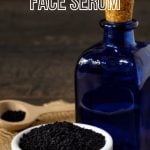
Nigella Seed Oil (more commonly known as Black Cumin Seed Oil) is a real powerhouse ingredient for your skin that you might not know about. But once you read about all of the black cumin seed oil benefits for skin, you are definitely going to want to add it to your skincare routine!

Part of my work creating plant-based cosmetics entails researching ingredients, and nigella seed oil has some of the most impressive qualities I have come across in a single ingredient. The INCI (Latin) name for this herb – also commonly called black cumin or black caraway – is Nigella Sativa (black cumin seed).
The cold-pressed oil has a golden color, deliciously warm, peppery scent and is so rich in essential oil components that it needs to be diluted heavily before application to the skin.
A Miracle Herb
Nigella received the title ‘Miracle Herb’ from a scientific paper published by the American National Library of Medicine. Because nigella has demonstrated such impressive abilities as battling certain types of tumors and cancers, it continues to hold science’s full attention with numerous ongoing studies.
Scientific studies to date have shown that nigella seed oil decreases blood pressure, promotes wound healing, and can help address blemishes with a reduction of up to 10%. In a 6-month study, topical application of nigella seed oil significantly decreased vitiligo.
Other studies indicate that nigella seed oil is an effective aid for treating psoriasis. A 2010 study showed that nigella seed (in an emulsion combined with borage oil) reduced skin irritation significantly while improving hydration and epidermal barrier function.
Nigella Seed Oil has also been proven to be a great natural remedy for anxiety when compared to placebo.
Current studies are trying to establish whether or not nigella might be able to help relieve:
– allergic reactions
– epilepsy in children
– the rashy skin reaction from nickel allergy
To add to all these positives, nigella has a very low degree of toxicity.
Nigella Seed Oil Benefits
Nigella seeds contain many beneficial actives:
fixed and essential oil
alkaloids
proteins
lineolic acid
palmitic acid
oleic acid
vitamin E
and (much) more
In short, nigella seed oil is a multifunctional powerhouse.
Some of the benefits are:
1. Moisturizing
Black Cumin Seed Oil is an excellent source of Vitamin B and promoted cohesion of cells and helps lock in moisture. which helps to retain moisture in skin.
2. Acne
Black Cumin Seed Oil has antibacterial, antimicrobial, anti-sceptic, and anti-inflammatory properties that help reduce acne.
3. Wrinkles
Black Cumin Seed Oil helps keep skin elastic and fights damaging free radicals so wrinkles are less of an issue.
4. Anti-inflammatory
Black Cumin Seed Oil has excellent anti-inflammatory and antiseptic properties. This makes it a great choice for sensitive skin
5. Dark Spots
The vitamin A, amino acids, and fatty acids found in Black Seed Oil help regenerate skin cells. Over time, it's possible for dark spots to fade.
Apart from being great for skincare, nigella seed oil also helps strengthen nails and bring bounce and shine to dull, brittle hair.
Tips for Topical Use
Before we get to the elixir formula, following are a few tips regarding the use of Nigella Seed Oil:
Always dilute nigella seed oil before use. Nigella is very potent so never use more than 10% of this oil in any blend.
Do not use nigella seed oil near the eyes.
Why Measure by Weight
Measuring by weight is the only way to be sure of the exact amount of each ingredient, which is vital when making skincare products. It is simply not accurate enough to measure the ingredients by volume.
The reason for this is that every oil has a different density and cannot be accurately measured by volume.
Therefore, ALWAYS measure by weight – it’s as easy as 1-2-3:
1. place container on scale
2. set scale to zero
3. pour oil into container until desired weight is reached
Note that for making skincare, you will want a scale that can handle precise measurements, like this one, which is actually the very scale that Adrienne uses in her kitchen :).)
Nigella Seed Oil (Black Cumin Seed Oil) Elixir
Throughout much of this year, I have been testing nigella seed oil in different cosmetic applications and it has already become a favored staple in my ingredients stockroom. Several clients have started asking for it specifically when ordering a custom face oil blend.
Now you can incorporate this wonderful skin-loving oil into your daily skincare routine. However, I created a formula for a luxurious, nourishing face elixir just for this blog's readers that can be used by men and women alike – either alone or under a moisturizer.
This blend is for adult skin and has a generous 7% nigella seed oil. If you have nut allergies, replace the organic sweet almond oil with either organic jojoba oil, organic thistle oil, or organic hemp seed oil. Be sure to use only cosmetic grade oils for your elixir.
How To Use This Elixir
Place 6-8 drops elixir in the palm of your hand.
Rub palms together to warm and disperse the product.
Apply to freshly-cleansed, damp face and neck using gentle, upward strokes and taking care to avoid the eyes.
Check the mirror.
See that fabulous face? — That’s you plus the magic of Nigella Seed Oil!

Where to Buy Black Cumin Seed Oil
There are a number of places to buy this oil, but one thing to note is the sourcing and the concentration of the active ingredient, thymoquinone.
I always recommend buying organic if possible, to avoid pesticides and for the highest quality ingredients.
Many black seed oils on the market are not organic and most have approximately 1% (or less) thymoquinone.
Some have higher concentrations like this one that hovers around 2-above 3%. I've spoken with this company and they seem to be a quality operation.
This black cumin seed oil has 7% thymoquinone. It's quite strong so you will have to dilute it if you used it on your skin, but the quality is amazing. Using my link will give you a nice discount.

Black Seed Oil Face Serum
Ingredients
- 1 oz jojoba oil
- 1 oz sweet almond oil
- 0.7 oz borage oil
- 0.5 oz rosehip oil
- 0.3 oz black seed oil
- 0.02 oz vitamin e oil
Instructions
- Sanitize your containers and equipment and be sure your work area is clean.
- Next, weigh each ingredient on a precise scale and transfer to a glass dropper bottle.
- Cap bottle and shake.
- Rejoice at your fabulous elixir-making abilities.
Notes
Please note that this formula is free of preservatives and should be used within 6 months of making.
So, what are you waiting for?
Get some Nigella Seed Oil and get working on having this powerhouse go to work towards making you more lovely, and most importantly, more healthy.
Don't Want to DIY?
This lovely face serum has Black Cumin Seed Oil as its base. Again, you can reach out to me at adrienne@wholenewmom.com or comment below for a coupon code to try it.
Have you ever heard of or used Nigella Seed Oil?

Lise M Andersen – LisaLise – is based in Copenhagen, Denmark where she creates plant-based custom cosmetics and formulations. Visit her website LisaLise.com where she also offers instructional e-books and DIY skincare kits. Follow along as she develops products at her blog, LisaLiseBlog.com, which also features many DIY how-to’s and an ever-growing ingredients library.
Sources:
- National Library of Medicine, Review on therapeutic potential of nigella sativa
- Pharmacological and Toxicological Properties of Nigella Sativa
- Plants for a Future: Nigella Sativa
- Journal of Dermatology, Dermatological Effects of Nigella Sativa, 2015
- M.S. Hanafi, M.E. Hatem, Studies on the anti-microbial activity of the Nigella sativa seed (Black Cumin)
- S. Amin, S.R. Mir, K. Kohli, B. Ali, M. Ali, A study of the chemical composition of black cumin oil and its effect on penetration enhancement from transdermal formulations
- Brazilian Journal of Medicine and Biological Research, Antitumor properties of nigella seed extracts
- Chopra RN, Nayar SL, Chopra IC. Glossary of Indian medicinal plants. New Delhi: Council of Scientific and Industrial Research; 1956
- Mohammad Akram Handawa, AntiCancer Activity of Nigella Sativa
- Thymoquinone in the clinical treatment of cancer – fact or fiction? US National Library of Health and Medicine
- Thymoquinine – 50 years of success in the battle against cancer models, Science Direct
- American Journal of Physiology, Thymoquinone, a bioactive component of Nigella sativa, normalizes insulin secretion from pancreatic ?-cells under glucose overload via regulation of malonyl-CoA
- Ivankovic S, Stojkovic R, Jukic M, Milos M, Milos M, Jurin M., The Anti-tumor activity of thymoquinone and thymohydroquinone, Sept 2006, PubMed
- Use of the naturally-occurring quinones thymoquinone and dithymoquinone as antineoplastic and cytotoxic agents, University of Kentucky Research Foundation Application for Patent
- Thymol (Wikipedia)
- Nigella sativa L. seeds modulate mood, anxiety and cognition in healthy adolescent males.
What about a post on the actual seeds? I have heard that the oils taken internally is pretty nasty tasting and that the seeds are easier to take…Any thoughts?
Hi Carol! I would think that the seeds would not be as easy to digest. In fact, yes, I just looked it up and the oil is more bioavailable and more concentrated. You would have to take more of the seeds. Encapsulating the oil works well. Hope that helps!