
Homemade Moisturizing Foaming Hand Soap
This post may contain affiliate links from which I will earn a commission. Learn more in our disclosure.
This Homemade Foaming Hand Soap is one of the easiest ways to create a greener and healthier you. It's simple to make, inexpensive, and it works really well–and is, of course, fun for kids (of all ages) to use!
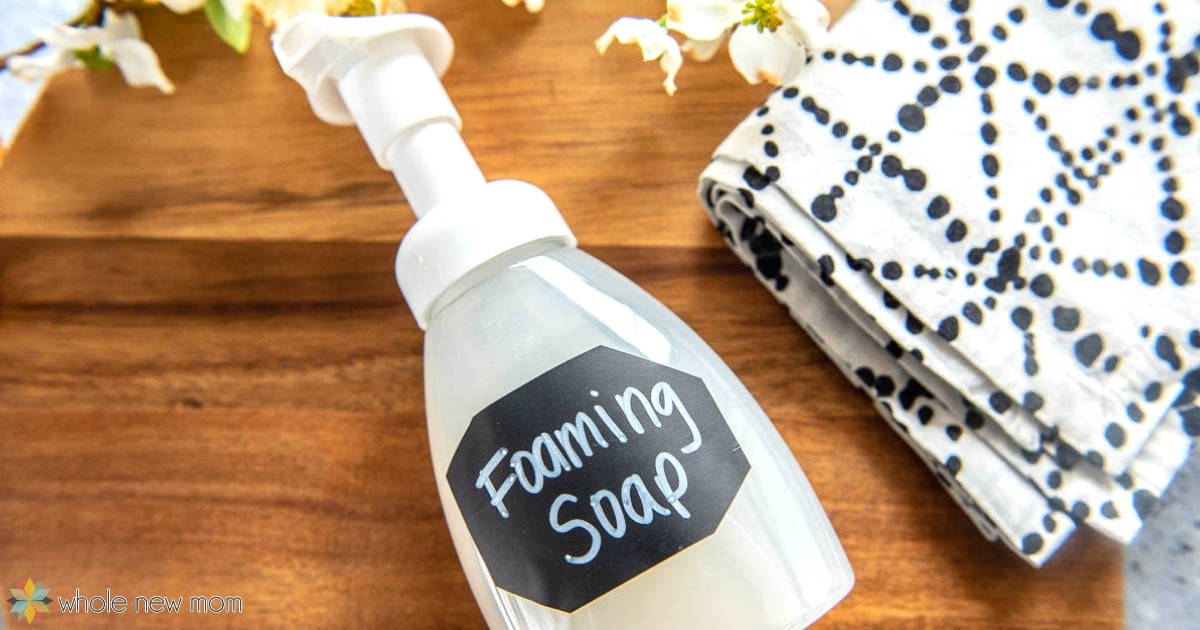
Why make your own homemade foaming hand soap?
Well, if you are:
- tired of refilling your soap pump containers over and over again thinking of the amount of money you are literally tossing down the sink?
- spending a lot of money purchasing foaming soap containers over and over again?
- frustrated with the goopy mess that standard soap pump soap leaves on your hands that sometimes isn't gone even after washing?
- wondering about all the extra ingredients in your hand soap that are probably not good for you (and please don't tell me that you are using anti-bacterial soap. Well, I take that back. You can tell me and then I'll recommend that you stop :-).)
Then I highly recommend that you consider making this soap now.

I am always motivated to save money while avoiding synthetics and toxins as much as possible, as long as I don't have to spend too much time doing it.
This motivation has led me to make my own Homemade Shower Cleaner, DIY Lip Scrub, Homemade Hairspray, DIY Chest Rub, and more.
Now, in addition to those things, you can even make your own foaming soap at home and:
- save a lot of money by refilling and not purchasing new pumps
- save money by making your own refill foaming soap
- save money over regular soap pumps by using less soap
- avoid toxic chemicals and fragrances by using only healthy ingredients in your soap
And you will be happy to know that it is EASY. SUPER EASY.


Why Is Glycerin in this Soap?
Glycerine adds a number of benefits to this homemade foaming soap.
Moisture
Glycerin is a humectant. As such, it moisturizes the skin by bringing moisture from the air into the skin's outer layer and also forms a protective layer to prevent moisture loss. Adding glycerin to your soap can help to lock in this moisture, leaving your hands (or other parts of your body, for that matter) more soft.
Glycerin mimics skin's natural moisturizing factor (NMF), so it's great for all skin types. It's important to do this since your NMF is depleted as you age and that is accelerated if you use irritating substances on your skin.
Better Texture
The glycerin makes for a smoother, thicker soap which is much nicer to pump and use than thin, runny foaming soaps.
Preservative
Actually you would need 50% glycerine for this soap to truly be preserved, but it's good to know that glycerine does add some preservative properties to this homemade foaming hand soap.
Don't Eat the Soap, but…..
One thing you might not know, is that vegetable glycerine is not only great for adding moisturizing qualities to this homemade foaming soap, but it's also a great sweetener alternative for those trying to consume fewer carbs. In most cases, you can use whatever glycerine you like for sweetening as well as for use in personal care products, but you might want to ask the manufacturer.
Actually, the ingredients in this foaming soap are so non toxic, you really don't have to worry if some gets in your mouth, but still I wouldn't go around making it a habit of eating it.
Where to Buy Vegetable Glycerine
There are many places that you can buy vegetable glycerine. You should be able to find it in a drugstore or nutrition store, but almost definitely in a health food store.
If you'd prefer to buy it online, you can find it on Amazon and also at Starwest Botanicals.

What Foaming Soap Container Is Best?
I have had multiple quality issues with some soap pumps and tried about 4 different kinds. One brand that kept breaking was the Pampered Chef version and the other was a Cuisipro. The Pampered Chef design appears to be unchanged, but the Cuisipro seems to have been redone.
One reader commented that she loves the dispenser from this product and simply removes the label off of the bottle after emptying it out. I would think you'd need to clean the pump out really well to get the residual scent out of it because artificial fragrances can be hard to get out.

This dispenser is a great option if you'd prefer to avoid plastic and use a glass bottle.

Another idea is using a mason jar with a foaming pump that fits on a mason jar. Yes, there's such a thing and here it is.

Do You Need a Preservative For Homemade Foaming Soap?
In the recipe card, you can see Optiphen Preservative as a recommendation for this soap.
Preserving anything with a water base is crucial due to the potential for bacterial growth.
The essential oils in the recipe, if being used, should help some, but you would for sure need more than that for adequate preservation.
Optiphen is great since it has no formaldehyde, no phthalates, and no formaldehyde releasers as well.

Homemade Moisturizing Foaming Hand Soap
Ingredients
- foaming soap dispenser (this brand has worked very well for us over the years)
- water
- natural liquid soap of your choice (the brand that I linked to is one good option)
- 1/2 tablespoon vegetable glycerine (for extra moisturizing) (optional)
- a few drops of your choice of essential oils (optional) (read my post on Which Essential Oils are Best? – Part One to see why I recommend this company)
- few drop olive oil (optional for better foaming and to extend the life of the soap pump)
- Optiphen Preservative (strongly recommended–use .5-1.5% or 1/4 teaspoon for an 8 ounce container)
Instructions
- Fill empty foaming soap dispenser with water, approximately 4/5 full.
- Fill remaining space with a liquid soap of your choice (and glycerine, essential oils, olive oil and preservative, if using) being careful not to get too close to the top.
- Shake gently to mix and use. Note: you definitely do not want to add the soap first. If you do, the soap will foam up as you are adding the water to fill the container and you will end up with a foaming, half-filled container.
Notes
So there you have it–simple, isn't it?
Very little work for a lot of money saved and better health for your family. You can easily reduce the toxic exposure in your home and you have a bit more of your financial resources available to address your family's needs and to bless others.
Have you made your own foaming soap before?
If not, will you try it?
could you use coconut oil instead of the vegetable glycerin?
I think it would clog the dispenser. Maybe add moisturizer right after instead?
Where is a good place to buy vegetable glycerine?
There’s a link from the recipe to Amazon and I put 2 more links at the bottom of the post – hope that helps :).
You can use fractionated coconut oil….it doesn’t harden like coconut oil used for cooking….I use 1/4 teaspoon along with 2 TBLSP of Dr. Bronners ….good luck!:)
I make mine similarly with Dr. Bronners and water. But I add a few drops of Thieves into it.
Thanks for the recipe! I tried it this morning using up the last bit of liquid soap I had. It works great and will be a big money saver as we go through a lot of hand soap.
Please tell me why you are against antibacterial soaps? Just curious. My family suffers from an IGG deficiency so that’s one area where I do use antibacterial (soap).
BTW- thanks for the info on NAN. Just received my 2nd order but wasn’t able to beat this latest infection!
I’m not sure what you mean by IGG deficiency. You mean you have low levels of IgG and so you use antibacterial soaps to prevent infections? Hope you like the oils!
That’s correct. My children and I have the deficiency. Like really deficient..as in seeing specialists…possible medical treatment (although I am holding off as long as possible). One child just finished his 32nd (at least) antibiotic. Our bodies cannot fight bacteria and viruses (colds, flu, pneumonia, etc) like regular folk. So, I was interested why you mentioned not using anti-bacterial soap at the top of this post.
Yes, we are a special situation so we may continue but I like your research and thought process so I am saving mysefl some time and asking an expert!
I am not an expert for sure. But here is what I do know about this topic. There are TONS of studies that soap and water do a better job than antibacterial soaps, plus the antibacterial stuff in these soaps is not good for you. I’ve seen studies linking triclosan to cancer–plus from what I have read they make you resistant to antibiotics (in case you really need them). That being said, I do recall reading that folks w/ certain health situations should use them so I am not sure what to think in your case. In a sense, that doesn’t make sense to me b/c if the soap and water do a better job, then that would be my personal preference. Here is a post that talks about antibacterial soaps vs soap and water.
I wonder if probiotics could help your situation. Has any practitioner talked w/ you about that? This post talks about it and other ways to boost your immune system. If I had this issue I would be doing everything I could naturally to boost my immune system. I have a post that talks about probiotics and I am going to start talking about them more in the near future so subscribe to my blog if you haven’t and stay tuned. It should all happen this coming month :).
I’m sorry my comment got cut off for some reason. To finish… Once I put the dimes in every dispenser they have worked great with no need for for the regular cleaning I had been doing to try to stop clogging. If you’ve used your dispensers for years with no problem, great. But if you’ve had to fight clogging try the silver solution. (Check with a local coin collector for junk Mercury dimes. I was lucky and inherited mine.) [I’m very ill and not up to editing for brevity. Please feel free to edit my two posts for brevity and combine into one. But _please_ pass on the word that clogging in foaming soap dispensers is caused by some kind of bacteria being able to grow in some diluted soap solutions. And the fix is as simple as dropping any little piece of silver in the dispensers. I’d like for this fix to be passed on to everyone who likes foaming soap dispensers. Please have the moderator remove this when editing. Thank you, and thanks for the site.]
Again, blech. I do have a clogged one. But maybe something else is wrong with it. Thanks!!! I’m the writer and the moderator, by the way :). I am sorry you aren’t well. Have you read my post on heavy metal toxicity? I was really sick until I started working with Ms. Vernon.
Maybe putting a few drops of colloidal silver into each bottle will prevent bacteria: I have used my own homemade dispenser soap for some time, and have never had issues with bacterial growing in it, though…
Colloidal Silver, a great medical help! (probably where the true silver from the ‘mercury’ dime comes from, I don’t think it has actual mercury in it: didn’t the really older dimes have mercury’s wings on it or something? That is probably where the name came from)
Read up on it.
I’ve loved and used foaming soap dispensers since I first came across fill yourself stainless steel ones at Bed Bath & Beyond many years ago. But I eventually ran into problems with them beginning to clog rather than foam. The problem in hindsight was accelerated by my premixing two liter batches of the soap/water mixture to refill the dispensers from as needed. I noticed fine white threads floating in the bottle of premix. I eventually removed clumps of these from the fine mesh plastic screens that are in all foaming soap dispensers. These when examined under a microscope were hollow tube structures, obviously bacteria. The answer is to get an old dime that’s real silver (e.g., a Mercury dime) that’s too worn to have any value other than its weight in silver and drop one in each dispenser. Then I only mix enough premix to keep the dispensers topped up. I have a 500ml soda bottle that I’ve marked on the side for a 3 parts to 1 part ratio.
Bleck. Do you think we need to put a dime in our foaming soap dispensers, then? Ick!
I use half peppermint Dr. Bronner’s castile soap and half water. I put it in a Bath and Body Works foaming soap dispenser with 1 of those pretty metal covers they have over it. It works perfectly, and it looks very pretty too!
Pretty metal cover? Can you share a link or something? Thanks!
https://www.bathandbodyworks.com/family/index.jsp?categoryId=11827844&cm_sp=LN-_-Gifts-_-Soap+Accessories&cp=12587013.12936218.11827845
Hopefully the link will work. Every Bath and Body Works store I have been in has them. I just ripped the label off the empty container and covered it up with the metal sleeve.
I do this all the time too…although it took some trial and error to get to the right ratio…what a rip to buy refills…so much more cost effective this way!
Thanks, Tessa! I know- what a rip off! Your hot chocolate looks so interesting! I might have to try it!
Sorry, but I did not have the time to read ALL of the replies… did read a bunch though. I wanted to share what foaming bottles we use for “free”. Instead of recycling the hair mouse bottles, we started reusing them for hand soap in the bathrooms and kitchen. I usually purchase Giovanni hair mouse from a co-op a friend operates, saves money for sure, then share the extra empty mouse bottles for hand soap with other friends!!! Hope someone can benefit from this, or maybe think of some other foaming bottle you could reuse over and over again… Oh, one more thing, one of the recipients of the Giovanni mouse bottle said she was going to cover her’s some pretty contact paper or make a cover out of fabric… Blessings and keep on saving:-D
I’ve been doing this for years with a bit of dish soap in a spray bottle. I don’t know what prompted me to try that in the first place, but it’s worked so well that I’ve just continued and rarely purchase other products. It makes a gentle but effective general purpose cleaner for around the house. It’s been my “go to” cleaner for most of the kid & pet clean up jobs, cleans well without alot of foaming. It also is “the best” cleaner for greasy messes in the kitchen and works incredibly well on my cook top….removes grease but leaves no residue so my cook top always looks spotless. No need to buy those expensive specialty cleaners!
I just finished off two foam pump dispensers that I’d gotten from Whole Foods and Target. Since my diluted spray mixture worked so well I’m looking forward to refilling the foam pumps with a homemade dilution. Lots less waste but the job gets done. Even my young teens have commented about how light yet how effective the foam pumps are. Now I’m ready to show them how to mix it themselves and be thrifty home managers!!